$4 – $29 per sq ftThat is the published range for driveway replacement cost in 2026, tear-out of the old surface included, and the sources disagree a lot. HomeGuide puts it at $4 to $15 per square foot, including $1 to $3 per square foot for removal, while Fixr puts it at $9 to $29. Gravel sits at the bottom of the range, plain concrete and asphalt in the middle, and pavers or stamped concrete at the top.
Replacing a driveway costs more than building one on bare ground, because the old slab or asphalt has to be broken up and removed first, and the base underneath may need rework. The material you choose for the new surface still decides most of the bill. Below are the prices per square foot and per driveway, the extra lines that show up on quotes, and when a repair or resurfacing job is enough.
Driveway replacement cost by size
| Driveway | Square feet | HomeGuide, new | Fixr, new |
|---|---|---|---|
| 12×24 (1 car) | 288 | $850 – $3,450 | $2,300 – $7,200 |
| 24×24 (2 cars) | 576 | $1,700 – $6,900 | $4,610 – $14,400 |
| 24×36 (3 cars) | 864 | $2,600 – $10,350 | $6,910 – $21,600 |
| 10×10 extension or apron | 100 | $300 – $1,200 | – |
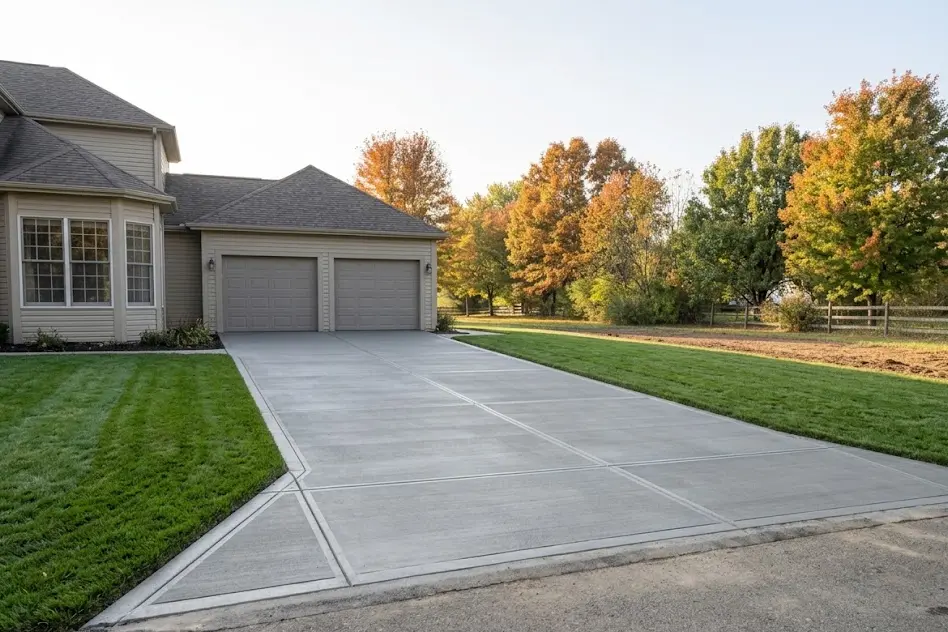
Those figures assume no old driveway in the way. When you are replacing, removal and disposal add $1 to $3 per square foot, which is why the replacement range runs $4 to $15 per square foot instead of $3 to $12 (HomeGuide). Fixr prices replacement much higher, at $9 to $29 per square foot including breaking up the old material, hauling it away, minor grading and installing the new surface. Its size prices above run about two to three times HomeGuide’s for the same driveway, so expect local quotes anywhere across that spread.
Our estimate: a 24×24 two-car driveway is 576 square feet. At HomeGuide’s replacement range of $4 to $15 per square foot, that gives about $2,300 to $8,640 for tear-out plus a new surface; at Fixr’s $9 to $29, about $5,180 to $16,700. These are our own multiplications, not measured prices; your quote depends on the material, access and the condition of the base.
Cost by driveway material
| Material | HomeGuide, new (per sq ft) | This Old House, replacement (per sq ft) |
|---|---|---|
| Gravel | $1 – $3 | $750 – $1,125 per 600 sq ft |
| Chip seal (tar and chip) | $2 – $5 | – |
| Asphalt | $3 – $7 | $3 – $25 |
| Concrete | $4 – $8 | $6 – $20 |
| Exposed aggregate concrete | $5 – $11 | – |
| Permeable pavers | $8 – $30 | – |
| Pavers | $10 – $30 | $10 – $70 |
| Heated (any surface) | $12 – $28 | adds $3,000 – $8,700 per job |
The same guide gives wider ranges in its detailed sections for some materials, which reflect more involved jobs: $6 to $15 per square foot for plain gray concrete, $5 to $12 or more for asphalt paving, and $4 to $10 per square foot for a fully built gravel driveway (HomeGuide). Treat the HomeGuide column as the floor for a simple, flat, easy-to-reach site. Homewyse’s September 2026 calculators start higher again: $9.86 to $12.11 per square foot for a basic concrete driveway and $12.79 to $15.63 for an asphalt one. This Old House puts the average 600-square-foot concrete replacement at $2,400 to $9,000 (This Old House).
Concrete costs more than asphalt up front and lasts longer: 30 to 40 years, and it handles hot climates better. Asphalt lasts 15 to 30 years and copes with freezing temperatures better than concrete, but needs sealing every 3 to 5 years (HomeGuide).
Stamped or decorative concrete costs $10 to $25 per square foot, and stamped patterns, colored stains or stencils add $2 to $15 per square foot over plain concrete (HomeGuide).
Pavers made of concrete, brick or stone run $10 to $30 per square foot, and high-end paving stone or brick $25 to $50. They last 25 to 75 years depending on maintenance and weather (HomeGuide).
Gravel is the cheapest surface. The stone itself costs $10 to $50 per ton including delivery up to 10 miles, and a well-built gravel driveway needs light raking and fresh gravel once or twice a year (HomeGuide).
Estimate your driveway replacement cost
Use the tables above to estimate your cost. The interactive calculator needs JavaScript.
Removal, base and site work
What sits under the new surface often explains the gap between two quotes. Whether the existing subbase can be reused is one of the main things that sets the cost of redoing a driveway (HomeGuide).
| Item | Cost |
|---|---|
| Remove and haul away old driveway | $1 – $3 per sq ft |
| Remove old driveway, whole job (This Old House) | $1,000 – $2,500 |
| Excavation (plants, soil, small trees) | $1 – $5 per sq ft |
| Grading and site prep | $5 – $8 per sq ft |
| Rebar or wire mesh in concrete | $1 – $3 per sq ft |
| New drainage trenches or channels | $400 – $2,400 |
| Concrete curbing | $5 – $18 per linear ft |
| Paver or brick border | $10 – $25 per sq ft |
| Tree removal / stump removal (Fixr) | $400 – $1,100 / $200 – $700 |
Labor makes up about half of the total project cost according to HomeGuide; Fixr puts it at 50% to 60%. Prices tend to be higher in large cities with a high cost of living, while material delivery can cost more in rural areas. Sites where heavy equipment is hard to maneuver cost more, heavily sloped lots push grading costs up, and a curved or circular layout adds 10% to 20% over a straight one for the extra labor (HomeGuide).
Repair or replace?
Not every tired driveway needs to come out. If the base is sound and the damage is on the surface, a repair or resurfacing job costs a fraction of a full replacement.
| Job | Cost |
|---|---|
| Fix cracks and patch potholes | $100 – $400 |
| Asphalt sealing | $1 – $2 per sq ft |
| Asphalt resurfacing | $1 – $3 per sq ft |
| Asphalt repair | $2 – $5 per sq ft |
| Concrete resurfacing | $3 – $7 per sq ft |
| Concrete repair (crumbling, spalling) | $3 – $8 per sq ft |
| Major repairs or resurfacing, total | $600 – $3,000 |
| Full replacement | $4 – $15 per sq ft |
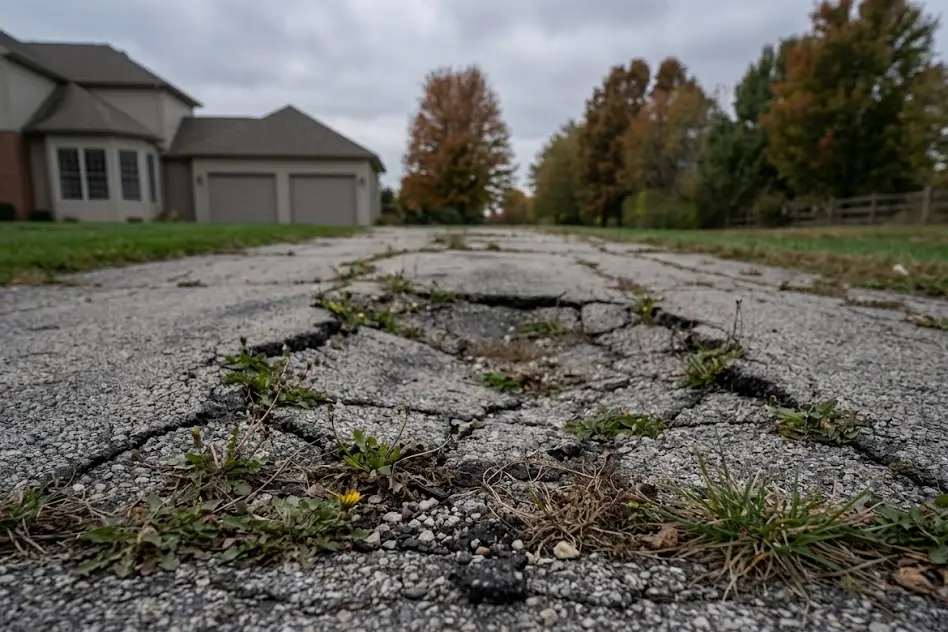
Resurfacing removes the damaged top layer and lays new concrete or asphalt over it, which gives the look of a new driveway at lower cost (HomeGuide). It only makes sense when what is underneath is stable: if the driveway has sunk, heaved or broken through, the problem is in the base, and replacement is the job to price.
Age matters too. Compare the years your driveway has already given against its expected life: 15 to 30 years for asphalt, 30 to 40 for concrete, 25 to 75 for brick or concrete pavers, and up to 100 years for a well-maintained gravel or cobblestone driveway (HomeGuide). Money spent patching a driveway near the end of that range buys fewer years than the same money spent on a younger one.
Permeable pavement and stormwater
A replacement is a chance to switch to a surface that lets water through. Permeable options include pervious asphalt, pervious concrete, interlocking pavers and plastic grid pavers. According to the U.S. Environmental Protection Agency, they let rain and snowmelt seep down into the soil and gravel below, reduce runoff, can help filter out pollutants, can reduce the need for road salt, and can cut the need for some conventional drainage features. The EPA marks that page as no longer being updated. Its green infrastructure guidance adds how the system works: water soaks in at the surface and is stored in layers of soil and gravel below, then either infiltrates into the ground or leaves through an underdrain (U.S. EPA, Types of Green Infrastructure).
They cost more than standard paving: permeable pavers $8 to $30 per square foot installed, porous asphalt $7 to $13, and pervious concrete $8 to $16. Grass paver grids, where grass grows through a concrete or plastic grid, run $4 to $12 per square foot (HomeGuide).
Permits and the street apron
A driveway permit typically costs $50 to $200. Most cities require one for new driveways and for replacements, but not for repairs, and some waive the fee when a paved apron already connects the property to the public street (HomeGuide); Fixr gives $50 to $600 for the license to pave or break a driveway that reaches the street, depending on length and city. Extending a driveway may also mean a new paved apron where it meets the street, and minimum and maximum widths can be set by local zoning, so check with your city or county before settling on a size, and confirm in the quote who pulls the permit.
How long before you can use it
Plan the job around your car. A new asphalt driveway needs at least 48 to 72 hours to cure; concrete needs 7 to 10 days before you can drive or park a passenger car on it. Gravel and pavers can be used as soon as installation is finished. Asphalt should be sealed 3 to 9 months after paving or repairs, then every 3 to 5 years (HomeGuide).
How to keep the bill down
- Check whether the base is sound before assuming you need a full replacement. Resurfacing or repair costs a fraction of tear-out.
- Choose plain concrete or asphalt over stamped, colored or paver finishes if budget matters most; decorative work adds $2 to $15 per square foot.
- Keep the same footprint. Widening, extending or curving the layout adds area, grading and labor.
- Keep an asphalt driveway sealed on schedule so it lasts closer to the top of its lifespan.
- Get at least three in-person quotes from contractors who work with the material you want, and compare them line by line, not by the total.
Questions to ask before you sign
- Does the price include removal and disposal of the old driveway?
- Will you reuse the existing base, or excavate and rebuild it? How thick will the base and the new surface be?
- For concrete: will you use reinforcement, and will you use control joints or expansion joints to limit cracking?
- How will water drain off the finished driveway, and is any drainage work included?
- What permits are needed, and will you obtain them?
- Are you licensed, insured and bonded, what does your warranty cover, and what is the payment schedule?
Sources
- HomeGuide, How Much Does a Driveway Cost?, December 19, 2025.
- Fixr, Driveway Paving Cost, updated August 29, 2025.
- This Old House, Driveway Repair and Replacement: Options & Costs, updated March 31, 2026.
- Homewyse, Cost to Install Concrete Driveway and Cost to Install Asphaltic Concrete Driveway, September 2026.
- U.S. Environmental Protection Agency, Soak Up the Rain: Permeable Pavement (page marked as no longer updated) and Types of Green Infrastructure.