$2,400 – $12,000That is the typical fence installation cost in 2026 for about 200 linear feet of new fence. The two cost guides we checked disagree: HomeGuide (February 2026) puts 200 feet of wood or vinyl at $4,000 to $12,000, or $20 to $60 per linear foot, while Fixr (January 2025) puts 200 feet at $2,400 to $7,000, or $12 to $35 per foot, with most people paying around $4,500. Homewyse (September 2026) starts a basic pressure-treated wood fence at $32 to $52 per linear foot. Replacing an existing fence runs $30 to $80 per linear foot according to HomeGuide, and $3,600 to $7,800 for most fences according to Fixr.
Fence quotes are priced by the linear foot, so the first number you need is the length of the run. After that, the material, the height and the ground you are digging into decide most of the price. The tables below show what each choice costs and which extra lines to expect on the bill.
Fence cost by length
| Fence length | HomeGuide | Fixr |
|---|---|---|
| 50 linear feet | $1,000 – $3,000 | $600 – $1,750 |
| 100 linear feet | $2,000 – $6,000 | $1,200 – $3,500 |
| 150 linear feet | $3,000 – $9,000 | $1,800 – $5,250 |
| 200 linear feet | $4,000 – $12,000 | $2,400 – $7,000 |
| 300 linear feet | $6,000 – $18,000 | $3,600 – $10,500 |
| 400 linear feet | $8,000 – $24,000 | $4,800 – $14,000 |
| 500 linear feet | $10,000 – $30,000 | not listed |
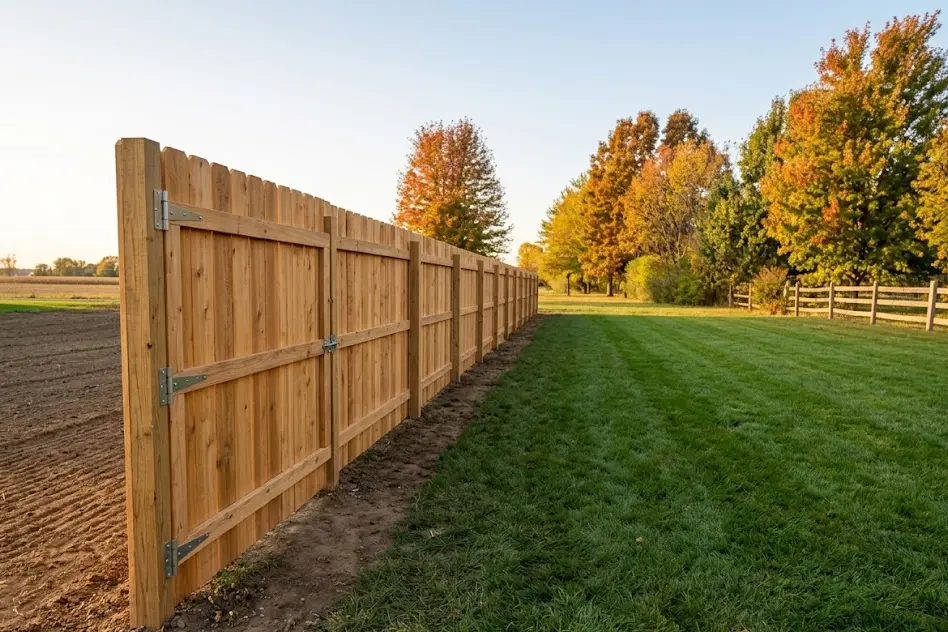
To work out your own length, measure the perimeter you want to enclose. If you are buying premade panels, divide the total length by the panel width, and plan on one post every 6 to 8 feet. Subtract the width of any gates from the fencing total (HomeGuide). Fixr notes that about 200 linear feet, enough to enclose a quarter acre, is the most common size (Fixr).
Cost per linear foot by material
| Material | HomeGuide, materials only | HomeGuide, installed | Fixr, installed |
|---|---|---|---|
| Wood (pine, spruce, cedar, pressure-treated) | $10 – $30 | $20 – $50 | $15 – $35 |
| Vinyl | $25 – $45 | $30 – $60 | $15 – $40 |
| Chain link | $4 – $15 | $10 – $40 | $12.25 – $40 |
| Aluminum | $15 – $50 | $25 – $75 | $15 – $40 |
| Steel | not listed | $20 – $80 | $15 – $60 |
| Wrought iron | $35 – $60 | $50 – $85 | $22 – $40 |
| Composite | $30 – $60 | $20 – $85 | $22 – $40 |
Wood is one of the cheapest fence materials, especially basic pine, spruce or cedar. Pressure-treated lumber and hardwoods push the price up. Wood needs sealing every 1 to 2 years and is vulnerable to rot and insects (HomeGuide).
The two guides differ most on metal and composite fences: HomeGuide tops out at $75 to $85 per foot for aluminum, wrought iron and composite, while Fixr caps all three at $40. For a basic pressure-treated wood fence with posts set in concrete, Homewyse estimates $32 to $52 per linear foot installed in September 2026, in the upper half of HomeGuide’s wood range and above Fixr’s.
Estimate your fence installation cost
Use the tables above to estimate your cost. The interactive calculator needs JavaScript.
Our estimate: for each material, the calculator uses the lowest and the highest installed price per foot found across HomeGuide and Fixr in the table above, so its range is wider than either guide alone. The extras are HomeGuide’s prices from the extra costs table below. This is our combination of published ranges, not a measured figure.
Vinyl costs more than wood to install but does not need annual resealing and does not rot. The trade-off: vinyl privacy fences can blow over in high-wind areas (HomeGuide).
Chain link is the cheapest common option. A 4-foot fence in plain galvanized steel mesh sits at the bottom of the range; 8- to 10-foot aluminum chain link sits at the top. A black vinyl-coated version, which resists rust, costs $10 to $34 per foot installed (HomeGuide). It gives no privacy unless slats are added.
Aluminum resists rust and is a common choice around pools. Wrought iron is usually the most expensive and the longest-lasting. Composite, made from plastic and wood fiber, does not need sealing and resists rot and pests; simple post-and-rail designs under 6 feet sit at the low end of its range (HomeGuide).
How long each fence lasts
| Material | Typical lifespan |
|---|---|
| Wood | 15 – 50 years |
| Vinyl | 20 – 30 years |
| Chain link | 15 – 20 years |
| Aluminum | 30 – 50 years |
| Composite | 25 – 30 years |
| Steel | 20 – 50 years |
| Wrought iron | 50 – 100 years |
Lifespan depends on material quality, installation, maintenance and climate (HomeGuide). A cheaper fence you replace twice can end up costing more than a pricier one you install once.
Our estimate: spread over its life, a 200-foot wood fence at $4,000 to $10,000 installed ($20 to $50 per foot) lasting 15 to 50 years costs roughly $80 to $667 a year; a 200-foot chain link fence at $2,000 to $8,000 ($10 to $40 per foot) lasting 15 to 20 years costs roughly $100 to $533 a year. We divided HomeGuide’s installed prices by its lifespan ranges (lowest cost over longest life, highest cost over shortest). This is our calculation, not a measured figure, and it leaves out maintenance such as sealing wood.
Cost by height and style
| Style | Typical height | HomeGuide, per foot | Fixr, per foot |
|---|---|---|---|
| Split rail | 2 to 4 rails | $15 – $35 | $6 – $11 |
| Picket | 3 – 5 feet | $20 – $50 | $15 – $33 |
| Privacy | 6 feet | $25 – $60 | not listed per foot |
| Privacy | 8 feet | $50 – $85 | not listed per foot |
Height is the biggest style decision after material. Going from a 6-foot to an 8-foot privacy fence doubles the low end of the per-foot price, and 8-foot fences are less common (HomeGuide). Check the height your city or county allows, and your HOA rules if you have one, before you choose.
Extra costs on a fence quote
| Item | HomeGuide | Fixr |
|---|---|---|
| Old fence removal and disposal | $10 – $20 per linear foot | $600 – $800 for most fences of 100 – 200 feet |
| Single fence post, installed | not listed | $50 – $300 per post, by material |
| Property line survey | $200 – $1,200 | not listed |
| Fence permit | $40 – $150 | not listed |
| Yard grading | $500 – $3,000 | not listed |
| Small tree removal | $400 – $1,200 | not listed |
| Stump removal | $100 – $400 | not listed |
| Painting or staining | $2 – $14 per linear foot | not listed |
Removing an old fence is part of why replacements cost more per foot than new installs. The guides price it differently: HomeGuide per foot, Fixr as a lump sum of $600 to $800 for most fences between 100 and 200 feet (Fixr). Homewyse’s September 2026 example for a 25-foot wood fence lists $82 to $173 to remove the old fencing plus $234 to $266 for debris disposal.
Our estimate: removing 150 feet of old fence at $10 to $20 per foot adds about $1,500 to $3,000 before the new fence goes in. This is a multiplication of HomeGuide’s per-foot removal price, not a measured figure.
Gates add to the total, especially several gates, custom sizes or automatic openers. Posts set deeper than 3 feet in concrete cost the most, and rocky ground, steep slopes and hard-to-reach spots raise labor (HomeGuide).
Permits, HOA rules and the property line
A fence permit typically costs $40 to $150 (HomeGuide). Your local building or zoning office decides whether you need one, how tall the fence can be and where it can sit. If you live in an HOA, read its rules on material, color and height before you collect quotes.
If you are not sure where your lot ends, a land survey costs $200 to $1,200 and marks the property lines so you know where you can legally build (HomeGuide). That is small next to the cost of moving a fence built on the wrong side of the line.
Call 811 before anyone digs
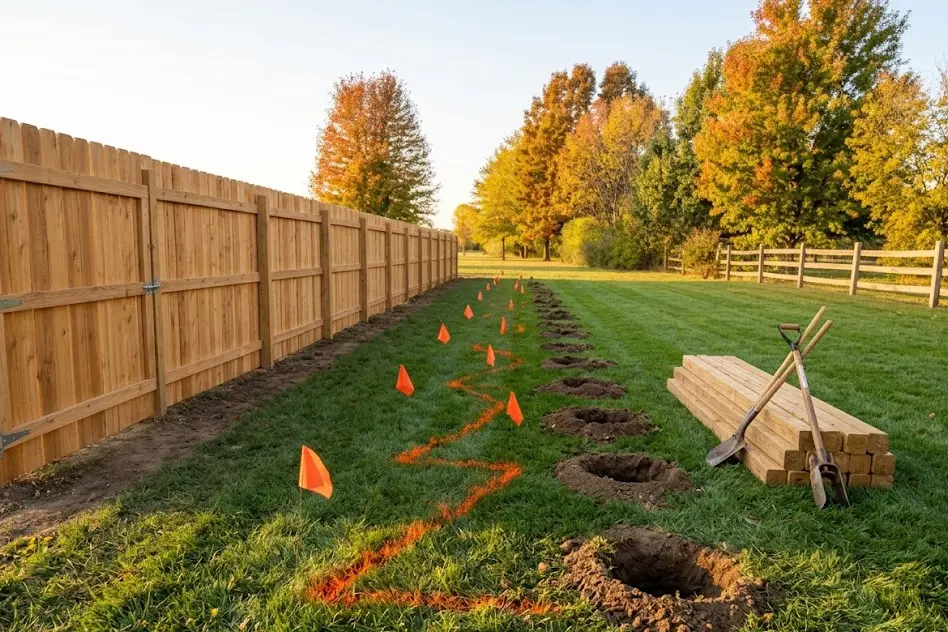
Every post hole is a dig. The national 811 program says you must contact 811 a few days before any digging project, by phone or with an online request, because some utilities are buried just inches below the surface (811 Before You Dig). Your state 811 center notifies the utility operators, who mark buried lines on your property with paint or flags (811 Before You Dig, For Homeowners).
- Wait the period your state requires for the lines to be marked.
- Confirm that every utility has responded to the request.
- Keep the marks visible for the whole job, and ask for a re-mark if the request will expire first.
- Avoid digging on top of, or within 18 to 24 inches of, the marks on all sides.
Those steps come from the 811 homeowner guide. The same program reports that not contacting 811 is the top cause of damage to buried utilities, and that shovels are the second most common tool involved (811 Before You Dig).
How long installation takes
A typical installation takes 2 to 4 days. Per 100 feet, a picket or privacy fence takes 13 to 16 hours of work, split rail 10 to 12, chain link 6 to 10, and a replacement 19 to 22. Posts set in concrete can need 1 to 4 days to cure. Spring and early fall are the easiest seasons, because frozen ground makes post holes hard to dig (HomeGuide).
How to keep the bill down
- Choose the style you need: a picket or split rail fence costs less per foot than a 6-foot privacy fence.
- Use chain link or split rail where you only need a boundary; they are the cheapest fences to install.
- Limit the number of gates and skip automatic openers unless you need them.
- Compare 3 to 5 written quotes from installers who have seen your property, and check that materials, labor, delivery and cleanup are all listed.
- Do not make the last payment until the fence is finished.
The quote and payment advice follows HomeGuide’s hiring checklist.
Questions to ask before you sign
- Does the price include removing the old fence, the permit, delivery and cleanup?
- Will you contact 811 and wait for the utility marks before digging?
- How deep will the posts go, and will they be set in concrete or gravel?
- Who confirms the property line, and who pulls the permit?
- What warranty do you give on the installation?
Sources
- HomeGuide, How Much Does Fence Installation Cost?, February 3, 2026.
- Fixr, Cost to Install Fence, updated January 31, 2025.
- Homewyse, Cost to Install a Fence, September 2026.
- 811 Before You Dig (call811.com), home page and 811 Information for Homeowners.