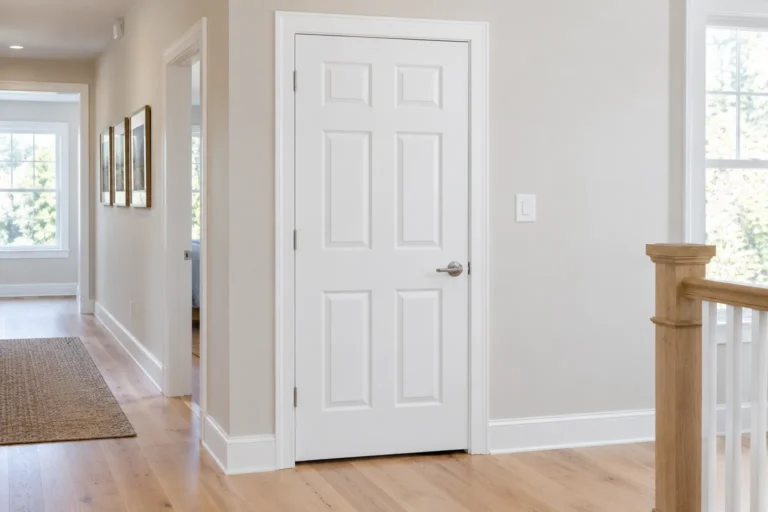
$6 – $9 per linear footThat is the typical baseboard installation cost in 2026, materials and labor included, which comes to $400 to $1,500 for most jobs, according to HomeGuide. The guides do not fully agree: Thumbtack puts the national range at $426 to $1,494 with most people paying about $805, and Homewyse prices a basic job at $8.96 to $13.71 per linear foot.
This guide is about baseboard trim, the board that covers the joint where the wall meets the floor, not baseboard heaters. Trim is priced by the linear foot, so the first step is measuring your walls. Below we compare published cost guides side by side, then break the price down by project size, material, room, labor, removal of the old boards and painting.
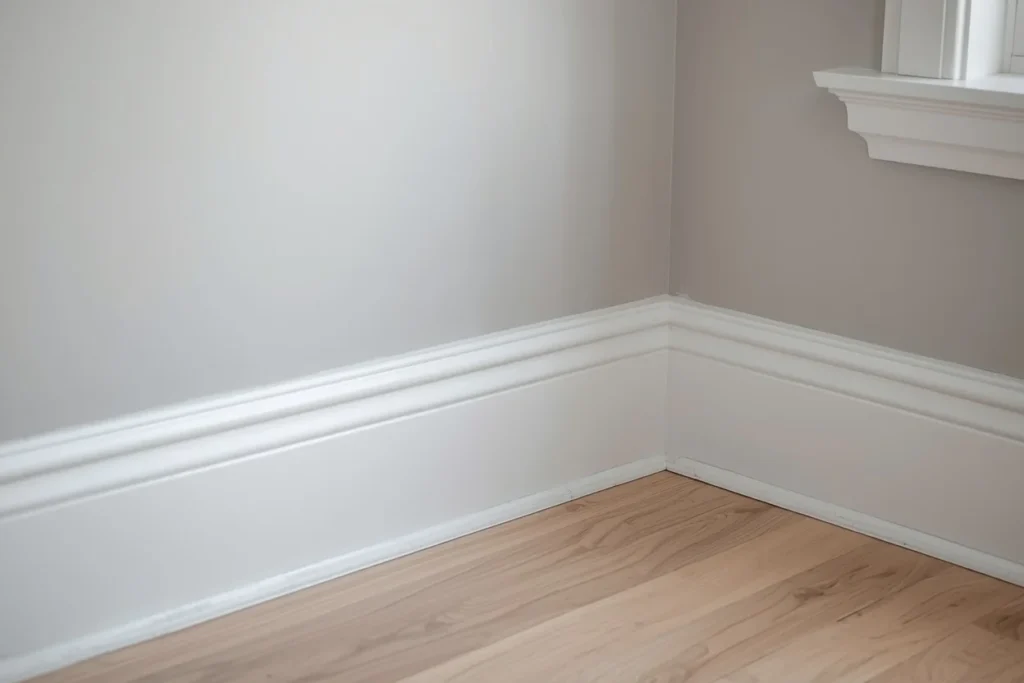
Baseboard installation cost per linear foot
| Guide | Per linear foot | Typical job | What the price covers |
|---|---|---|---|
| HomeGuide | $6 – $9 | $400 – $1,500 for 100 – 150 linear feet | Installation, materials and labor |
| Thumbtack | $1.54 – $22.41 (full range); $7.50 in its worked example | $426 – $1,494; most people pay about $805 | Materials and labor; style and finish drive the spread |
| Homewyse | $8.96 – $13.71 | $1,119 – $1,712 for 125 linear feet | Basic oak profile, labor, supplies and tool allowance; removal and disposal are extra |
| Forbes Home (older guide) | $0.50 – $1.50 | — | Installation of base molding; far below every other guide |
Three of the four guides are 2025 or 2026 pages and sit close together once you allow for what each includes. Thumbtack’s $7.50 is a hypothetical contractor quote it uses to build a price table, not a measured average. Homewyse is the highest because it prices a plain oak profile at non-discounted retail and builds in labor and a tool allowance. The Forbes figure of $0.50 to $1.50 per linear foot is far lower than every other guide and its page is from February 2024, so treat it as an outlier. A carpenter writing for Networx likewise puts the rate for simple baseboards in an empty room at about $2 a foot, and says some carpenters charge $20 to $25 per corner instead; that is one tradesperson’s account rather than a national survey.
Our estimate: the lowest low and highest high of HomeGuide and Homewyse is $6 to $13.71 per linear foot. HomeGuide’s own size chart works out to $4 to $10 per linear foot ($200 ÷ 50 and $500 ÷ 50), wider than its $6 to $9 headline. Both are our arithmetic on published ranges, not measured prices.
Estimate your baseboard installation cost
Our estimate: the published ranges above multiplied out for your inputs. Not a quote. Installed ranges from HomeGuide (October 2025) and Homewyse (May 2026); painting from HomeGuide and Forbes (February 2024) at $1 to $4 and Homewyse (May 2026) at $2.30 to $4.88; removal and disposal from Homewyse (May 2026). State adjustment: BLS construction wages (May 2025), applied to an assumed 50% labor share. How we calculate
Cost by project size
| Linear feet | HomeGuide | Thumbtack (at $7.50 per foot) |
|---|---|---|
| 50 | $200 – $500 | — |
| 100 | $400 – $1,000 | $750 |
| 150 | $600 – $1,500 | $1,125 |
| 200 | $800 – $2,000 | $1,500 |
| 250 | — | $1,875 |
| 300 | — | $2,250 |
HomeGuide says bigger jobs can cost less per linear foot because of bulk materials, and that rounded, stepped or sculpted profiles cost more than flat boards. To work out your length, Thumbtack says to measure each wall from corner to corner, subtract doorways, divide the inches by 12, and add about 10% for angle cuts and outside corners (Thumbtack).
Cost by material
| Material | HomeGuide | Thumbtack | Networx |
|---|---|---|---|
| MDF | $1.00 – $3.50 | as little as $1.57 at retailers | $4 – $5 per stick (length not given) |
| PVC or vinyl | $0.50 – $5.00 | a 120-foot vinyl roll for $160 at one retailer | — |
| Wood (all species) | $1.00 – $10.00 | jointed pine $1.50 – $5.60; a 96-inch oak or maple piece about $25 at one retailer | clear pine $0.50 – $1.50; tall hardwood base has exceeded $12 |
HomeGuide says MDF and softwoods such as pine are cheaper than hardwoods but not as durable. HomeServe adds that MDF takes paint well but suits dry areas such as living rooms, bedrooms and hallways, while PVC resists water and is the pick for bathrooms, laundry rooms and basements. Thumbtack notes that MDF does not take stain well and that oak and maple do.
Our estimate: converting Thumbtack’s retailer examples to a per-foot price, $25 ÷ 8 ft is about $3.13 for oak or maple and $160 ÷ 120 ft is about $1.33 for vinyl. Homewyse’s retail oak profile is $328 to $494 for 132 feet, or about $2.48 to $3.74 per foot. These are our arithmetic on published prices, not measured figures.
Height matters too. HomeServe lists 3-inch boards as the most common size, 5-inch as the mid-range option and 7 inches or taller as the premium choice, and says taller, more ornate boards need more material and careful cutting. HomeGuide’s rule for choosing a size is to multiply the ceiling height by 7% and pick the board closest to the result.
Our estimate: applying HomeGuide’s rule in inches, an 8-foot ceiling (96 inches × 0.07) points to about 6.7 inches and a 9-foot ceiling (108 inches × 0.07) to about 7.6 inches. That is our arithmetic on HomeGuide’s rule, not a recommendation for your home.
Cost by room
| Room (our assumed size) | Linear feet | At HomeGuide $6 – $9 | At Homewyse $8.96 – $13.71 |
|---|---|---|---|
| Half bath, 5 × 6 ft | 19 | $114 – $171 | $170 – $260 |
| Bathroom, 5 × 8 ft | 23 | $138 – $207 | $206 – $315 |
| Bedroom, 10 × 12 ft | 41 | $246 – $369 | $367 – $562 |
| Large bedroom, 12 × 14 ft | 49 | $294 – $441 | $439 – $672 |
| Living room, 15 × 20 ft | 67 | $402 – $603 | $600 – $919 |
Our estimate: a 10 × 12 ft bedroom has a 44-foot perimeter (2 × (10 + 12)), or 41 feet after one 3-foot door; 41 × $6 = $246 and 41 × $9 = $369. The other rows use the same method. Real rooms have more doors, closets and corners, and the guides do not publish per-room prices, so use this only to size a budget.
Baseboards are usually part of a bigger job. If you are redoing floors, see our guides to tile installation cost and hardwood floor refinishing cost; for whole rooms, bathroom remodel cost, kitchen remodel cost and basement remodel cost. On order of work, HomeServe says to install baseboards after the flooring but before the final paint touch-ups, and HomeGuide says that with carpet you should paint or stain the boards and let them dry before it goes in.
What the labor costs
| Source | Carpenter rate | Notes |
|---|---|---|
| HomeGuide | $30 – $100 per hour | Trim carpenters install about 20 linear feet per hour; 100 – 150 feet takes about 5 to 7½ hours |
| Thumbtack | $35 – $90 per hour | Some carpenters charge per linear foot; its example is $5 of labor per foot |
| Forbes Home (older guide) | $65 – $100 per hour | About six hours for an average trim job |
| BLS, median carpenter wage | $29.12 per hour | May 2025 wage paid to carpenters, not a contractor’s billing rate |
HomeGuide says rooms with many angles and corners take longer than large flat walls, and that crooked walls, common in older homes, generally take longer and cost more. HomeServe lists room shape, board size, location and the carpenter’s skill as the main labor drivers, and says materials make up about half the total price on a typical job.
Our estimate: at HomeGuide’s 5 to 7½ hours and $30 to $100 an hour, labor for 100 to 150 linear feet works out to $150 ($30 × 5) to $750 ($100 × 7.5). That is our arithmetic on two published ranges, not a measured price.
Removing old baseboards
| Source | Removal cost |
|---|---|
| HomeGuide | About $50 – $100 per hour extra in labor |
| HomeServe | $50 – $150 extra in labor fees |
| Homewyse | $99 – $483 (3.3 hours) for about 125 linear feet, plus $73 – $83 to haul away debris |
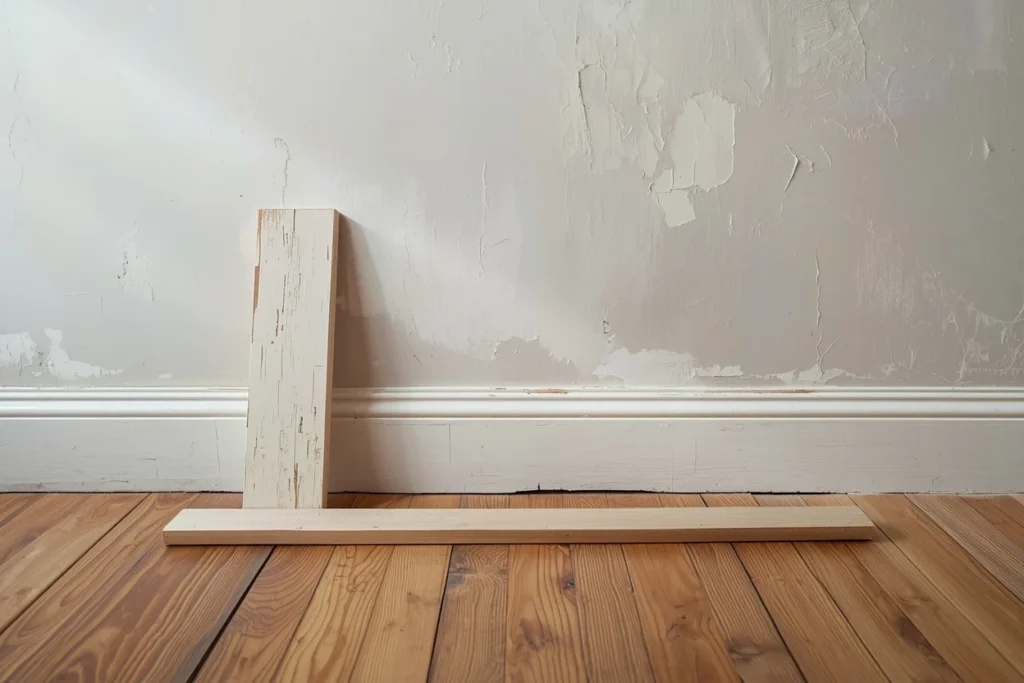
Thumbtack says the installer has to cut away old paint or caulk to pry the trim off, then scrape and sand leftover glue or caulk, and that an older home may need extra gap filling. If you can remove the old boards without damaging the wall, HomeGuide and Forbes both list doing it yourself as a saving.
Check the age of the house first. EPA says about three-quarters of U.S. homes built before 1978 still contain some lead-based paint, and its rule requires anyone paid to disturb painted surfaces in a pre-1978 home to be certified in lead-safe work practices. In general the rule does not apply to homeowners working on their own pre-1978 home, but it does if you rent out part of it (EPA). If you hire someone for this job in an older house, ask whether they hold that certification; our guide to how to find a contractor covers vetting.
Our estimate: Homewyse’s removal total of $99 to $483 for about 125 feet works out to about $0.79 to $3.86 per linear foot ($99 ÷ 125 and $483 ÷ 125). It is our arithmetic on a published job total, not a measured price.
Painting, caulking and finishing
| Source | Per linear foot | What it covers |
|---|---|---|
| HomeGuide | $1 – $4 extra | Painting trim if you buy unfinished baseboards |
| HomeServe | $1 – $4 | Painting trim or baseboards; stain or custom colors may cost more |
| Forbes Home (older guide) | $1 – $4 | Painting or staining; baseboards may cost more because they are wider |
| Homewyse | $2.30 – $4.88 | Prep, patching up to four minor defects per 100 feet, caulking the edge, spot priming and two coats; $287 – $609 for about 125 feet |
Our interior painting cost guide covers trim as part of a full room. On caulking, Homewyse’s installation labor includes patching and smoothing nail holes and, if the trim is being painted, caulking the edge gaps. HomeServe says contractors typically include basic gap filling, caulking small gaps and filling nail holes, in their standard labor, but that large holes, water stains or uneven walls are priced separately. HomeGuide puts drywall repair at $300 to $500 for each hole or crack, or $300 to $1,500 or more in total.
HomeGuide says you can paint baseboards before or after they go up. Painting first prevents mistakes, but you will still need to touch up the nail holes, and most homeowners paint the walls before installing the trim. Pre-painted or pre-stained boards cost more than unfinished trim.
Other trim installed with baseboards
| Trim | Installed, per linear foot |
|---|---|
| Baseboard molding | $6 – $9 |
| Shoe molding | $4 – $6 |
| Quarter round | $3 – $7 |
| Door casing | $5 – $10 |
Shoe molding and quarter round fill the gap between the baseboard and the floor, and HomeGuide says they are thinner and lighter than door casing. HomeGuide prices crown molding separately, at $7 to $16 per linear foot installed. HomeGuide puts all trim installation at $4 to $10 per linear foot on average, depending on the type.
How to keep the bill down
- Paint the baseboards you have instead of replacing them, as HomeGuide suggests, unless they are warped or water damaged (Thumbtack).
- Choose MDF or pine over hardwood. In the guides above, MDF runs $1 to $3.50 a foot against $1 to $10 for wood.
- Remove the old boards yourself before the carpenter arrives, if you can do it without damaging the wall (HomeGuide, Forbes).
- Paint or stain the boards yourself before installation (HomeGuide), or buy them pre-painted so the contractor puts in fewer hours (Forbes).
- Bundle the work with other trim, such as door casings, which HomeServe says can reduce the per-foot price.
- If you are having floors installed, ask the flooring company whether it also installs baseboards (Thumbtack).
- Get at least three written estimates to compare, as HomeGuide advises.
Questions to ask before you sign
- Is the price per linear foot for materials and labor, or labor only?
- Does it include removal and disposal of the old baseboards, or does that cost extra? (HomeGuide lists this among the questions to ask.)
- Is painting, caulking and nail-hole filling included, or only the installation?
- What material and board height do you recommend for this room?
- Are you licensed, insured and bonded, and, if the house was built before 1978, certified in lead-safe work practices?
- How do you handle damage to walls or floors during the job, and do you offer a written warranty?
Sources
- HomeGuide, How Much Does Baseboard Installation Cost? (2026), written October 15, 2025.
- Thumbtack, Baseboard Installation Cost in 2026, last updated April 9, 2026.
- Homewyse, Cost to Install Baseboard and Cost to Paint Baseboards, May 2026 national averages.
- HomeServe, How Much Does It Cost to Install Baseboards?, November 7, 2025. Its per-foot installation price is attributed to HomeGuide, so it is not counted as an independent source for that figure.
- Forbes Home, How Much Does It Cost To Install Trim?, audited February 29, 2024 (older guide).
- Networx, How Much Does It Cost to Install Molding?, a trim carpenter’s account; the page shows last updated September 23, 2026.
- U.S. Bureau of Labor Statistics, Occupational Outlook Handbook: Carpenters, May 2025 wage data, last modified August 27, 2026.
- U.S. Environmental Protection Agency, Lead Renovation, Repair and Painting Program.