$1,000 – $3,500That is the typical attic insulation cost in 2026, labor and materials included, or about $1 to $6.50 per square foot installed. HomeGuide puts the average job at $1,000 to $2,700 and HomeBuddy at $1,500 to $3,500. Small attics start around $500, and large ones or spray foam jobs can pass $6,000. Removing old insulation first adds $1 to $2.25 per square foot.
Attic insulation is one of the few home projects that pays you back. The price depends on four things: how big the attic floor is, which material goes in, how thick it has to be for your climate, and whether the old insulation has to come out first. The figures below break down each one.
Attic insulation cost by attic size
| Attic floor (sq ft) | HomeGuide | HomeBuddy |
|---|---|---|
| 500 | $500 – $2,000 | $750 – $1,500 |
| 700 | $700 – $2,800 | — |
| 1,000 | $1,000 – $4,000 | $1,500 – $3,500 |
| 1,200 | $1,200 – $4,800 | — |
| 1,500 | $1,500 – $6,000 | $2,250 – $5,500 |
| 2,000 | $2,000 – $8,000 | $3,000 – $7,000 |
| 2,500 | — | $3,750 – $9,000+ |
The national average job comes to about $1,800. Some insulation companies set a minimum of $1,500 to $2,000 per project, which matters if your attic is small (HomeGuide). HomeBuddy prices installed attic insulation at $1.50 to $6.50 per square foot and notes that some contractors charge a flat minimum of $300 to $500 for small jobs (HomeBuddy).
The two guides agree at the low end but not at the top: HomeGuide runs to about $4 per square foot and HomeBuddy to $6.50. Small jobs also cost more per square foot. The September 2026 estimate from Homewyse for a basic 500 sq ft attic, with loose-fill insulation to R-19, basic labor, supplies and a blowing machine, comes to $1,869 to $3,861, or $3.74 to $7.72 per square foot, before removing old material, hauling debris or any contractor markup.
Cost by insulation type
| Type | HomeGuide, per sq ft | HomeGuide, typical total | HomeBuddy, per sq ft |
|---|---|---|---|
| Blown-in (fiberglass or cellulose) | $0.90 – $2.40 | $900 – $3,600 | $1.00 – $2.50 (cellulose) |
| Batts and rolls | $0.80 – $2.60 | $1,100 – $3,900 | $0.90 – $1.80 (fiberglass) |
| Loose-fill, placed by hand | $1.00 – $2.50 | $1,100 – $3,800 | — |
| Spray foam, attic floor | $1.00 – $4.50 | $1,100 – $6,800 | see spray foam below |
| Spray foam, rafters and roof deck | — | $1,500 – $9,000 | see spray foam below |
| Reflective (radiant barrier) | $0.50 – $2.20 | $550 – $3,300 | $0.50 – $2.20 |
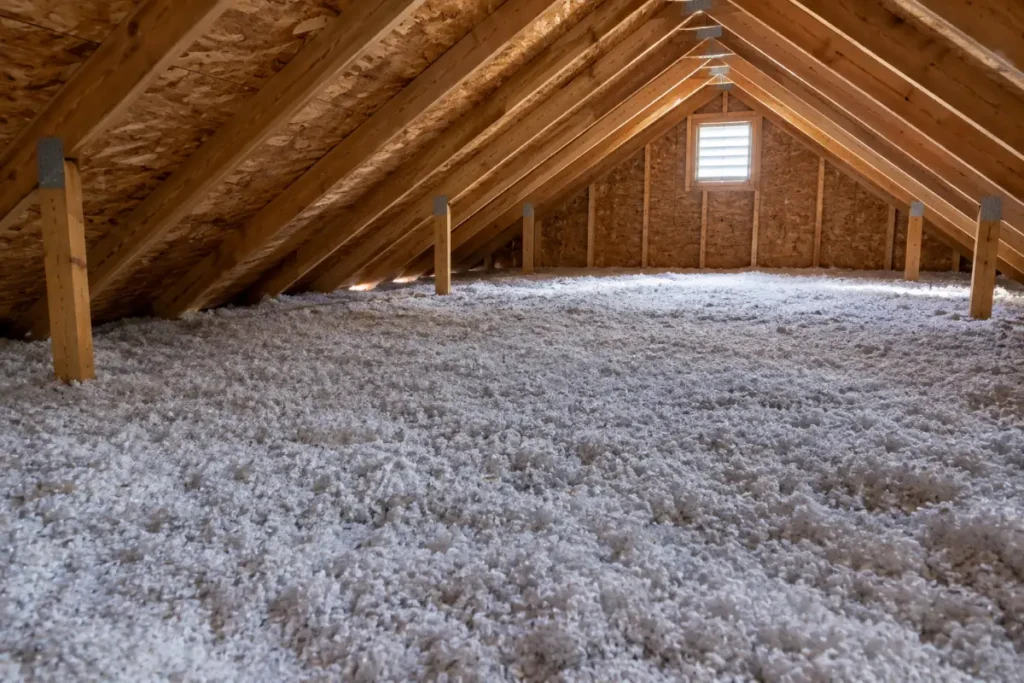
Blown-in fiberglass costs $1.00 to $2.80 per square foot installed across all uses, with an R-value of 2.2 to 2.9 per inch and little or no settling. Blown-in cellulose costs $1.20 to $2.80 per square foot installed, insulates better per inch (R-3.1 to R-3.8) and is made mostly from recycled newspaper treated with fire retardant, but it settles about 10% after installation (HomeGuide). Blown-in material is the usual choice for attic floors because it fills gaps and odd-shaped spaces around joists and fixtures.
Batts work best where the framing is standard and there are few obstructions. A complete replacement with batts can reach $4.70 per square foot to hit the recommended R-value (HomeGuide).
Estimate your attic insulation cost
Use the tables above to estimate your cost. The interactive calculator needs JavaScript.
Our estimate: the calculator multiplies your attic size by the per-square-foot range of the type you pick, then adds the extras you tick. Where HomeGuide and HomeBuddy both price an item, it takes the lower of the two lows and the higher of the two highs (blown-in, for example, runs from $0.90 in HomeGuide to $2.50 in HomeBuddy). It is not a measured figure or a quote.
Spray foam: open cell or closed cell
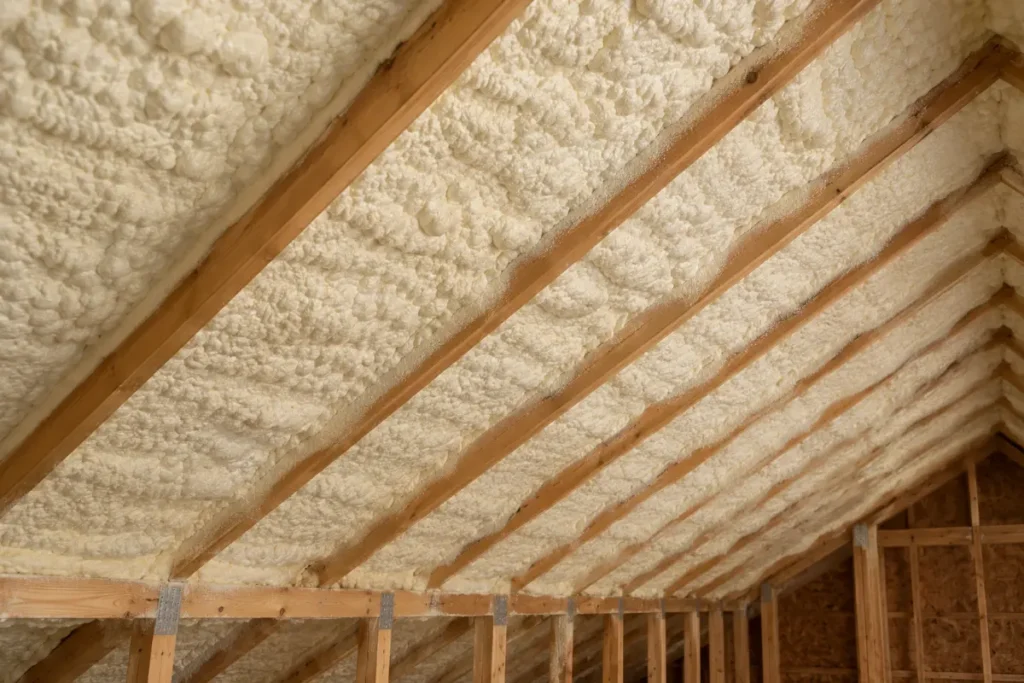
Attic spray foam costs $1.50 to $5.00 per square foot, or $0.60 to $2.90 per board foot (one square foot, one inch thick) installed. HomeBuddy prices it by foam type instead: $1.00 to $3.00 per square foot for open cell and $2.00 to $4.50 for closed cell, installed (HomeBuddy). The two types differ in price and in where they belong (HomeGuide):
| Foam | R-value per inch | Material per board foot | Best use |
|---|---|---|---|
| Open cell | 3.5 – 3.7 | $0.30 – $0.50 | Attic floor of a vented attic; an air barrier, may need a vapor barrier |
| Closed cell | 5.0 – 7.0 | $0.90 – $1.00 | Roof deck of an unvented attic; air, moisture and vapor barrier |
Spray foam is the best performer but also the most expensive option, and it is a job for a certified professional because it involves mixing hazardous chemicals. A thin layer of foam topped with blown-in or batt insulation is a cheaper way to both air seal and reach the target R-value (HomeGuide).
How much insulation your climate needs
Insulation is rated by R-value: the higher the number, the better it resists heat moving through it. ENERGY STAR publishes the levels that are cost-effective when adding insulation to an existing attic, by climate zone (ENERGY STAR):
| Climate zone | Uninsulated attic | Attic with 3–4 inches already |
|---|---|---|
| 1 | R-30 | R-25 |
| 2 | R-49 | R-38 |
| 3 | R-49 | R-38 |
| 4A and 4B | R-60 | R-49 |
| 4C, 5 and 6 | R-60 | R-49 |
| 7 and 8 | R-60 | R-49 |
More R-value means more material and more hours, so the price climbs with it. For blown-in insulation on a 1,000 sq ft attic, HomeGuide prices each level as follows:
| R-value | Minimum thickness | Installed, per 1,000 sq ft |
|---|---|---|
| R-30 | 10.25 in | $660 – $1,200 |
| R-38 | 13 in | $840 – $1,500 |
| R-44 | 15 in | $990 – $1,700 |
| R-49 | 16.5 in | $1,100 – $1,900 |
| R-60 | 20 in | $1,400 – $2,400 |
Removing old insulation
Removal costs $1 to $2 per square foot, which puts a full tear-out and replacement at $2 to $6 per square foot. Old insulation should come out if it has fire, water or pest damage, or if the material is hazardous. Taking it out also exposes the attic floor so every gap can be sealed. If the existing layer is dry and intact, you can usually top it up instead, and the new layer does not have to be the same material. Adding more insulation costs $1 to $4 per square foot with professional installation (HomeGuide). HomeBuddy puts removal at $1.00 to $2.25 per square foot, and a full replacement involving removal, air sealing or spray foam at $3,000 to $10,000 or more, against $1,500 to $3,500 for adding a layer over clean, dry insulation (HomeBuddy).
Our estimate: tearing out old insulation from a 1,000 sq ft attic ($1 to $2 per sq ft, so $1,000 to $2,000) and blowing in R-49 ($1,100 to $1,900 per 1,000 sq ft) would come to roughly $2,100 to $3,900 before air sealing. This adds up the HomeGuide ranges above; it is not a measured figure, and a real quote may bundle or discount the two jobs.
Related clean-up lines can appear too: attic cleaning runs $100 to $500 or more, a pest inspection $40 to $150, and attic mold removal $1,500 to $15,000 (HomeGuide).
Air sealing and other extras
| Work | HomeGuide | HomeBuddy |
|---|---|---|
| Air sealing the attic | $350 – $3,000 | $200 – $600 (average attic) |
| Removing old insulation | $1 – $2 per sq ft | $1.00 – $2.25 per sq ft |
| Baffles at the soffit vents | $2 – $3 each | — |
| Roof vent installation | $200 – $700 | — |
| Minor roof leak repair | $150 – $1,000 | — |
Air sealing the attic floor of a vented attic is essential for insulation to work well, and some contractors include it in their price. Baffles stop the insulation from blocking airflow from the soffit vents, and any bathroom or kitchen fan that exhausts into the attic has to be vented outside before new insulation goes in (HomeGuide).
What the labor line pays for
Insulation labor costs $0.50 to $1.30 per square foot, depending on the material, the R-value and how hard the space is to work in. A blown-in attic job takes a two-person crew 2 to 4 days (HomeGuide). Steep roofs, tight corners and older homes that need more sealing push the labor up (HomeGuide). HomeBuddy gives a wider labor range of $0.25 to $2.00 per square foot (HomeBuddy).
For comparison, the median insulation worker in the United States earned $24.68 an hour in 2025, according to the Bureau of Labor Statistics. The billed price also covers the blowing machine, the truck, insurance and the company’s overhead.
Does it pay for itself?
The EPA estimates that homeowners save an average of 15% on heating and cooling costs, or 11% on total energy costs, by air sealing and adding insulation in attics, floors over crawl spaces and basements (ENERGY STAR). HomeGuide puts the savings from attic insulation alone at 10% to 20% of heating and cooling costs (HomeGuide).
Your own payback depends on what you spend on heating and cooling today and how thin your current insulation is. The biggest gains come in attics with little or no insulation; topping up an attic that already meets the levels above returns much less. A home energy audit can show which improvements are worth it before you pay for any of them.
No federal tax credit in 2026
Insulation and air sealing materials that met the energy code used to qualify for the Energy Efficient Home Improvement Credit: 30% of the cost, within an annual limit of $1,200. The credit only covers property placed in service before December 31, 2025, so insulation installed in 2026 does not qualify (IRS). Utility and state rebates are separate programs; check with your utility before you book the work.
How to keep the bill down
- Top up instead of tearing out when the old insulation is dry, clean and undamaged.
- Insulate to the level ENERGY STAR recommends for your zone, not beyond it. Over-insulating gives a poor return.
- Consider doing blown-in or batts yourself if you are comfortable in an attic. Spray foam is not a DIY job.
- Ask whether air sealing and baffles are in the quote before comparing totals.
- Get at least three itemized quotes and do not pay in full before the work starts.
Questions to ask before you sign
- What R-value will I end up with, and how thick will the finished layer be?
- Is air sealing included, and which gaps and fixtures will you seal?
- Does my old insulation need to come out, and is removal in the price?
- Will you install baffles and check that fans vent outside?
- Are you licensed and insured, and what warranty covers the work?
Sources
- ENERGY STAR, Recommended Home Insulation R-Values and Why Seal and Insulate?
- Internal Revenue Service, Energy Efficient Home Improvement Credit.
- U.S. Bureau of Labor Statistics, Occupational Outlook Handbook: Insulation Workers, 2025 pay data.
- HomeGuide, Attic Insulation Cost, January 2026.
- HomeGuide, Blown-In Insulation Cost, November 2025.
- HomeBuddy, How Much Does Attic Insulation Cost?, updated August 25, 2026.
- Homewyse, Cost to Insulate an Attic, September 2026.