$2,000 – $8,500That is the typical stair lift cost in 2026 for a straight staircase, lift and professional installation included. A curved lift, which needs a rail built for your stairs, runs $7,500 to $20,000, and an outdoor lift $3,500 to $12,000. Four published cost guides agree on that order; they differ mainly on how high a curved lift can go. Original Medicare does not pay for a stair lift, but some state, veterans’ and tax programs may help.
The shape of the staircase decides most of the price: a straight run uses a standard rail cut to length, while a landing or a turn means a custom rail. Below are the installed prices by type, what installation and electrical work add, how used and rented lifts compare, what upkeep costs, and which programs may help pay. Prices are national ranges from published guides, not quotes.
Stair lift cost by type
| Type | HomeGuide | Fixr | NCOA | ConsumerAffairs |
|---|---|---|---|---|
| Straight (indoor) | $2,000 – $8,500 | $2,000 – $8,000 | $2,500 – $5,000 | $3,000 – $8,000 |
| Curved or with a landing | $7,500 – $15,000+ | $8,000 – $20,000 | $8,000 – $12,000 | $10,000 – $15,000 |
| Outdoor | $3,500 – $12,000 | $4,000 – $12,000 | $4,000 – $8,000 | $4,000 – $10,000 |
| Standing (perch) lift | — | $2,500 – $10,000 | — | — |
| Wheelchair platform lift | $4,000 – $15,000+ | $5,000 – $20,000 | — | — |
The four guides agree that a straight lift is the cheapest and a curved one the dearest, but the top of each range varies. NCOA’s figures are the lowest: it splits a straight lift into $2,000 – $3,500 for the equipment and $500 – $1,500 for installation, and a curved one into $7,000 – $10,000 plus $1,000 – $2,000 (NCOA). Fixr puts the national average for a standard straight lift at about $4,000 (Fixr).
Our estimate: the ranges at the top of this page take the lowest low and the highest high of the four guides for each type: $2,000 to $8,500 for a straight lift, $7,500 to $20,000 for a curved lift and $3,500 to $12,000 for an outdoor lift. They are a combination of published ranges, not a measured price.
Estimate your stair lift cost
Use the tables above to estimate your cost. The interactive calculator needs JavaScript.
Straight, curved, outdoor or standing
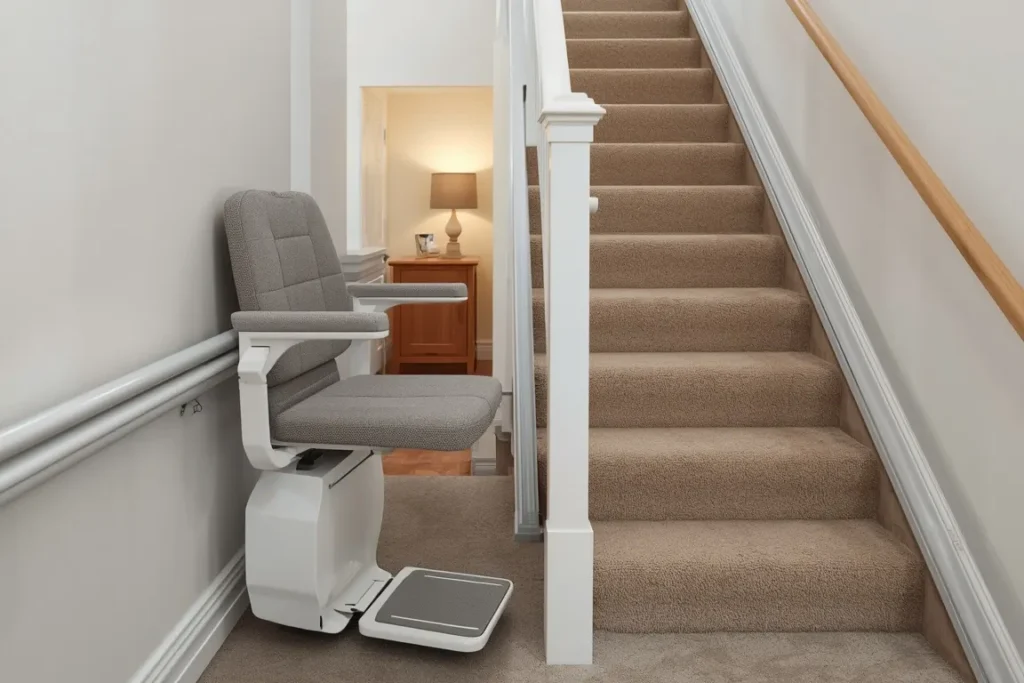
Straight lifts are the most common and the easiest to install. They fit a staircase with no curve or landing, using a standard rail that the technician cuts to length (HomeGuide).
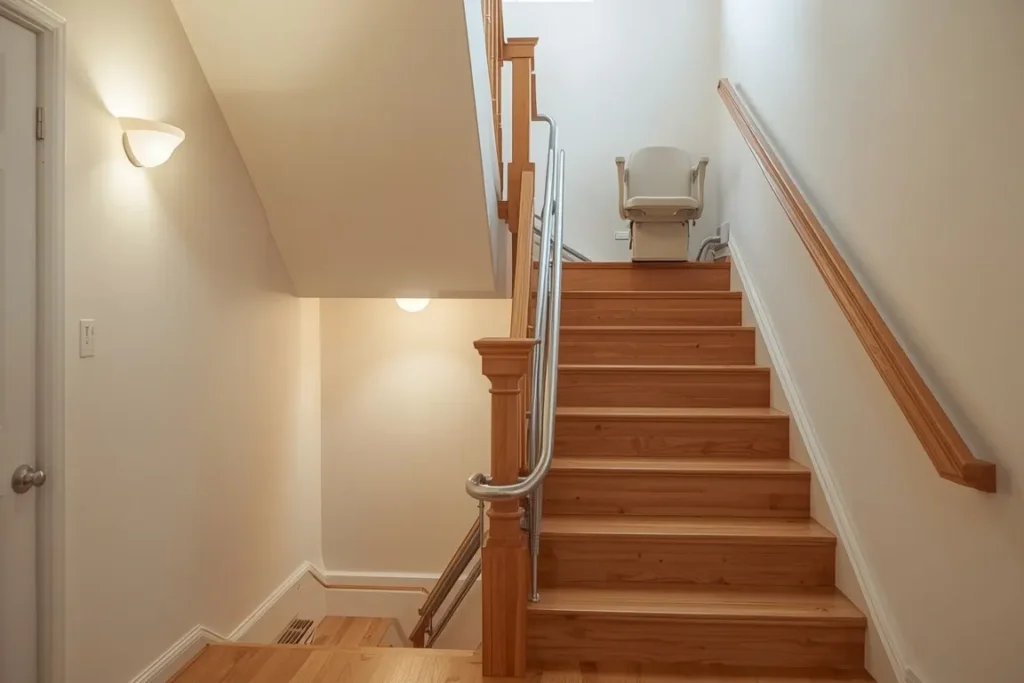
Curved lifts are built to the exact measurements of your staircase. That custom rail is needed for curved stairs and also for straight stairs broken by one or more intermediate landings (HomeGuide). If your stairs are two straight flights joined by a landing, both HomeGuide and Fixr suggest pricing two straight lifts instead of one curved lift; Fixr’s accessibility expert says it can save thousands of dollars (Fixr).
Outdoor lifts use weatherproof materials that resist corrosion, rain, snow and wind, and usually come with a waterproof cover (HomeGuide). They also need an outdoor electrical outlet, which adds to the bill (NCOA).
Standing or perch lifts let the rider lean in a semi-standing position, for people who find it hard to sit down on or rise from a standard chair (HomeGuide). Fixr notes they can fit narrow stairs where a seated lift will not, but may not suit people with severe mobility problems (Fixr).
Wheelchair platform lifts carry a wheelchair or scooter user without leaving the chair. An inclined platform lift runs on a track along the stairs and folds up when not in use; a vertical platform lift works like a small open elevator (HomeGuide).
What drives the price
- Staircase length. A longer staircase needs more rail (HomeGuide).
- Power source. Fixr prices battery-operated lifts at $3,000 – $5,000 installed and lifts wired to household power at $4,000 – $7,000, partly because the wired type often needs an electrician (Fixr). Most lifts run on batteries that recharge from an outlet at the staircase (HomeGuide), and a battery lift keeps working in a power cut (Fixr).
- Weight capacity. HomeGuide and NCOA put standard lifts at 300 to 400 pounds and heavy-duty models at up to 600 pounds; Fixr gives a lower standard limit of 200 to 250 pounds and says heavy-duty lifts start at around $5,000. Check the rated limit of the model you are quoted.
- Seat and features. A seat belt, swivel seat, folding seat and footrest, remote control and adjustable seat height are usually standard; power swivel, power-folding footrests, custom upholstery and folding rails cost more (HomeGuide).
| Add-on | Extra cost, installed |
|---|---|
| Remote control | $50 – $150 |
| Armrest | $50 – $150 |
| Lift-up footrest | $50 – $200 |
| Speed control | $75 – $200 |
| Obstruction sensors | $100 – $400 |
Installation, electrical work and removal
Most quotes include installation, because the dealer or maker fits the lift. HomeGuide puts installation labor at $1,000 – $5,000 depending on the lift style, cheapest for a straight lift (HomeGuide); NCOA gives $500 – $2,000 (NCOA) and ConsumerAffairs $500 – $2,000 (ConsumerAffairs). Ask whether labor is in the price you are given.
| Item | HomeGuide | Fixr |
|---|---|---|
| New electrical outlet near the stairs | $150 – $350 | $120 – $200 |
| Dedicated circuit (hardwired lift) | $250 – $900 | — |
| Electrician, per hour | $50 – $130 | — |
| Drywall patching after fitting the rail | $300 – $500 | — |
| Removal of the lift later | — | $100 – $300 (sometimes free) |
A straight lift takes 2 to 6 hours to install and a curved one 3 to 8 hours, longer if an electrician has to run new wiring (HomeGuide). Fixr says most homes do not need a permit for a stair lift, but some do, so check with your local building office (Fixr). HomeGuide reports that the Accessibility Equipment Manufacturers Association does not support do-it-yourself installation, and ConsumerAffairs notes that some makers will not honor the warranty unless a certified technician fits the lift.
When the lift is no longer needed, Fixr says a reusable unit is often taken out free or at a discount, but you may still have to pay a handyman to repair the holes left by the rail brackets (Fixr).
New, used or rented
| Option | HomeGuide | Fixr | NCOA | ConsumerAffairs |
|---|---|---|---|---|
| Used or refurbished straight lift, installed | $2,000 – $3,000+ | $1,500 – $2,500 | — | $500 – $1,000 less than new; from about $3,000 |
| Rental, per month | $150 – $500 | $150 – $500 | $175 – $500 | $100 – $300 |
| Refundable rental deposit | $500 – $1,000 | $500 – $1,000 | — | — |
| Rental installation and removal | charged extra | $800 – $1,200 | sometimes included | a few hundred to a few thousand dollars |
Used lifts are usually former rentals or wrongly ordered units that the seller refurbishes and checks before resale, and most are for straight stairs (HomeGuide, Fixr). NCOA notes that reconditioned lifts often carry a warranty, though coverage may be limited. Rentals are also mostly limited to straight stairs, often with a three-month minimum, and some companies offer rent-to-own (HomeGuide).
Our estimate: using Fixr’s rental figures ($150 to $500 a month, plus $800 to $1,200 for installation and removal, leaving out the refundable deposit), six months of rental comes to roughly $1,700 to $4,200, and twelve months to $2,600 to $7,200. Against a used straight lift at $1,500 to $3,000 installed, renting makes most sense for a few months of need, such as recovery after surgery, which is also HomeGuide’s advice. This is our arithmetic, not a measured price.
Maintenance, batteries and warranty
| Ongoing cost | HomeGuide | Fixr | NCOA | ConsumerAffairs |
|---|---|---|---|---|
| Yearly maintenance visit or plan | $100 – $300 | $100 – $200 | $100 – $300 a year (plan) | $100 – $250 per visit |
| Battery replacement | — | — | $200 – $300 every 1 – 3 years | — |
A yearly visit covers inspecting the lift, lubricating the machinery and checking the battery, and some makers require it to keep the warranty valid (HomeGuide). Most warranties run one to two years, though some makers offer ten years or a lifetime (Fixr). Fixr and NCOA both put the typical life of a stair lift at about ten years; NCOA’s battery interval is 1 to 3 years in its cost section and 2 to 5 years in its FAQ.
Our estimate: a new straight lift at $2,000 to $8,500 plus ten yearly service visits at $100 to $300 comes to about $3,000 to $11,500 over the roughly ten-year life Fixr and NCOA give. Batteries are extra unless a warranty or service plan covers them. This is a calculation from the published ranges, not a measured figure.
Alternatives: platform lift, home elevator or ramp
| Option | HomeGuide | Fixr |
|---|---|---|
| Wheelchair platform lift (inclined or vertical) | $4,000 – $15,000+ | $5,000 – $20,000 |
| Home elevator, two floors | $30,000 – $60,000 | $38,000 – $55,000 |
| Permanent wheelchair ramp | $1,000 – $6,000+ | $1,700 – $5,000 (typical ramp) |
A home elevator costs several times more than a stair lift: HomeGuide adds $10,000 to $15,000 or more for each extra floor (HomeGuide), and Fixr puts the national average at $50,000 (Fixr). A ramp only solves a few entrance steps, not a full flight inside; HomeGuide prices installed ramps at $100 to $250 per linear foot depending on the material (HomeGuide, older guide, November 2024). Other options the guides list are moving daily life to one floor or moving to a single-story home.
Does Medicare pay for a stair lift?
Original Medicare generally does not. Medicare Part B covers durable medical equipment (DME) that is used for a medical reason, is typically only useful to someone who is sick or injured, and is ordered by a doctor for use at home; you pay 20% of the Medicare-approved amount after the Part B deductible (Medicare.gov). Medicare’s national DME reference list marks “stairway elevators” as denied, under the same reasoning as elevators: a convenience item, not primarily medical in nature (CMS, National Coverage Determination 280.1, version effective June 9, 2025).
Do not confuse a stair lift with a seat lift. The same CMS list covers seat lift mechanisms under separate conditions, and NCOA explains that Part B may pay for the motorized lift mechanism of a lift chair, not the chair itself, when a doctor prescribes it (NCOA). Some Medicare Advantage plans offer supplemental benefits that can include home modifications or mobility equipment, but whether a stair lift qualifies depends on the plan (HomeGuide, NCOA). Your plan’s documents, or free counseling from your State Health Insurance Assistance Program (SHIP), can tell you what your plan pays.
Other ways to pay: Medicaid, VA, USDA and local help
- Medicaid HCBS waivers. Nearly all states run home and community-based services waivers that help people who would otherwise need institutional care stay at home; about 257 are active, and states can add services that help people move from or avoid institutions (Medicaid.gov). NCOA notes some waivers can pay for home modifications, depending on the state; your state Medicaid office can tell you what yours covers.
- VA housing grants. For fiscal year 2026, the Specially Adapted Housing grant goes up to $126,526 and the Special Home Adaptation grant up to $25,350, for veterans and service members with certain service-connected disabilities who own or will own the home (VA). The VA adjusts these caps each year.
- VA HISA benefit. The Home Improvements and Structural Alterations benefit pays a lifetime $6,800 for a service-connected disability, or for any disability when the veteran has a service-connected rating of at least 50%, and $2,000 in other cases, but its exclusions list porch lifts and stair glides (VA Prosthetic and Sensory Aids Service). It can cover electrical work made necessary by installed home medical equipment, so ask your local Prosthetic and Sensory Aids Service what applies.
- USDA Section 504 home repair. In eligible rural areas, very-low-income homeowners aged 62 or older can get grants of up to $10,000 to remove health and safety hazards, and low-income owners can borrow up to $40,000 at a fixed 1% for 20 years (USDA Rural Development).
- Area Agencies on Aging. Some provide grants or refer people to home-modification funding (NCOA). Find yours through the Eldercare Locator or at 1-800-677-1116.
- Other insurance and financing. Workers’ compensation or accident insurance may cover a lift if the disability came from an accident, and some long-term care policies cover home modifications a provider says are medically necessary (HomeGuide, NCOA). Many sellers offer financing; compare the terms before you sign.
Is a stair lift tax deductible?
It can count as a medical expense. IRS Publication 502 says special equipment installed in a home counts when its main purpose is medical care, and that improvements made to accommodate a home to a disability usually do not raise the home’s value, so their full cost can be included. Its list names “installing porch lifts and other forms of lifts,” while noting that elevators generally do add value; for those, only the cost above the rise in the home’s value counts. Upkeep of such equipment also qualifies when its main purpose is medical care. You can deduct only the part of your total medical expenses above 7.5% of your adjusted gross income, and only if you itemize on Schedule A (IRS Publication 502, for 2025 returns). A tax professional can tell you how this applies to you.
Why stairs matter: falls in older adults
More than one in four adults aged 65 and older falls each year, and falls lead to about 4.5 million emergency department visits a year among older people. Falls are the most common cause of traumatic brain injury in older adults, and broken or uneven steps are among the home hazards the CDC lists as risk factors (CDC, September 8, 2026). The National Institute on Aging recommends secure handrails on both sides of any stairs and light switches at the top and bottom (NIA). If the bathroom is a concern too, see our guide to walk-in shower cost.
How to keep the bill down
- For two straight flights with a landing, ask for a price on two straight lifts as well as one curved lift (HomeGuide, Fixr).
- Ask about a refurbished straight lift with a warranty.
- Rent if the need is short-term, such as recovery from surgery.
- Pick features for what the rider needs, not what sounds appealing, as NCOA advises.
- If there is already an outlet at the top or bottom of the stairs, a battery lift may avoid new wiring.
- Get at least three on-site estimates for similar models, and be wary of the lowest bid (HomeGuide).
- Check Medicaid, VA, USDA and Area Agency on Aging help before you buy.
Questions to ask before you sign
- Is installation included, and does the price cover any electrical outlet or wiring?
- What is the weight limit, and does it suit the rider?
- Will the folded lift leave enough room for others to use the stairs?
- What does the warranty cover, for how long, and does it require yearly service?
- How much is the maintenance plan, and does it include batteries?
- Is a permit needed here, and who gets it?
- What will removal cost if we no longer need the lift?
- Are you licensed and insured, and can you give references for recent installations?
Sources
- HomeGuide, How Much Does a Stair Lift Cost?, September 2, 2025.
- Fixr, Stairlift Prices, updated January 31, 2025.
- National Council on Aging, Stair Lift Costs: A Complete Guide, February 13, 2026.
- ConsumerAffairs, How Much Does a Stair Lift Cost?, updated May 7, 2025.
- Fixr, Home Elevator Cost, updated January 31, 2025.
- Fixr, Wheelchair Ramp Installation Cost, updated January 31, 2025.
- HomeGuide, How Much Does a Wheelchair Ramp Cost?, older guide (November 6, 2024).
- Medicare.gov, Durable medical equipment (DME) coverage.
- Centers for Medicare & Medicaid Services, National Coverage Determination 280.1: Durable Medical Equipment Reference List, version effective June 9, 2025.
- Medicaid.gov, Home & Community-Based Services 1915(c).
- U.S. Department of Veterans Affairs, Disability housing grants for Veterans, updated November 18, 2025.
- U.S. Department of Veterans Affairs, Home Improvements/Structural Alterations (HISA), updated February 12, 2025.
- USDA Rural Development, Single Family Housing Repair Loans & Grants.
- Internal Revenue Service, Publication 502 (2025), Medical and Dental Expenses.
- Centers for Disease Control and Prevention, Facts About Older Adult Falls, September 8, 2026.
- National Institute on Aging, Preventing Falls at Home: Room by Room, content reviewed September 12, 2022.
- Administration for Community Living, Eldercare Locator.
- SHIP Technical Assistance Center, Find your local SHIP.