$5,419 – $6,313That is the typical assisted living cost per month in 2026, measured as a national median by three independent cost studies. The CareScout Cost of Care Survey, the long-running national survey formerly published with Genworth, puts the 2025 median at $6,200 a month, or $74,400 a year (CareScout). What you will actually pay depends mostly on your state, the size of the apartment and how much help with daily care you need: state medians run from about $4,000 to more than $12,000 a month.
Most families pay these bills themselves, and Medicare does not help with them. Below you will find the national figures side by side, the median for every state, the fees that sit on top of the monthly rate, how assisted living compares with home care and a nursing home, and the programs that can cover part of the cost.
Assisted living cost per month and per year
| Source | What it measures | Per month | Per year |
|---|---|---|---|
| CareScout Cost of Care Survey | Median rate reported by 4,944 licensed communities, July–November 2025 | $6,200 | $74,400 |
| A Place for Mom | Median paid by 24,305 residents who moved in during 2025, rent plus care fees | $5,419 | — |
| A Place for Mom | National average, same data | $5,830 | $69,960 |
| SeniorLiving.org | Median estimate from community pricing and family surveys, June 2026 | $6,313 | $75,756 |
Our estimate: the headline range runs from the lowest national median ($5,419, A Place for Mom) to the highest ($6,313, SeniorLiving.org). It is a spread between three published medians, not a measured range of prices.
The three studies measure different things, which explains most of the gap. CareScout asks communities for their rates; from July through November 2025 it completed 4,944 surveys with licensed assisted living communities in all 50 states and the District of Columbia (CareScout). A Place for Mom uses what new residents of communities in its partner network actually paid in 2025, base rent plus care fees (A Place for Mom). SeniorLiving.org combines community pricing with responses from families who pay for care (SeniorLiving.org).
All of them point the same way: up. CareScout’s median rose 5% in a year, from $5,900 in 2024 to $6,200 in 2025 (CareScout), and A Place for Mom’s rose 4.4%, from $5,190 to $5,419 (A Place for Mom). Industry data from the National Investment Center for Seniors Housing & Care shows rates paid by existing assisted living residents 6.5% higher in March 2026 than a year earlier (NIC, June 15, 2026).
Estimate your assisted living cost
Use the tables above to estimate your cost. The interactive calculator needs JavaScript.
Our estimate: the calculator multiplies a monthly range by the number of months you enter. The “lower-cost state” band runs from the cheapest state median in any of the three studies ($3,983, Louisiana, A Place for Mom) to the cheapest in the highest-priced study ($4,715, Mississippi, SeniorLiving.org); the “higher-cost state” band runs from the dearest state in A Place for Mom’s data ($8,960, Washington, D.C.) to the dearest in CareScout’s ($12,096, Hawaii). It does not include yearly rate increases, so a multi-year total will likely run higher. It is not a quote.
Assisted living cost by state
| State | CareScout (2025) | A Place for Mom (2025 move-ins) | SeniorLiving.org (June 2026) |
|---|---|---|---|
| Alabama | $4,425 | $4,100 | $4,851 |
| Alaska | $9,882 | $7,000 | $10,819 |
| Arizona | $6,250 | $4,820 | $6,759 |
| Arkansas | $4,637 | $4,845 | $5,012 |
| California | $7,000 | $5,739 | $7,798 |
| Colorado | $6,584 | $6,070 | $6,235 |
| Connecticut | $9,118 | $7,099 | $9,501 |
| Delaware | $7,600 | $7,230 | $9,079 |
| District of Columbia | $9,845 | $8,960 | $9,198 |
| Florida | $5,610 | $4,624 | $5,649 |
| Georgia | $5,300 | $4,395 | $5,241 |
| Hawaii | $12,096 | $6,193 | $12,000 |
| Idaho | $5,175 | $5,100 | $4,880 |
| Illinois | $6,219 | $5,970 | $6,191 |
| Indiana | $5,639 | $4,568 | $5,692 |
| Iowa | $5,381 | $5,790 | $5,500 |
| Kansas | $5,975 | $5,720 | $6,313 |
| Kentucky | $5,528 | $4,500 | $5,198 |
| Louisiana | $5,163 | $3,983 | $5,411 |
| Maine | $8,205 | $7,241 | $8,475 |
| Maryland | $7,173 | $6,690 | $7,514 |
| Massachusetts | $9,600 | $7,250 | $9,610 |
| Michigan | $5,818 | $5,039 | $6,408 |
| Minnesota | $6,573 | $5,310 | $6,180 |
| Mississippi | $4,369 | $4,106 | $4,715 |
| Missouri | $5,400 | $5,500 | $5,464 |
| Montana | $6,075 | $5,778 | $6,508 |
| Nebraska | $6,350 | $5,575 | $5,430 |
| Nevada | $6,241 | $5,928 | $6,482 |
| New Hampshire | $8,025 | $6,752 | $7,884 |
| New Jersey | $8,710 | $7,480 | $9,068 |
| New Mexico | $5,950 | $4,880 | $6,538 |
| New York | $7,110 | $6,195 | $6,684 |
| North Carolina | $6,496 | $5,730 | $6,741 |
| North Dakota | $4,729 | $4,665 | $5,660 |
| Ohio | $6,103 | $5,449 | $5,835 |
| Oklahoma | $6,150 | $5,288 | $4,908 |
| Oregon | $6,875 | $6,693 | $7,758 |
| Pennsylvania | $6,480 | $5,438 | $6,473 |
| Rhode Island | $7,781 | $5,800 | $7,466 |
| South Carolina | $5,350 | $4,568 | $5,081 |
| South Dakota | $4,900 | $4,740 | $5,517 |
| Tennessee | $5,845 | $4,928 | $5,685 |
| Texas | $5,666 | $5,458 | $5,570 |
| Utah | $5,475 | $4,500 | $4,971 |
| Vermont | $8,597 | $7,885 | $8,352 |
| Virginia | $6,945 | $6,025 | $6,909 |
| Washington | $7,600 | $6,160 | $7,400 |
| West Virginia | $6,340 | $5,425 | $5,941 |
| Wisconsin | $6,540 | $5,595 | $6,525 |
| Wyoming | $5,325 | $5,120 | $4,986 |
The cheapest states are in the South and the Plains in every study. CareScout’s lowest medians are Mississippi ($4,369), Alabama ($4,425), Arkansas ($4,637), North Dakota ($4,729) and South Dakota ($4,900). A Place for Mom’s are Louisiana ($3,983), Alabama ($4,100) and Mississippi ($4,106); SeniorLiving.org’s are Mississippi ($4,715), Alabama ($4,851) and Idaho ($4,880).
The most expensive are Hawaii, Alaska, Washington, D.C., and the Northeast. CareScout puts Hawaii at $12,096, Alaska at $9,882, D.C. at $9,845, Massachusetts at $9,600 and Connecticut at $9,118. SeniorLiving.org’s top five are almost the same: Hawaii ($12,000), Alaska ($10,819), Massachusetts ($9,610), Connecticut ($9,501) and D.C. ($9,198). A Place for Mom’s most expensive is D.C. ($8,960), followed by Vermont ($7,885) and New Jersey ($7,480).
The studies disagree most where communities are few. For Hawaii, A Place for Mom’s $6,193 is about half of the other two figures, and for Alaska its $7,000 sits well below CareScout’s $9,882. In a small market, a few move-ins or a few survey answers can move the median a lot, so in those states ask several communities for written prices before relying on any of the three numbers.

What the monthly fee includes
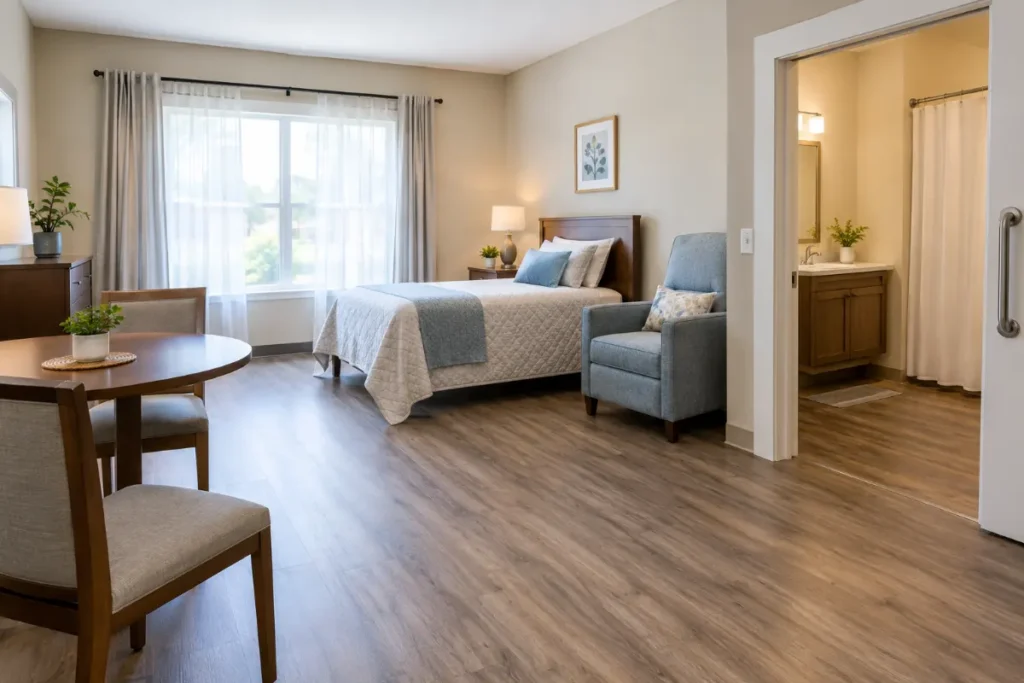
Residents usually live in their own apartment or room and share common areas. According to the National Institute on Aging, services typically include up to three meals a day, help with personal care, help with medications, housekeeping and laundry, 24-hour supervision and on-site staff, and social activities. Most facilities offer a few levels of care, and residents pay more if they need extra services (NIA, content reviewed October 2023).
How that extra help is billed depends on the community. A Place for Mom describes three pricing models (A Place for Mom, August 2026):
- All-inclusive: one monthly fee covers room, board, care and amenities, and it does not change when care needs change, as long as the community can provide that level of care.
- A la carte: a base fee plus charges for what you use, such as medication help, beauty shop visits, parking, pet rent, internet, laundry and some transportation.
- Tiered: set price levels by the amount of help needed; a lower tier might cover help with three daily activities, a higher one five or more.
The level is usually set by an assessment. A Place for Mom’s senior living advisor notes that a nurse typically assesses a new resident at move-in and again about 30 days later, and that the result determines the care fee (A Place for Mom). The same source says most states require communities to disclose fees, services and the residency agreement in writing before or at admission, although the rules vary by state.
Extra fees on top of the base rate
| Charge | How it is billed | Typical amount | Source |
|---|---|---|---|
| Community or move-in fee | Once, at move-in | $1,000 – $5,000 | The Senior List; Caring.com |
| Care services (level of care) | Monthly, on top of rent | From about $150, rising with the help needed | The Senior List |
| Therapy or medication management | Monthly add-on | Several hundred dollars each | The Senior List |
| Second person in the same apartment | Monthly | About $1,200 (national median) | A Place for Mom |
| One-bedroom instead of a studio | Monthly | Often $900 – $1,200 more | A Place for Mom |
| Memory care instead of standard assisted living | Monthly | $6,690 – $8,019 median, against $5,419 – $6,313 | A Place for Mom; SeniorLiving.org |
| Yearly rate increase | Each year | 3% – 5% | The Senior List; A Place for Mom |
Caring.com reports that about 61% of assisted living communities charge a community fee, a one-time payment toward the setup of a new resident, administration and upkeep (Caring.com). The Senior List notes that some communities let you pay the move-in fee upfront or spread it across monthly payments (The Senior List).
Memory care costs more because of higher staffing levels, specialized dementia training and enhanced safety features (A Place for Mom). SeniorLiving.org puts the premium at typically 15% to 25% over assisted living (SeniorLiving.org).
For couples, SeniorLiving.org gives a June 2026 median of $6,259 a month for a private one-bedroom apartment in assisted living; couples usually do not pay double, but they do pay for the second person’s meals and care (SeniorLiving.org).
Assisted living vs. home care vs. nursing home
| Type of care | CareScout (2025) | A Place for Mom (2026 report) | SeniorLiving.org (2026) |
|---|---|---|---|
| Assisted living | $6,200 a month | $5,419 a month | $6,313 a month |
| Memory care | — | $6,690 a month | $8,019 a month |
| Independent living (no hands-on care) | — | $3,200 a month | — |
| Home care, per hour | $35 | $34 | — |
| Home care, per month | $6,673 at 44 hours a week | $2,944 at 20 hours a week | — |
| Adult day health care | $95 a day ($2,058 a month) | — | — |
| Nursing home, semi-private room | $9,581 a month | — | $9,842 a month |
| Nursing home, private room | $10,798 a month | — | $11,294 a month |
Home care is billed by the hour, so its monthly cost depends entirely on the schedule. CareScout’s monthly figure assumes 44 hours a week, which works out to $80,080 a year (CareScout). A Place for Mom says the most common schedule is about 20 hours a week, or $2,944 a month at its $34 median rate, and that most agencies require at least seven hours a week (A Place for Mom). At 20 hours a week, home care costs less than the assisted living medians; at 44 hours a week, CareScout’s home care figure ($6,673) is above its assisted living median ($6,200).
Our estimate: by CareScout’s 2025 medians, a semi-private nursing home room costs about 55% more than assisted living ($9,581 ÷ $6,200) and a private room about 74% more ($10,798 ÷ $6,200). These are ratios of national medians, not measured price differences in any one place.
A nursing home is not simply a pricier version of assisted living. Assisted living is for people who need help with daily care, but not as much help as a nursing home provides (NIA). Funding differs too: federal Medicaid law requires states to cover nursing facility care, room and board included, while it does not cover room and board in assisted living (KFF). Which setting fits is a question for the person’s doctor or care team.
How people pay for assisted living
Private pay. Most people pay the full cost themselves, from income, savings and other assets (NIA; KFF, March 14, 2025).
Medicare does not pay. Medicare does not cover long-term custodial care, meaning help with daily activities such as dressing, bathing and using the bathroom, whether it is given at home, in an assisted living facility or in a nursing home. Medicare Supplement (Medigap) policies do not cover it either (Medicare.gov). Original Medicare may still cover certain medically necessary services a resident receives, when its usual coverage rules are met (SeniorLiving.org).
Medicaid waivers. Federal law bars Medicaid from paying assisted living room and board, but states can pay for the care. In KFF’s 2024 survey of state Medicaid programs, 41 of the 47 states that responded cover home care services for eligible assisted living residents, most often through 1915(c) home and community-based services waivers (32 states), and 34 cover personal care. Only 10 states require assisted living facilities to accept new residents covered by Medicaid. The National Center for Assisted Living estimates Medicaid pays for daily services for about 200,000 residents, roughly one in five (KFF). Waivers can be limited to certain areas and target groups (Medicaid.gov), and eligibility, enrollment limits and waitlists vary by state (SeniorLiving.org). Your state Medicaid agency has the rules that apply to you.
Long-term care insurance. Some policies partly cover assisted living (NIA). Policies commonly require that the person need help with at least two activities of daily living, though the qualifications vary by policy (SeniorLiving.org). For tax purposes, the IRS treats someone as chronically ill when a licensed health care practitioner certifies that they cannot do at least two of six daily activities (eating, toileting, transferring, bathing, dressing, continence) without substantial help for at least 90 days, or need substantial supervision because of severe cognitive impairment (IRS Publication 502). Check the benefit trigger and limits in the policy itself.
VA Aid and Attendance. Veterans and survivors who receive a VA pension and need help with daily activities such as bathing, feeding and dressing can get an Aid and Attendance payment added to it (VA, updated May 8, 2026). The pension pays the difference between your income for VA purposes and a yearly limit: from December 1, 2025, $29,093 for a veteran with no dependents who qualifies for Aid and Attendance, and $34,488 with one dependent. Unreimbursed medical expenses can reduce countable income, and the net worth limit through November 30, 2026, is $163,699 (VA pension rates, updated December 18, 2025).
Life insurance. LongTermCare.gov, run by the federal Administration for Community Living, lists four ways a policy can help: combination life and long-term care products, accelerated death benefits, life settlements and viatical settlements. Accelerated benefits are typically capped at 50% of the death benefit, and whatever you take now is subtracted from what your beneficiaries receive. A life settlement sells the policy for cash and is usually only available to women 74 and older and men 70 and older. Using these options may affect Medicaid eligibility (ACL, LongTermCare.gov, archived copy of September 5, 2026; the live page blocks automated access).
Taxes. Amounts paid for qualified long-term care services for a chronically ill person, provided under a plan of care prescribed by a licensed practitioner, count as medical expenses. Medical expenses are deductible only above 7.5% of adjusted gross income and only if you itemize (IRS Publication 502, for 2025 returns). A tax professional can tell you how much of a particular bill qualifies.
Free help. The Eldercare Locator, a public service of the Administration for Community Living, connects you to local services at 1-800-677-1116 (Eldercare Locator). For Medicare questions, your State Health Insurance Assistance Program offers one-on-one counseling from an unbiased source (SHIP).
How to keep the bill down
- Compare totals, not base rates. Ask each community for a care assessment and a written monthly total; The Senior List says an assessment is the only way to predict the full charges (The Senior List).
- Ask for the asking rate and then for the rate new residents are actually paying. In March 2026, initial rates for new assisted living residents averaged 7.3% ($515) below asking rates (NIC).
- Consider a studio. A one-bedroom often costs $900 to $1,200 a month more (A Place for Mom).
- Look a little further out. Communities in large metro areas or high cost-of-living areas are often more expensive (A Place for Mom), and they tend to get cheaper the further they are from major cities (The Senior List).
- For couples, ask whether there is a couple’s discount and how the second-person fee is set.
- Check Medicaid waiver and VA eligibility early. Waivers can have enrollment limits and waitlists (SeniorLiving.org), and VA reviews asset transfers made in the 3 years before a pension claim (VA).
Questions to ask before you sign
- Is the monthly price all-inclusive? If not, what does the base rate include, and what does each add-on cost?
- Are there pricing tiers for levels of care? How is the level assessed, how often is it reassessed, and what happens if care needs change?
- Is there a community or move-in fee? How much is it, is any of it refundable, and can it be paid over time?
- Does the price go up every year, and by how much?
- Does the community accept Medicaid waiver payments or residents who run out of money? What happens if the family can no longer pay?
- How many care staff are there per resident, what training do they have, and how often do key staff turn over?
- How do residents get to medical appointments, and is there a secure unit for people with dementia if it is needed later?
These questions come from A Place for Mom’s cost checklist (August 2026), SeniorLiving.org’s touring list (September 2026) and the National Institute on Aging’s guide to choosing a facility (NIA, content reviewed October 2023), which also suggests a second visit without calling ahead and reading the contract again before signing.
More senior care cost guides
- Nursing Home Cost in 2026: Per Day, Month and Year by State
- Stair Lift Cost in 2026: Straight vs Curved, Installed
- Walk-In Tub Cost in 2026: Prices, Installation and What Medicare Pays
Sources
- CareScout, Cost of Care Survey, 2025 data (survey conducted July–November 2025); national and state figures read in October 2026.
- Medicare.gov, Long-term care.
- Medicaid.gov, Home & Community-Based Services 1915(c).
- KFF, What Services Does Medicaid Cover in Assisted Living Facilities?, March 14, 2025.
- U.S. Department of Veterans Affairs, Aid and Attendance benefits and Housebound allowance, updated May 8, 2026, and Current pension rates for Veterans, updated December 18, 2025.
- Administration for Community Living, LongTermCare.gov, Using Life Insurance to Pay for Long-Term Care, archived copy of September 5, 2026.
- Internal Revenue Service, Publication 502, Medical and Dental Expenses, for 2025 returns.
- National Institute on Aging, Long-Term Care Facilities: Assisted Living, Nursing Homes, and Other Residential Care and How To Choose a Nursing Home or Other Long-Term Care Facility, both content reviewed October 12, 2023.
- Administration for Community Living, Eldercare Locator; SHIP Technical Assistance Center, State Health Insurance Assistance Program.
- National Investment Center for Seniors Housing & Care, Independent Living Rate Growth Moderates, While Assisted Living Accelerates, June 15, 2026.
- A Place for Mom, 2026 Costs of Long-Term Care and Senior Living, updated February 20, 2026, and How much does assisted living cost? A state-by-state guide, distributed by Stacker, August 3, 2026.
- SeniorLiving.org, How Much Does Assisted Living Cost?, September 4, 2026; Memory Care Costs in 2026, July 28, 2026; Nursing Home Costs in 2026, June 30, 2026.
- The Senior List, How Much Does Assisted Living Cost?, May 29, 2026.
- Caring.com, What Is a Community Fee for Assisted Living?, updated September 17, 2025.