$400 – $3,000 per windowThat is the typical energy efficient windows cost in 2026, installed: HomeGuide puts energy efficient windows (double or triple glazing, low-E coatings, gas fills) at $400 to $3,000 each, and This Old House at about $400 to $900 for most windows. Ten windows land between $4,000 and $30,000 by HomeGuide’s figures. The efficiency upgrades themselves are a small slice of that bill; the payback on them depends almost entirely on what you are replacing and where you live.
This guide is about the efficiency part of the price: what low-E coatings, argon fills and a third pane add, what ENERGY STAR requires in your climate, how much energy the federal models say you will save, and how long the extra money takes to come back. For basic prices by frame material and window style, see our guide to window replacement cost.
Energy efficient windows cost by glazing
| Glazing | HomeGuide | Fixr | This Old House | Forbes Home |
|---|---|---|---|---|
| Single-pane (for comparison) | — | $200 – $650 | — | $440 average |
| Double-pane, standard | $400 – $2,000 | $450 – $2,000 | $234 – $1,224 (average $900) | $815 average |
| Double-pane with low-E coating | $450 – $2,000 | $300 – $1,100 (low-E glass) | — | — |
| Triple-pane | $450 – $3,000 | $1,000 – $4,000 | $400 – $3,000 (average $1,000) | $1,300 average |
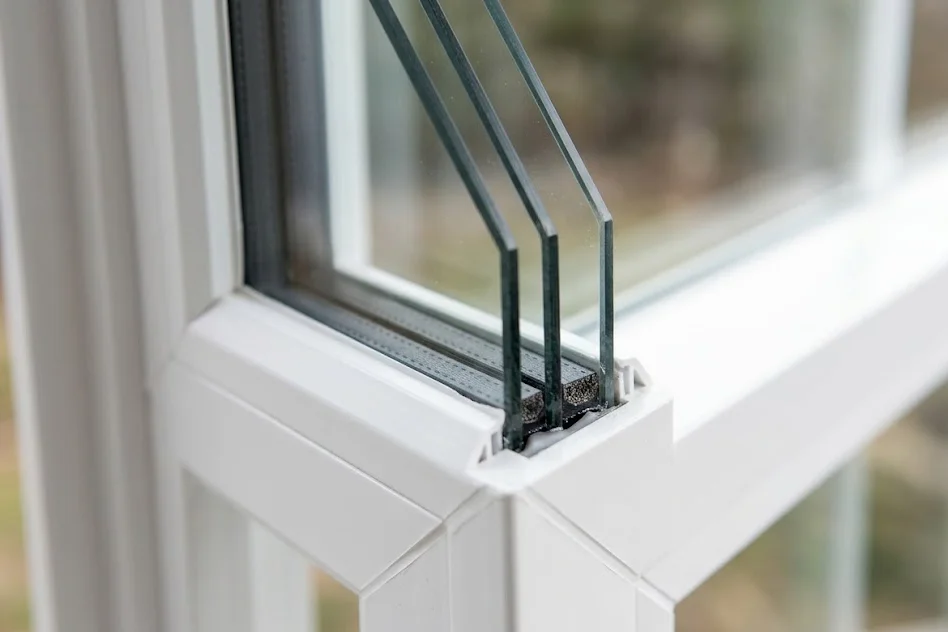
All four guides agree that a third pane costs more, but not by how much. HomeGuide starts triple-pane only $50 above double-pane, and This Old House’s averages are $100 apart; Fixr starts triple-pane at $1,000, more than twice its double-pane floor, and Forbes Home’s triple-pane average is about 60% above its double-pane one. Fixr prices low-E as a glass type without saying how many panes, which is why its range sits below its own double-pane figure. Read the low-E row as “the coating does not move the price much” rather than as a precise quote.
For a whole house, HomeGuide prices energy efficient windows at $4,000 to $30,000 for 10 windows and $8,000 to $60,000 for 20 (HomeGuide, September 8, 2025). The window unit itself is 65% to 75% of a typical replacement bill and labor the other 25% to 35% (HomeGuide, February 5, 2026).
Estimate your energy efficient windows cost
Our estimate: the published ranges above multiplied out for your inputs. Not a quote. Installed ranges per window from HomeGuide (double-pane and low-E: February 2026; triple-pane: January 2026). Extras from HomeGuide (September 2025 and January 2026). Fixr (January 2026) prices triple-pane higher, at $1,000 to $4,000 per window. State adjustment: BLS construction wages (May 2025), applied to an assumed 30% labor share. How we calculate
Our estimate: the calculator multiplies HomeGuide’s installed price per window by the number of windows and adds the extras HomeGuide lists: removal and disposal at $50 to $250 or more per window, trim repainting at $25 to $150 per window, siding repair at $200 to $1,100 (HomeGuide, energy-efficient windows) and a permit at $50 to $300 (HomeGuide, triple-pane windows). The 30% labor share used for the state adjustment is the midpoint of HomeGuide’s 25% to 35%. The result is arithmetic on published ranges, not a quote.
What the efficiency upgrades add to the price
Low-E coating. A low-E coating is a microscopically thin metal or metallic oxide layer on the glass that lowers the U-factor and can be tuned to let in more or less solar heat. The Department of Energy says windows with low-E coatings typically cost about 10% to 15% more than regular windows and cut energy loss by as much as 30% to 50% (U.S. Department of Energy). HomeGuide puts the increase at 10% to 20% (HomeGuide).
Our estimate: applying the Department of Energy’s 10% to 15% premium to HomeGuide’s $400 to $2,000 price for a standard double-pane window gives roughly $40 to $300 extra per window for low-E glass. It is a calculation from two published figures, not a measured price.
Argon or krypton fill. The gap between panes, usually about half an inch, is filled with an inert gas instead of air. Argon is the common choice because it is inexpensive and works well in that gap; krypton insulates better in thinner gaps but costs more (U.S. Department of Energy).
A third pane. Triple-pane glass weighs 25% to 50% more than double-pane, which can mean more installers on larger windows; labor runs $100 to $800 per window against $100 to $500 for double-pane (HomeGuide; HomeGuide). The heavier glass needs a sturdier frame, which also leaves slightly less glass area.
The most detailed public look at what each step costs comes from the Environmental Protection Agency’s research for the current ENERGY STAR window criteria. It is an older analysis (July 2021), based on 2020 quotes for 138 windows without installation, but no newer federal cost study exists:
| Whole-window U-factor | Most common way manufacturers reach it | Retail premium per window (SHGC above 0.25) | Retail premium per window (SHGC 0.25 or below) |
|---|---|---|---|
| 0.32 – 0.35 | One low-E coating, air fill, basic frame | Baseline | $7.50 |
| 0.28 – 0.31 | One low-E coating, argon fill | $6 | $13.50 |
| 0.27 | Same, plus improved frame and spacers | $18 | $25.50 |
| 0.24 – 0.26 | Two low-E coatings (one on the room side), argon fill | $29 | $36.50 |
| 0.22 – 0.23 | Triple-pane, two low-E coatings, argon fill | $54 | $61.50 |
| 0.21 and below | Triple-pane with room-side low-E, argon, non-metal spacers, improved or foamed frame | $66 | $73.50 |
Those premiums are tiny next to the $400 to $3,000 installed prices the cost guides report today, and the EPA itself found that window prices vary widely and that thermal performance was not the main driver of price. Its product-line comparisons showed the same spread: some lines charged more than $120 to add a third pane, while five charged less than $60 (EPA, July 2021). In practice, the brand, frame and installer move your quote far more than the glass package does.
What ENERGY STAR requires in your climate zone
ENERGY STAR does not certify a technology; it certifies performance. A window qualifies when its ratings from the National Fenestration Rating Council (NFRC) meet the limits for one of four U.S. climate zones. The current criteria, Version 7.0, took effect on October 23, 2023 (ENERGY STAR).
| ENERGY STAR zone | U-factor | Solar heat gain coefficient (SHGC) |
|---|---|---|
| Northern | 0.22 or lower | 0.17 or higher |
| Northern, alternative | 0.23 or 0.24 | 0.35 or higher |
| Northern, alternative | 0.25 or 0.26 | 0.40 or higher |
| North-Central | 0.25 or lower | 0.40 or lower |
| South-Central | 0.28 or lower | 0.23 or lower |
| Southern | 0.32 or lower | 0.23 or lower |
Read the table with the EPA cost research above and the price logic becomes clear. A Southern-zone window at 0.32 can be a double-pane unit with one low-E coating; South-Central’s 0.28 typically means adding argon; North-Central’s 0.25 usually takes a second, room-side low-E coating; and the Northern zone’s 0.22 is where triple-pane becomes the most common route. The Northern alternatives let a double-pane window with a higher solar gain qualify, because letting in more winter sun offsets a slightly higher U-factor in a cold climate (EPA, July 2021).
So “ENERGY STAR” on a quote in Minnesota and on one in Florida describes two different windows. Ask which zone the window is certified for and check it against yours with ENERGY STAR’s climate zone finder.
How to read the NFRC label
Every certified window carries an NFRC label, and ENERGY STAR uses those ratings to decide which products qualify. The numbers to compare between quotes (NFRC Consumer Guide to Windows):
- U-factor (top left): how much heat escapes through the whole window. Typical range 0.10 to 2.00; lower is better, and it matters most in cold climates.
- Solar heat gain coefficient (top right): how much of the sun’s heat gets in, from 0 to 1. Lower cuts cooling bills in hot climates.
- Visible transmittance: how much daylight gets through, from 0 to 1. Higher means brighter rooms.
- Air leakage (optional): a rating above 0.3 rules a window out of ENERGY STAR.
- Condensation resistance (optional): from 1 to 100; higher means less moisture on the inside glass, which matters most in cold climates.
Compare whole-unit ratings, not center-of-glass figures: the whole-unit numbers include the frame and reflect real performance more accurately (U.S. Department of Energy).
How much energy efficient windows save
Heat gain and loss through windows account for 25% to 30% of the energy a home uses for heating and cooling (U.S. Department of Energy). ENERGY STAR’s modeled savings for replacing every window in a typical home:
| ENERGY STAR zone | Replacing single-pane clear windows | Replacing double-pane clear windows |
|---|---|---|
| Northern | $568 a year (12%) | $282 a year (6%) |
| North-Central | $493 a year (11%) | $253 a year (6%) |
| South-Central | $547 a year (12%) | $336 a year (7%) |
| Southern | $563 a year (12%) | $373 a year (8%) |
The headline ENERGY STAR figure is “up to 13%” off the energy bill when replacing single-pane windows. Some cost guides promise far more: HomeGuide says energy efficient windows save 20% to 50% compared with standard windows (HomeGuide), and in a This Old House survey of homeowners who replaced windows for efficiency, nearly half reported saving at least $50 a month (This Old House, April 2026). Those are self-reported or unexplained figures. We use the federal model, which states its assumptions, for every calculation below.
The real payback
There are two very different questions here, and they have very different answers.
1. Your windows need replacing anyway. Is the ENERGY STAR version worth the extra? Usually yes. When the EPA set the current criteria, it calculated how long the price premium of a certified window takes to pay back for a whole home of about 24 windows:
| ENERGY STAR zone | Savings vs. a typical market window (U-factor 0.35) | Payback of the premium | Savings vs. a code-minimum window (U-factor 0.30) | Payback of the premium |
|---|---|---|---|---|
| Northern | $107 a year | 12.0 years | $67 a year | 17.0 years |
| North-Central | $76 a year | 9.0 years | $39 a year | 14.0 years |
| South-Central | $67 a year | 4.8 years | $20 a year | 9.0 years |
| Southern | $51 a year | 3.5 years | — | — |
2. Your windows work. Will replacing them pay for itself in energy savings? Rarely. The whole project, not just the premium, has to be paid back.
Our estimate: ENERGY STAR’s model home has about 24 windows (357 square feet of glass at 15 square feet per window, per the EPA). At HomeGuide’s $450 to $2,000 for a double-pane low-E window, that is $10,800 to $48,000. Divided by ENERGY STAR’s savings of $493 to $568 a year for replacing single-pane windows, simple payback is about 19 to 97 years. Replacing double-pane clear windows, which saves $253 to $373 a year, takes about 29 to 190 years. This ignores energy price changes, interest and resale value; it is our arithmetic, not a measured result.
HomeGuide expects windows to last 15 to 30 years (HomeGuide), so only the cheapest single-pane replacements come close to paying for themselves on energy alone. The better reasons to replace are rot, failed seals, sashes that will not open, comfort and noise. If you replace for those reasons, buy the efficient version: that is where the payback is short.
Cheaper ways to cut window energy loss
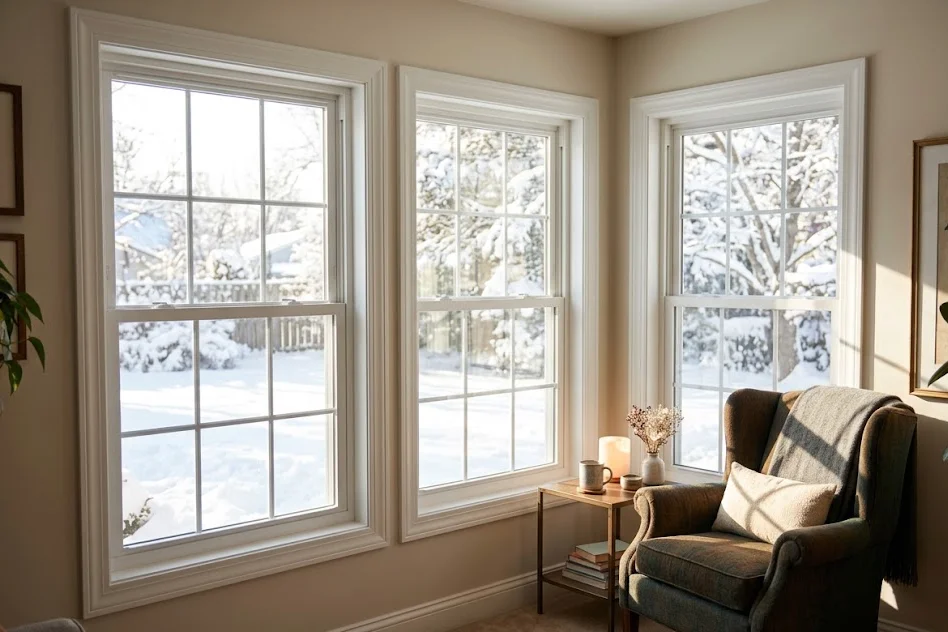
If your windows are in good condition, the Department of Energy says improving them may be the most cost-effective option: check for air leaks, caulk and weatherstrip, add storm windows or panels, solar control film, insulating window coverings or exterior shading (U.S. Department of Energy).
Low-E storm windows are the strongest of those options on paper. The EPA estimates that ENERGY STAR certified storm windows fitted over single-pane clear windows save about $350 a year on heating and cooling, about 10%, and pay back their extra cost in about three years (ENERGY STAR). Storm windows cost $150 to $400 each installed (HomeGuide), and weatherstripping $5 to $10 per window (HomeGuide).
Windows are only one part of the envelope. If the attic is under-insulated, that money may go further there; see our guide to attic insulation cost.
Tax credits and rebates in 2026
There is no federal tax credit for windows installed in 2026. The Energy Efficient Home Improvement Credit (section 25C) paid 30% of the cost, up to $600 a year, for exterior windows and skylights that met ENERGY STAR Most Efficient requirements, but it covers only property placed in service through December 31, 2025 (IRS, page last reviewed April 28, 2026). The IRS confirmed in August 2025 that the credit “will not be allowed for any property placed in service after December 31, 2025” under the law signed on July 4, 2025 (IRS, FS-2025-05).
Some pages have not caught up. The ENERGY STAR windows page still tells shoppers to claim federal tax credits, and HomeGuide’s energy-efficient windows guide still describes the $600 credit as current. If a salesperson builds a federal credit into the price of a 2026 installation, ask to see it in writing.
Utility and state programs are separate and some still pay for efficient windows. Search by ZIP code in the Database of State Incentives for Renewables & Efficiency (DSIRE), run by N.C. State University, and in ENERGY STAR’s rebate finder, and ask your utility directly before you sign.
How to keep the bill down
- Buy to your climate zone, not to the highest spec. Triple-pane is the common route to the Northern zone’s 0.22 U-factor; in the Southern zone a double-pane window with one low-E coating can qualify.
- Compare quotes on the NFRC numbers. Two windows with the same U-factor and SHGC perform the same, whatever the glass package is called.
- Replace when the windows are failing, and fix them while they are not. Storm windows and weatherstripping cost a fraction of new windows.
- Do the whole house in one visit if you are replacing anyway. Window units cost less when bought in bulk.
- Check for utility rebates before you order. Many utilities offer incentives for ENERGY STAR certified windows (ENERGY STAR), and the terms are set by each program.
Questions to ask before you sign
- What are the whole-window U-factor, SHGC and air leakage on the NFRC label of each window you are quoting?
- Which ENERGY STAR climate zone is this window certified for, and is it mine?
- How much would the same window cost without the low-E coating, the argon fill or the third pane? Show me the difference per window.
- Are you installing to the manufacturer’s instructions, and does the warranty require a certified installer?
- Is any rebate or tax credit included in this price, and where is it in writing?
Sources
- ENERGY STAR (U.S. EPA), Residential Windows, Doors, & Skylights, Version 7.0 criteria effective October 23, 2023, with savings estimates of October 2023; Key Product Criteria; Methodology for ENERGY STAR Savings Estimates for Windows; Storm Windows.
- U.S. EPA, ENERGY STAR Windows, Doors, and Skylights Version 7.0 Criteria Analysis Report, July 2021 (older analysis).
- U.S. EPA, Response to Comments on the Draft 2 Specification Revision, Version 7, released with the Final Draft in July 2022 (older analysis).
- U.S. Department of Energy, Energy Saver, Window Types and Technologies and Update or Replace Windows. Both pages have been removed from energy.gov; the links are archived copies of June 29, 2026 and January 1, 2026.
- National Fenestration Rating Council, NFRC Consumer Guide to Windows: Window Ratings.
- Internal Revenue Service, Energy Efficient Home Improvement Credit, last reviewed April 28, 2026; FS-2025-05, August 21, 2025.
- N.C. Clean Energy Technology Center, Database of State Incentives for Renewables & Efficiency.
- HomeGuide, Energy-Efficient Windows Cost, September 8, 2025; Double-Pane Windows Cost, February 5, 2026; Triple-Pane Windows Cost, January 27, 2026; Window Replacement Cost, February 5, 2026.
- Fixr, How Much Does Window Replacement Cost?, updated January 21, 2026.
- This Old House, How Much Do Energy-Efficient Windows Cost?, updated April 24, 2026; How Much Do Double-Pane Windows Cost? and How Much Do Triple-Pane Windows Cost?, both updated June 23, 2026.
- Forbes Home, How Much Does Window Replacement Cost?, audited May 20, 2025.