$1,400 – $5,600That is the typical ductwork replacement cost in 2026 for a whole house, removal of the old ducts and installation of the new ones included. Priced by length, replacement runs $25 to $55 per linear foot, or $270 to $500 per duct run. Ducts in a basement sit at the low end; ducts in a tight attic or crawl space push the price up. That range is from HomeGuide (December 2025); Fixr (August 2025) quotes a much wider $1,856 to $17,149 for replacement, because it assumes a 2,500 sq ft home with 275 feet of duct.
Before you pay for new ducts, it is worth knowing whether yours need replacing at all. Leaks and loose joints can often be sealed for less than new ducts cost, and duct cleaning is a separate service that the EPA says has never been shown to prevent health problems. The figures below show what each option costs and which extra lines tend to appear on the quote.
Ductwork replacement cost by house size
| Home size | Typical cost to replace |
|---|---|
| 1,000 – 1,500 sq ft | $1,400 – $3,400 |
| 1,500 – 2,000 sq ft | $2,100 – $4,500 |
| 2,000 – 2,500 sq ft | $2,800 – $5,600 |
| 2,500 – 3,000 sq ft | $3,500 – $6,700 |
| 3,000 – 3,500 sq ft | $4,200 – $7,800 |
| 3,500 – 4,000 sq ft | $4,900 – $9,000 |
The guides disagree a lot on the total. Fixr puts the cost to replace ductwork at $1,856 to $17,149, and its figures for installing ductwork run from $689 to $8,232 for a 1,200 sq ft house up to $2,009 to $24,008 for a 3,500 sq ft house. Its separate repair guide gives a narrower $3,000 to $6,000 as the national average for new ducts (Fixr). Fixr bases its main range on 275 linear feet of duct, while HomeGuide says the average home has about 100 feet, which explains much of the gap. Ask your contractor how many feet of duct your quote covers.
HomeGuide puts the national average at $3,500, with reported jobs running from $1,000 to $8,000, based on 399 project costs from its members. Most replacements take 1 to 2 days, and up to 4 days for larger homes or when walls and ceilings have to be opened and repaired (HomeGuide).
A home that has never had ducts costs more: a new duct system retrofitted into an existing house runs $40 to $65 per linear foot, or $2,400 to $6,600 in total, because the plenum, fittings, dampers and register boots all have to be added (HomeGuide).
Cost per linear foot and by duct type
Residential replacement costs $25 to $55 per linear foot to tear out the old ducts and install new ones, and the average home has about 100 linear feet of ductwork (HomeGuide). Fixr breaks the price down by duct type, and Homewyse prices a basic new installation:
| Job and duct type | HomeGuide | Fixr | Homewyse |
|---|---|---|---|
| Replacement, typical residential | $25 – $55 | — | — |
| Replacement, galvanized sheet metal | — | $21.38 – $62.36 | — |
| Replacement, galvanized spiral | — | $9.06 – $37.14 | — |
| Replacement, flexible insulated | — | $6.75 – $34.19 | — |
| Replacement, flexible uninsulated | — | $6.95 – $28.95 | — |
| New ducts, retrofit into a home without them | $40 – $65 | $5.22 – $58.95 (lowest flex to highest sheet metal) | $15.90 – $19.06 (basic install) |
Our estimate: across the three guides, installed replacement prices run from about $7 to $62 per linear foot, with HomeGuide’s $25 to $55 in the middle. We have not averaged them; the spread mostly reflects duct type, access and what each guide includes. This range is our reading of the table, not a measured figure. Homewyse adds that general contractor supervision adds 13% to 22% on top of its figure (Homewyse).
Our estimate: 100 linear feet × $25 to $55 per foot = $2,500 to $5,500 for an average home. This is our own multiplication of HomeGuide’s per-foot price and average duct length, not a measured figure; real homes vary widely in how much duct they have.
The material itself is a small part of that price. This is what the duct costs before installation and contractor markup:
| Duct type | Material per linear foot | Strengths and weaknesses |
|---|---|---|
| Flexible, non-insulated | $1 – $3 | Light, fits tight spaces; prone to tears, pests and moisture; shortest lifespan |
| Flexible, insulated | $2 – $4 | Made for unconditioned spaces; can grow mold if it gets wet |
| Fiberglass duct board | $4 – $6 | Needs no added insulation; does not tolerate moisture |
| Sheet metal | $7 – $13 | Rigid, mold-resistant, long lifespan; best with outside insulation |
Our estimate: for 100 feet of duct, the material comes to about $100 to $300 in non-insulated flex and $700 to $1,300 in sheet metal (100 × HomeGuide’s per-foot material prices). This is our calculation, not a quoted price, and it leaves out fittings, insulation and labor, which make up most of the bill.
Homewyse’s September 2026 estimate points the same way: for a 25-foot run it prices the insulated flexible duct, fittings and register at $72 to $84 and the basic labor at $296 to $359 (Homewyse).
Cheap flex duct is not always the bargain it looks like. ENERGY STAR lists tangled or kinked flexible ducts as a sign of a poorly performing system (ENERGY STAR), and in a crawl space flex duct only makes sense if the space stays dry and is fully encapsulated; in humid climates rigid metal lasts longer there (HomeGuide).
Estimate your ductwork replacement cost
Use the tables above to estimate your cost. The interactive calculator needs JavaScript.
Attic, crawl space or basement
| Where the ducts run | Typical cost to replace |
|---|---|
| Basement | $1,800 – $3,100 |
| Attic | $2,200 – $5,600 |
| Crawl space | $3,000 – $7,300 |
| Mobile home (under the floor) | $1,000 – $3,300 |
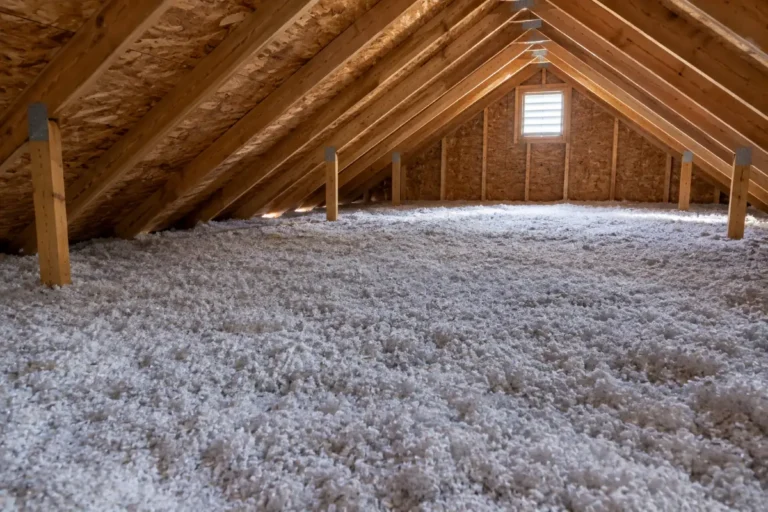
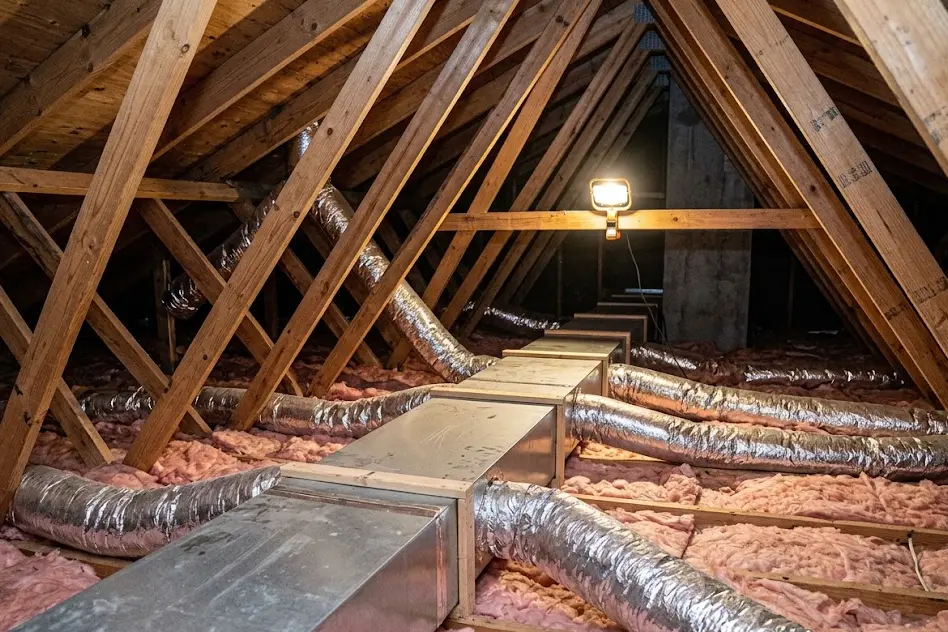
Access drives the difference. Basement ducts are the cheapest to replace because they are easy to reach. In a crawl space, contractors often recommend cleaning, repairing or encapsulating the space before installing new ducts (HomeGuide); we cover that job in our guide to crawl space encapsulation cost. Fixr’s repair prices follow the same order: fixing a typical 30-foot section runs $200 to $800 in a basement, $200 to $850 in an attic, $200 to $900 in a crawl space and $300 to $1,000 inside a wall (Fixr).
Location also matters for your energy bill. The Department of Energy says sealing is even more important when ducts run through an unconditioned attic or vented crawl space, because leaking supply ducts push heated or cooled air out, and leaking return ducts pull unconditioned air in. It recommends that qualified professionals seal and insulate ducts in those spaces (U.S. Department of Energy).
Full replacement or repair?
| Job | HomeGuide | Fixr |
|---|---|---|
| Minor repair (a leak, a vent, a short section) | $200 – $700 | $200 – $1,000 (patch: $150 – $500) |
| Manual sealing with mastic or tape | $400 – $1,900 | $1,000 – $3,000 (all sealing) |
| Aerosol sealing from the inside | $1,300 – $2,700 | $1,000 – $3,000 (all sealing) |
| Replacing one duct run or section | $270 – $500 | $250 – $3,000 |
| Full replacement | $1,400 – $5,600 | $3,000 – $6,000 |
Ductwork lasts 10 to 20 years on average, and ducts often need work when you upgrade to a bigger or more efficient heating and cooling unit. HomeGuide’s guide recommends replacing them alongside a new AC unit when they are moldy, cracked or more than 20 years old (HomeGuide). If the ducts are sound but leaky, sealing is the cheaper fix.
Duct sealing: aerosol vs mastic
According to ENERGY STAR, “about 20 to 30 percent of the air that moves through the duct system is lost due to leaks, holes, and poorly connected ducts” in a typical house (ENERGY STAR). It adds that leaky ducts can reduce heating and cooling efficiency by as much as 20 percent, and that sealing and insulating them can often pay for itself in energy savings (ENERGY STAR).
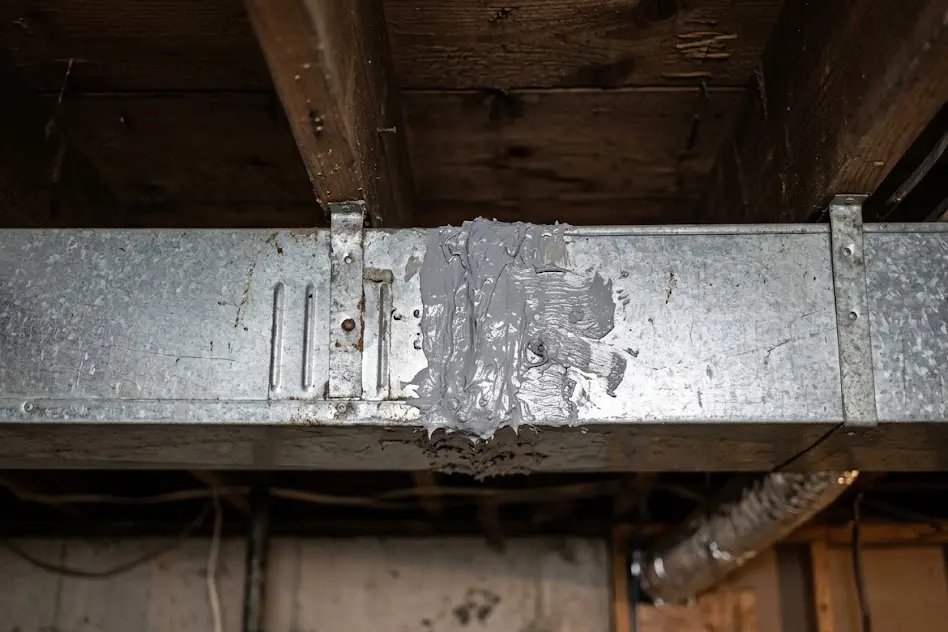
Manual sealing ($400 to $1,900) means applying mastic or metal tape to the outside of the ducts. It is best for large holes and loose connections on ducts you can reach, but hidden ducts may require cutting into walls or ceilings. Aerosol sealing ($1,300 to $2,700) injects a sealant into the ducts that closes cracks up to 5/8 inch wide from the inside, which suits ducts that are hard to reach (HomeGuide). HomeGuide’s separate duct sealing guide prices the job at $1 to $2 per square foot of home, or $1,000 to $6,000 in total, and notes that aerosol sealing will not fix ducts that are disconnected or blocked (HomeGuide, October 2025).
If you seal accessible ducts yourself, the Department of Energy calls mastic the preferred material for seams and joints, with one limit: it will not bridge gaps over ¼ inch, which must first be covered with web-type drywall tape or heat-approved tape (U.S. Department of Energy). ENERGY STAR warns never to use duct tape, because it does not last (ENERGY STAR).
Sealing has a safety side too. Leaky ducts can cause backdrafting, where combustion gases such as carbon monoxide from a gas furnace, water heater or dryer are drawn back into the house (ENERGY STAR). That is why ENERGY STAR asks contractors to run a combustion safety test after the ducts are sealed (ENERGY STAR).
Duct cleaning is not duct replacement
Duct cleaning is a different service from replacement. The EPA says cleaning services typically, but not always, cost $450 to $1,000 per heating and cooling system. It also says duct cleaning “has never been shown to actually prevent health problems,” and that it does not recommend routine cleaning, only cleaning as needed (EPA).
According to the EPA, cleaning is worth considering when there is substantial visible mold inside hard ducts, when ducts are infested with rodents or insects, or when they are clogged with dust and debris that blows out of the supply registers. Two EPA points bear directly on replacement: insulated ducts whose insulation gets wet or moldy cannot be effectively cleaned and should be removed and replaced, and with accessible flex duct it can be cheaper simply to replace it than to clean it (EPA). In either case, the cause of the mold or moisture has to be fixed first, or the problem comes back.
Asbestos in older duct systems
The heating system itself can contain asbestos. The EPA lists oil and coal furnaces with asbestos insulation among the places it may be found (EPA), and it tells duct service providers to check the system for asbestos-containing materials, such as insulation and register boots, before starting work. Those materials should not be disturbed or removed except by specially trained and equipped contractors (EPA).
You cannot tell whether a material contains asbestos by looking at it unless it is labeled, and taking samples yourself is not recommended. Material in good condition that will not be disturbed is best left alone, but tearing out old ducts disturbs it, so repair or removal should be done by a trained and accredited asbestos professional. Federal law does not require that accreditation for work in detached single-family homes, though some states and localities do (EPA). The EPA suggests having a trained and accredited professional inspect for asbestos when you plan work that could disturb building materials, which is what a duct tear-out does.
The extra lines that raise the price
| Work | Typical cost |
|---|---|
| Duct inspection for a replacement quote | $40 – $100 |
| Permit for new ductwork | $50 – $250 |
| Home energy audit | $200 – $500 |
| Adding a vent to existing ductwork | $250 – $500 |
| Mold inspection and testing | $200 – $650 |
| Duct insulation | $800 – $2,000 |
| Drywall repair after opening walls | $300 – $1,500+ |
| Ceiling repair | $300 – $1,200 |
| Moving ductwork to a new route | $25 – $55 per linear foot |
| HVAC mechanic labor | $83 – $151 per hour |
| General contractor supervision | 13% – 22% of the job |
A leakage test is a separate line. A pressure test that checks the ducts for leaks costs $200 to $450, and a full inspection that also covers the furnace and AC unit $150 to $500 (HomeGuide). When ducts run through an attic, crawl space or garage, ENERGY STAR recommends insulation with an R-value of 6 or higher (ENERGY STAR).
Replacing ducts along with the HVAC system
| System | Unit installed | Unit plus new ductwork |
|---|---|---|
| Central air conditioner | $3,300 – $5,900 | $4,700 – $11,500 |
| Furnace | $2,000 – $5,400 | $3,400 – $11,000 |
| Heat pump | $3,800 – $8,200 | $5,200 – $13,800 |
Doing both at once lets the contractor size the ducts for the new equipment. ENERGY STAR notes that a well-designed, sealed duct system may let you downsize to a smaller, less costly heating and cooling unit (ENERGY STAR). Permits for replacing ducts as part of a full system install cost $250 to $1,500 (HomeGuide).
What the labor line pays for
HomeGuide’s per-foot material prices exclude installation and markup, and labor costs rise for rerouting ducts, cutting into floors or ceilings, and working in older homes (HomeGuide). Fixr says HVAC mechanics typically charge $83 to $151 an hour to install ductwork, and Homewyse allows 2.4 hours of basic labor, $296 to $359, for a 25-foot run in easy conditions (Homewyse).
For comparison, the median heating, air conditioning and refrigeration mechanic and installer in the United States earned $29.33 an hour, or $61,010 a year, in May 2025, according to the Bureau of Labor Statistics. That is what the worker earns, not what the company bills per hour.
Signs your ducts need replacing
ENERGY STAR lists these signs of poorly performing ducts (ENERGY STAR):
- High utility bills in both summer and winter.
- Rooms that are hard to heat and cool, or that always feel stuffy.
- Ducts located in an attic, crawl space or garage.
- Tangled or kinked flexible ducts.
Those signs point to leaks, which sealing may fix. The signs that point to replacement are physical damage: collapsed, loose, torn or rusted sections, mold or moisture damage, pest infestations, and ducts that are more than 20 years old when the heating and cooling system is being replaced (HomeGuide). Wet or moldy duct insulation is also a replacement job, according to the EPA.
How to keep the bill down
- Ask for a leakage test before agreeing to a full replacement. If the ducts are sound, sealing costs a fraction of new ductwork.
- Replace only the damaged runs when the rest of the system is in good shape; a single run costs $270 to $500 (HomeGuide).
- Do not pay for duct cleaning to fix leaks or comfort problems. The EPA finds little evidence that cleaning only the ducts improves system efficiency (EPA).
- If you are replacing the furnace, AC or heat pump within a few years, time the duct work to match, so the ducts are sized once for the new equipment.
- Get at least three written, itemized quotes, and check whether inspection, pressure testing, permits and drywall repair are included before comparing totals.
Questions to ask before you sign
- Will you inspect the whole duct system, including the attic and crawl space, and check the supply and return air balance?
- Do my ducts need replacing, or would sealing and insulating them solve the problem?
- Which duct type do you recommend for each location, and will ducts in unconditioned spaces be insulated to R-6 or higher?
- Will you test for leaks after installation and run a combustion safety test on gas or oil appliances?
- Have you checked for asbestos-containing materials, and who will handle them if you find any?
- Does the quote include the permit, removal of the old ducts, and any wall or ceiling repair?
The first, third and fourth questions follow the checklist ENERGY STAR gives for hiring a duct contractor (ENERGY STAR).
Sources
- ENERGY STAR, Duct Sealing, Benefits of Duct Sealing and Hire a Professional Contractor for Duct Improvement Projects.
- U.S. Department of Energy, Energy Saver, Minimizing Energy Losses in Ducts. The page has been removed from energy.gov; the link is an archived copy of June 13, 2026.
- U.S. Environmental Protection Agency, Should You Have the Air Ducts in Your Home Cleaned? (EPA 402-K-97-002).
- U.S. Environmental Protection Agency, Protect Your Family from Exposures to Asbestos and Learn About Asbestos.
- U.S. Bureau of Labor Statistics, Occupational Outlook Handbook: Heating, Air Conditioning, and Refrigeration Mechanics and Installers, pay data for May 2025.
- HomeGuide, Cost to Install or Replace Ductwork, December 2025, and Air Duct Sealing Cost, October 2025.
- Fixr, How Much Does It Cost to Install Ductwork? and Cost to Repair Ductwork, both updated August 29, 2025.
- Homewyse, Cost to Install Ductwork, September 2026.