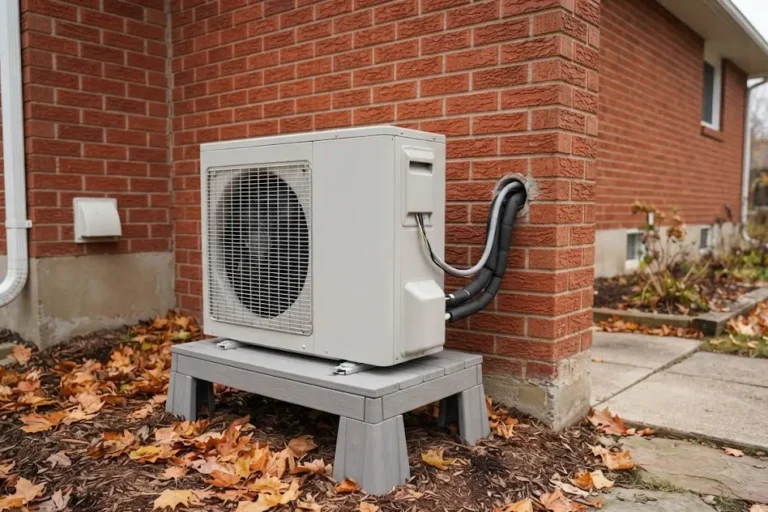
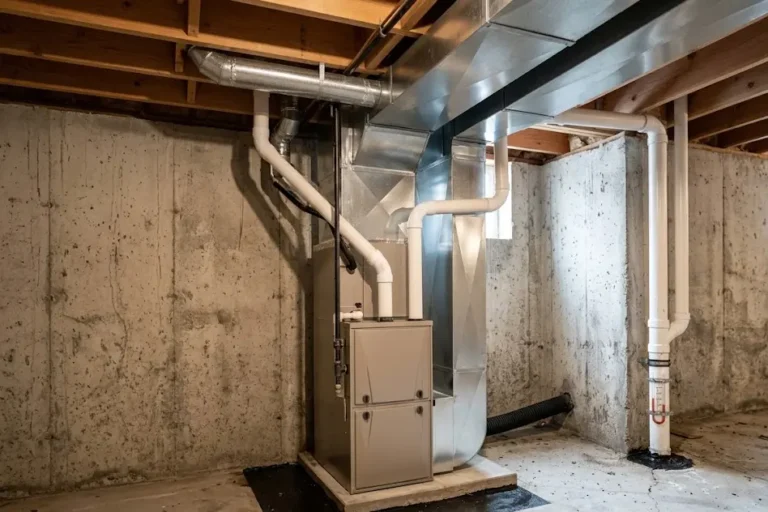
$2,800 – $7,500That is the typical furnace replacement cost in 2026, unit and installation included. HomeGuide puts a standard-efficiency model at $3,500 to $7,500 installed, Today’s Homeowner at $2,800 to $7,000 (about $4,800 on average), and Homewyse prices a basic gas furnace install at $3,168 to $3,769 before permits. A high-efficiency furnace (90% AFUE or more) runs $3,800 to $11,500 installed (HomeGuide). Fuel type, the size of the house, and whether the venting has to change decide where your quote lands.
Our estimate: the headline range runs from the lowest published low ($2,800, Today’s Homeowner) to the highest published high for a standard model ($7,500, HomeGuide). It is a combined range, not a measured figure. The three guides broadly agree; Homewyse sits at the low end because it prices only basic work in easy conditions and leaves out permits and contractor markup.
A furnace usually fails in the coldest week of the year, which is the worst time to shop. If yours is still running, use the time to understand what drives the price. The figures below cover the cost by fuel, by house size and by efficiency, the extra lines that appear on a quote, and the safety point that matters most with any fuel-burning furnace: carbon monoxide.
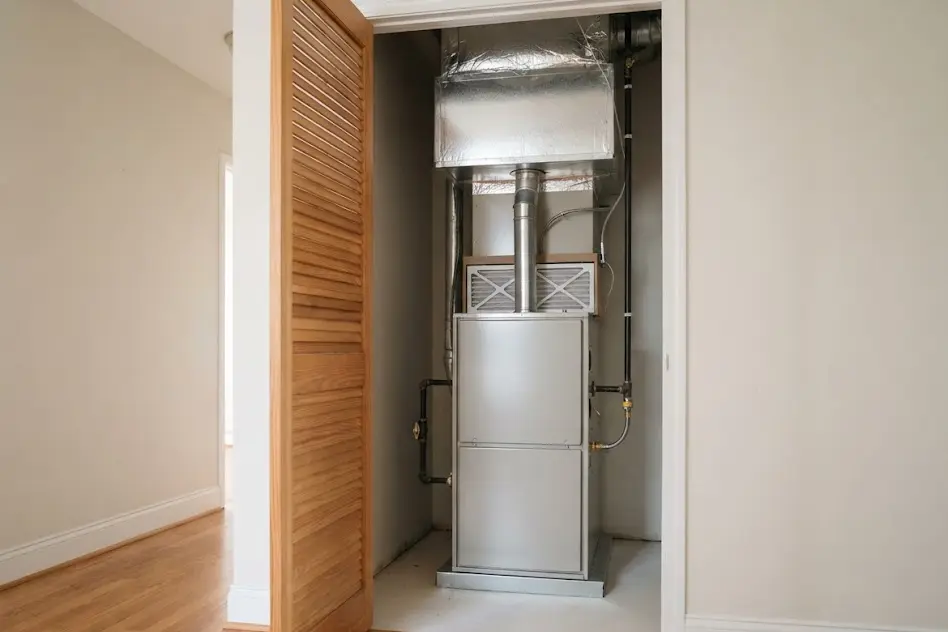
Furnace replacement cost by fuel type
| Fuel | Unit only (HomeGuide) | Installed (HomeGuide) | Replacement installed (Today’s Homeowner) |
|---|---|---|---|
| Electric | $1,000 – $3,500 | $2,500 – $7,000+ | $2,000 – $7,000 |
| Natural gas | $1,500 – $6,500 | $3,000 – $10,000+ | $3,300 – $7,800 |
| Oil | $1,500 – $6,500 | $4,000 – $10,000+ | $6,400 – $9,300 |
| Propane | $1,500 – $6,500 | $3,000 – $12,000+ | Not given |
| Pellet | $2,500 – $12,000 | $4,000 – $17,000 | Not given |
The two guides agree on electric and gas; they differ most on oil, where Today’s Homeowner’s range starts $2,400 higher than HomeGuide’s. For a basic gas furnace swap in easy conditions, Homewyse (September 2026) estimates $3,168 to $3,769 for a 96% AFUE, 120,000 BTU unit with existing ductwork, not counting permits or general contractor markup.
Gas furnaces are the most common heating system in the United States. If the house already has a gas line, the installation stays simple; converting from another fuel typically adds $350 to $2,000 or more for the gas line (HomeGuide).
Electric furnaces cost the least up front and have fewer moving parts, but running costs can be much higher in cold climates. Oil furnaces need an on-site storage tank and regular maintenance, and remain common in northeastern states with limited natural gas. Propane furnaces work like gas models but may need a tank and supply lines set up (HomeGuide).
Switching from one fuel to another on a replacement adds $500 to $2,000 or more for new fuel lines, electrical changes or venting (HomeGuide).
Estimate your furnace replacement cost
Use the tables above to estimate your cost. The interactive calculator needs JavaScript.
Cost by home size and furnace BTUs
| Home size | BTU output needed | Installed (HomeGuide) | Installed (Today’s Homeowner) |
|---|---|---|---|
| 1,000 – 1,500 sq ft | 30,000 – 90,000 | $2,000 – $4,500 | $2,800 – $5,000 |
| 1,500 – 2,500 sq ft | 45,000 – 150,000 | $3,000 – $6,500 | $3,000 – $6,500 |
| 2,500 – 3,500 sq ft | 75,000 – 210,000 | $4,000 – $9,500 | $4,000 – $7,000+ |
| 3,500 sq ft and up | 105,000+ | $5,500 – $10,000+ | $4,750 – $7,000+ (3,000 sq ft and up) |
The two guides line up for mid-size homes; for large homes HomeGuide’s upper figures run well above Today’s Homeowner’s.
The spread in BTUs is wide because climate, insulation, ceiling height and windows all change how much heat a house needs. A professional load calculation accounts for those factors and costs $150 to $500, though some contractors credit it toward the installation (HomeGuide).
The Department of Energy recommends improving the home’s efficiency first, with insulation or better windows, and only then having a heating contractor size the furnace: a tighter house can use a smaller unit, and a properly sized furnace runs most efficiently (U.S. Department of Energy).
Where the money goes
| Item | Typical cost |
|---|---|
| Furnace and materials | $2,000 – $4,000+ |
| Installation labor | $1,500 – $3,500+ |
| Labor rate | $75 – $150+ per hour |
| Removing and disposing of the old furnace | $50 – $200+ |
| Permit | $50 – $300 |
| Sealing minor duct leaks | $200 – $700 |
| Whole-home humidifier | $400 – $1,200 |
Homewyse itemizes a basic gas furnace install (September 2026, national average): the furnace itself $1,611 to $1,880, 10.8 hours of basic labor $1,331 to $1,613, job supplies $175 to $199, equipment $51 to $77, removing the old unit $136 to $164 and debris disposal $85 to $97. It excludes permits and says to add 13% to 22% if a general contractor supervises the job.
A standard replacement takes 4 to 8 hours; a fuel change, major duct work or a hard-to-reach location can stretch it to one or two full days. Cramped crawl spaces and attics can raise the cost by 25% to 50% (HomeGuide).
For context on the labor line, the median annual wage for heating, air conditioning and refrigeration mechanics and installers was $61,010 in May 2025, or $29.33 an hour, according to the U.S. Bureau of Labor Statistics. The billed rate also pays for the truck, tools, licensing, insurance and the permit.
AFUE: what efficiency costs and saves
Furnace efficiency is measured by annual fuel utilization efficiency (AFUE). An AFUE of 90% means 90% of the energy in the fuel becomes heat for the home and the other 10% escapes up the chimney and elsewhere. Older furnaces run at 56% to 70%, while modern ones reach as high as 98.5% (U.S. Department of Energy).
| Furnace | AFUE | Source |
|---|---|---|
| Federal minimum, indoor gas furnace (made before Dec. 18, 2028) | 80% | 10 CFR 430.32 |
| Federal minimum, indoor gas furnace (made on or after Dec. 18, 2028) | 95% | 10 CFR 430.32 |
| Federal minimum, indoor oil furnace | 83% | 10 CFR 430.32 |
| ENERGY STAR gas furnace, U.S. South | 95% or more | ENERGY STAR |
| ENERGY STAR gas furnace, U.S. North | 97% or more | ENERGY STAR |
| ENERGY STAR oil furnace | 87% or more | ENERGY STAR |
ENERGY STAR says certified gas furnaces in the northern half of the country are up to 18% more efficient than baseline models and can save $160 a year in energy costs; in the southern half, up to 16% more efficient and about $60 a year. Certified oil furnaces are up to 4% more efficient and save about $90 a year (ENERGY STAR).
That difference is why the Department of Energy says it usually makes sense to buy the highest-efficiency system in a cold climate, while in milder climates the extra cost of going from 80% to 90% to 95% may be hard to justify (U.S. Department of Energy). A high-efficiency furnace costs $3,800 to $11,500 installed, against $3,500 to $7,500 for a standard one (HomeGuide, April 2025). Today’s Homeowner gives $4,700 to $7,000 for a moderate-efficiency furnace and $6,200 to $11,000 or more for the most efficient models.
Our estimate: using the DOE definition of AFUE, delivering the same amount of heat with a 95% furnace instead of an 80% one takes 80 ÷ 95 = about 84% of the fuel, roughly 16% less. A household spending $1,000 a year on furnace fuel would spend about $840 for the same heat. This is our own arithmetic, not a measured figure: real savings also depend on duct losses, fuel prices and how the system is installed.
Venting changes for a high-efficiency furnace
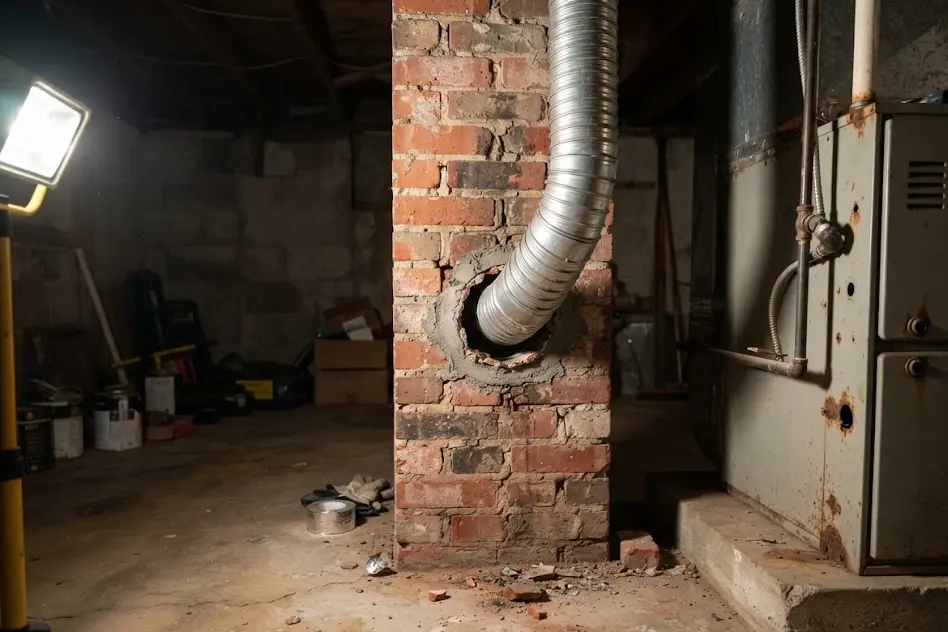
Venting is the line most often missing from a low quote. High-efficiency sealed-combustion furnaces produce an acidic exhaust that is not suitable for old, unlined chimneys, so the exhaust must go out through a new vent or the chimney must be lined (U.S. Department of Energy). PVC vent pipe is used safely on condensing furnaces.
The Department of Energy says a chimney should be relined in two situations. First, when an older furnace is replaced by one of 80% AFUE or more, because these mid-efficiency units are more likely to leave acidic condensation in the chimney. Second, when it is replaced by a 90%+ unit or a heat pump: the furnace stops using the chimney, and a gas water heater left venting alone into it may draft poorly and cause condensation, so the liner should be resized for the water heater, or the water heater vented through the wall (U.S. Department of Energy). If you are also weighing a new water heater, our guide to water heater replacement cost covers its venting lines.
HomeGuide notes that high-efficiency furnaces often need different venting than standard ones, and that vent or duct modifications can add $500 to $2,000 or more to the project (HomeGuide).
Carbon monoxide: the safety side of a new furnace
Gas, propane and oil furnaces burn fuel, and incomplete burning produces carbon monoxide (CO), a colorless, odorless, poisonous gas. The Consumer Product Safety Commission says more than 200 people in the United States die every year from CO produced by non-automotive consumer products, including malfunctioning furnaces, water heaters and other fuel-burning appliances (CPSC). The CDC counts more than 400 deaths a year from unintentional CO poisoning not linked to fires, more than 100,000 emergency department visits and more than 14,000 hospitalizations (CDC).
Both agencies give the same practical advice, and it bears directly on a replacement:
- Have fuel-burning appliances installed by qualified professionals, following the manufacturer’s instructions and local building codes (CPSC).
- Have the heating system inspected and serviced every year, including chimneys and flues for blockages, corrosion and loose connections (CPSC).
- Install battery-operated or battery-backup CO alarms on every level of the home and outside sleeping areas; interconnected alarms are best (CPSC).
- Replace CO detectors following the manufacturer’s instructions or every 5 years (CDC).
- Make sure gas appliances are vented properly (CDC).
Early CO poisoning feels like the flu without the fever: headache, fatigue, shortness of breath, nausea and dizziness. If you suspect it, get outside to fresh air immediately and call the fire department from a neighbor’s home (CPSC). The Department of Energy adds that sealed-combustion furnaces, which take outside air in and exhaust directly outside, avoid the risk of drawing combustion gases into the house, a risk that back drafting creates with non-sealed units (U.S. Department of Energy).
Repair or replace your furnace?
HomeGuide’s rule is to replace a furnace that is more than 15 years old and needs frequent repairs, or when a repair would cost more than half the price of a new one. Warning signs include rising energy bills, rooms that heat unevenly, frequent cycling or loud noises, soot buildup, and a yellow flame instead of a blue one on a gas furnace (HomeGuide).
The Department of Energy singles out old coal burners converted to oil or gas and gas furnaces with pilot lights instead of electronic ignition as prime candidates for replacement (U.S. Department of Energy). HomeGuide puts typical lifespans at 15 to 25 years for gas and oil furnaces, 20 to 30 for electric and 15 to 20 for propane (HomeGuide).
No federal tax credit for 2026 installs
The Energy Efficient Home Improvement Credit covered qualifying natural gas, propane and oil furnaces, but it applies to improvements made through December 31, 2025 (IRS). A furnace installed in 2026 does not qualify. Utility and state rebates are separate programs; ENERGY STAR has a rebate finder by ZIP code on its furnace page.
How to keep the bill down
- Replace before the old furnace fails, so you are not choosing in an emergency.
- Improve insulation and air sealing first; a tighter house may need a smaller furnace.
- Keep the same fuel if it works for you. Fuel changes add $500 to $2,000 or more.
- Match efficiency to your climate. The premium for 95%+ AFUE pays back faster where winters are long.
- Check whether your utility offers a rebate before you buy.
- Compare at least three written quotes for the same size and efficiency.
Questions to ask before you sign
- What BTU size do you recommend, and can I see the load calculation behind it?
- What is the AFUE of the quoted furnace, and is it ENERGY STAR certified for my region?
- Will the venting change? Does the chimney need a liner, and what happens to my water heater’s vent?
- Does the price include removal of the old furnace, the permit and a CO check after installation?
- Will you inspect the ductwork for leaks?
- How long is the equipment warranty, and what does your labor warranty cover?
Sources
- HomeGuide, How much does a new furnace cost?, December 31, 2025.
- Today’s Homeowner, How Much Does Furnace Replacement Cost? (2026), updated September 3, 2025.
- Homewyse, Cost to Install a Gas Furnace, September 2026.
- HomeGuide, High-efficiency furnace cost, April 20, 2025.
- U.S. Department of Energy, Energy Saver, Furnaces and Boilers. The page has been removed from energy.gov; the link is an archived copy of May 31, 2026.
- Electronic Code of Federal Regulations, 10 CFR 430.32, Energy and water conservation standards, up to date as of September 24, 2026.
- ENERGY STAR, Furnaces and Furnaces Key Product Criteria.
- U.S. Consumer Product Safety Commission, Carbon Monoxide Fact Sheet.
- Centers for Disease Control and Prevention, Carbon Monoxide Poisoning Basics, January 12, 2026.
- Internal Revenue Service, Energy Efficient Home Improvement Credit.
- U.S. Bureau of Labor Statistics, Occupational Outlook Handbook: Heating, Air Conditioning, and Refrigeration Mechanics and Installers, pay data for May 2025.