$600 – $3,100That is the typical water heater replacement cost in 2026 for a standard 40- to 50-gallon tank, unit and installation included. Going tankless costs $1,400 to $5,600, and a heat pump water heater $2,000 to $4,600. Other cost guides land in a similar band: Fixr puts a tank at $600 – $2,500 installed. A same-for-same swap sits at the low end; moving the heater or changing fuel pushes the price up.
Most replacements happen in a hurry, when the old tank leaks. If yours is still working, you have time to compare types and quotes. The figures below show what each option costs, what it costs to run, and which extra lines tend to appear on the bill.
Cost by water heater type
| Type | HomeGuide | Fixr | This Old House |
|---|---|---|---|
| Standard tank (40–50 gal) | $600 – $3,100 | $600 – $2,500 | from $1,200 |
| Tankless | $1,400 – $5,600 | $1,000 – $4,000 | about $2,800 on average |
| Hybrid heat pump | $2,000 – $4,600 | $1,200 – $4,600 | $2,500 – $3,500 |
| Indirect (runs off a boiler) | $2,000 – $4,500 | $1,200 – $4,500 | — |
| Solar | $3,000 – $9,000 | $1,700 – $5,500 | $2,000 – $5,500 |
The three guides agree on the order — tank cheapest, solar dearest — but not on the top of each range. HomeGuide’s ceilings are the highest; Fixr’s are lower for tankless and solar. This Old House publishes an overall range of $1,600 to $5,400 but a tank starting price of $1,200, while its own size table below starts at $600, so treat its figures as a rough cross-check. For the unit alone, HomeGuide lists $400 – $2,100 for a tank, $600 – $2,600 for tankless and $1,500 – $3,000 for a heat pump model (HomeGuide).
Water heater replacement cost calculator
Use the tables above to estimate your cost. The interactive calculator needs JavaScript.
Tank water heater cost by size
| Tank size | HomeGuide | Fixr | This Old House |
|---|---|---|---|
| 30 gallons | $500 – $1,900 | $550 – $2,100 | — |
| 40 gallons | $600 – $3,000 | $550 – $2,300 | $600 – $1,200 |
| 50 gallons | $700 – $3,100 | $700 – $2,500 | $700 – $1,800 |
| 65 gallons | $900 – $3,400 | — | — |
| 75 gallons | — | $1,100 – $3,400 | $900 – $2,300 |
| 80 gallons | $1,200 – $4,000 | $1,200 – $3,600 | $1,000 – $3,000 |
The low ends match closely across all three guides; the high ends differ by up to $1,800 for a 40-gallon tank ($1,200 at This Old House against $3,000 at HomeGuide). Ask for the model and warranty behind any quote near the top of these ranges.
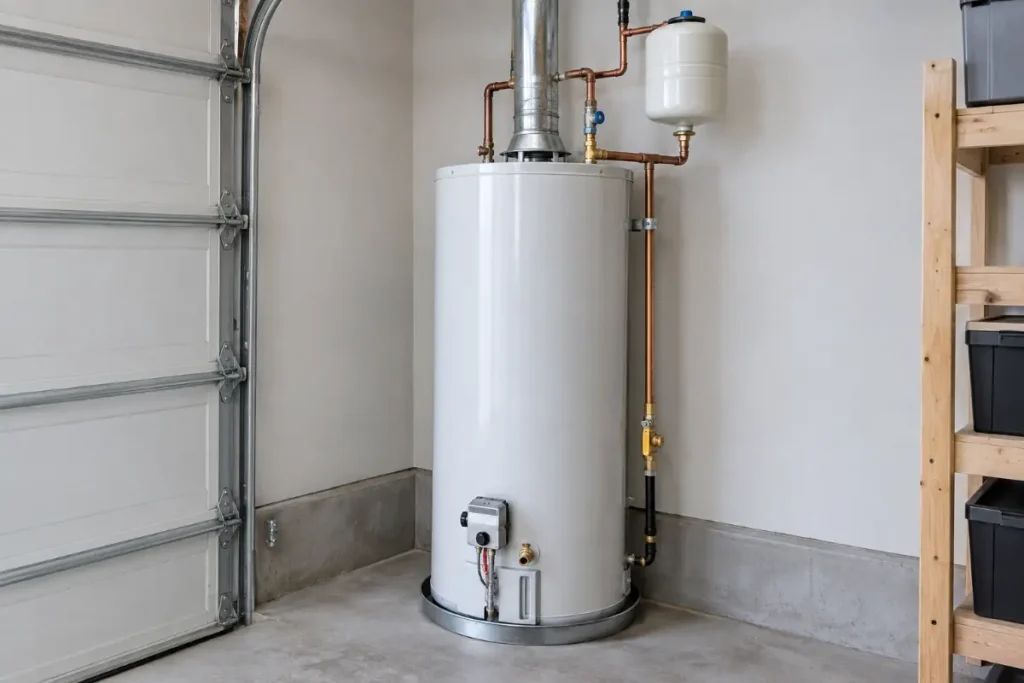
As a rough guide, 1 to 2 people need 23 to 30 gallons, 2 to 3 people 36 to 40, 3 to 4 people 40 to 60, and 5 or more 50 to 80 gallons (HomeGuide). Buying bigger than you need costs more up front and keeps more water hot for nothing.
Tank, tankless or heat pump?
| Tank | Tankless | |
|---|---|---|
| Installed cost | $600 – $3,100 | $1,400 – $5,600 |
| Yearly running cost, gas | $250 – $420 | $220 – $480 |
| Yearly running cost, electric | $530 – $600 | $340 – $540 |
Tank heaters are the cheapest to buy and the simplest to swap, but they keep a full tank hot around the clock. The Department of Energy puts their typical life at 10 to 15 years, against more than 20 for most tankless units (U.S. Department of Energy).
Tankless heaters cost more to install, often because of gas line, venting or electrical upgrades. We break those costs down in our guide to tankless water heater installation cost.
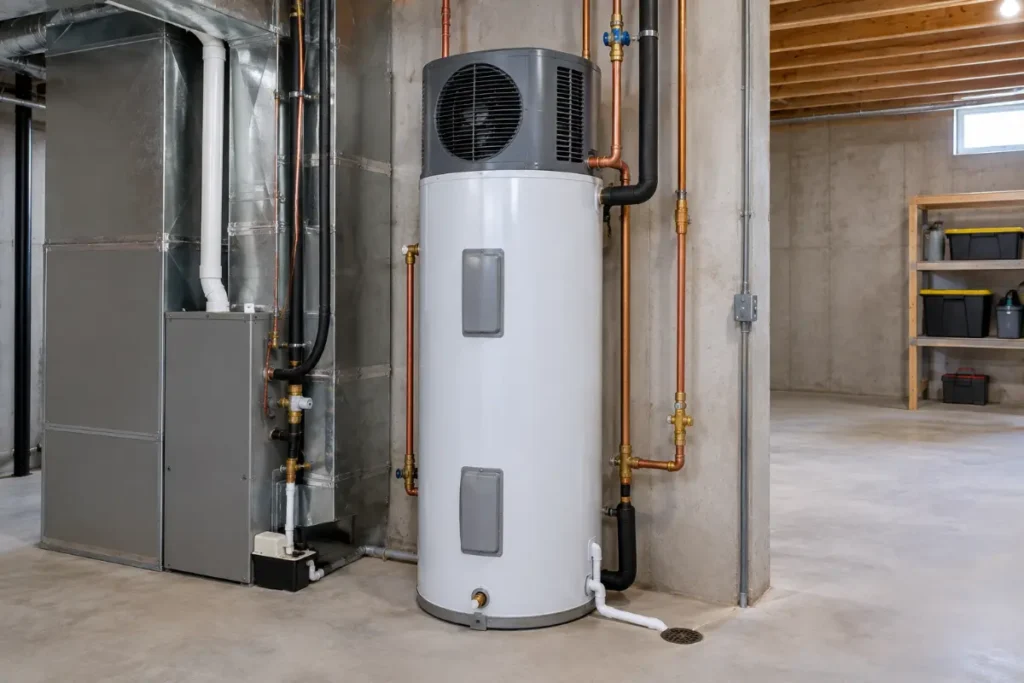
Heat pump water heaters move heat from the surrounding air into the water instead of generating it, which makes them two to three times more energy efficient than a conventional electric water heater. They need a space that stays between 40°F and 90°F all year and at least 1,000 cubic feet of air around them, and they cool the room they are in (U.S. Department of Energy). A garage in a cold climate or a small closet is the wrong place for one.
The extra lines that raise the price
| Work | HomeGuide | Fixr |
|---|---|---|
| Removing and disposing of the old heater | $75 – $500 | $75 – $500 |
| Permit | $50 – $200 | $25 – $1,500 |
| Expansion tank | $100 – $400 | — |
| Bringing plumbing up to code | $75 – $500+ | — |
| Replacing an existing vent | $100 – $600 | — |
| Power vent with its electrical connection | — | $300 – $1,000 |
| Venting a gas heater for the first time | $500 – $1,500 | — |
| New dedicated electrical circuit | $250 – $900 | — |
| Larger gas line | $350 – $2,000 | — |
| Moving the heater to a new location | $500 – $2,500 | — |
| Roughing in utilities (new install, not a replacement) | — | $400 – $1,800 |
Fixr’s permit range is much wider because it covers permits for new gas lines, electrical connections or major plumbing changes, not only a like-for-like swap (Fixr).
Changing fuel is its own line: going from electric to gas costs $400 to $2,000 or more, depending on whether a gas line is already there, and going from gas to electric $250 to $1,000 or more for the new circuit and wiring (HomeGuide). This Old House budgets more for the new gas lines when converting from electric to gas: $1,500 to $2,300 (This Old House).
What the labor line pays for
Labor for a standard tank replacement runs $200 to $1,000, and a like-for-like swap takes a plumber 2 to 6 hours. Switching from a tank to tankless costs $600 to $2,500 in labor alone. For awkward installs, such as a heater squeezed into a closet, expect $125 to $300 per extra labor hour (HomeGuide). Fixr puts labor at $300 to $1,500, or $45 to $200 an hour where plumbers bill hourly (Fixr); This Old House cites $40 to $200 an hour, with most jobs taking 1 to 3 hours (This Old House).
For comparison, the median plumber in the United States earned $30.67 an hour in May 2025, according to the Bureau of Labor Statistics. The billed rate covers far more than the wage: the van and tools, licensing, insurance, the permit and hauling away the old tank.
When to replace instead of repair
A common rule: replace a water heater that is more than 10 years old, or when a repair would cost more than half the price of a new one (HomeGuide). Water pooling under the tank or rust in the hot water are signs the tank itself is failing, and a tank cannot be patched. Replacing it before it bursts is almost always cheaper than cleaning up after it.
No federal tax credit in 2026
Until the end of 2025, the Energy Efficient Home Improvement Credit paid up to $2,000 a year for a qualifying heat pump water heater and up to $600 for a qualifying gas one. It does not apply to equipment placed in service after December 31, 2025 (IRS). Utility and state rebates are separate programs and some still run; check with your utility before you buy.
How to keep the bill down
- Replace on your schedule, not in an emergency. After-hours and emergency calls cost extra.
- Keep the same fuel and the same spot if they work for you. Fuel changes and relocations are the most expensive extras.
- Size the heater to your household, not to the biggest tank that fits.
- Ask whether removal of the old tank, the permit and the expansion tank are included before comparing totals.
- Get at least two written quotes. A licensed plumber pulling the permit protects you if the gas or electrical work is inspected later.
Questions to ask before you sign
- What size and first-hour rating do you recommend for my household, and why?
- Does the quote include removal of the old heater, the permit, an expansion tank and any code corrections?
- Will my current vent, gas line or circuit work with the new unit?
- For a heat pump model: is my space warm enough and large enough for it to work efficiently?
- What is the warranty on the tank, and what is your warranty on the installation?
More plumbing cost guides
- Septic Tank Pumping Cost in 2026: Prices by Tank Size
- Septic Tank Replacement Cost in 2026: Tank, Drain Field and Full System
- Sewer Line Replacement Cost in 2026: Per Foot, Trenchless and Repair Prices
- Sump Pump Installation Cost in 2026: New Pit, Replacement and Backup
- Tankless Water Heater Installation Cost in 2026: Is It Worth It?
- Water Softener Installation Cost in 2026: Price by Type and Yearly Running Costs
- Well Pump Installation Cost in 2026: Replacement, Types and Prices
Sources
- U.S. Bureau of Labor Statistics, Occupational Outlook Handbook: Plumbers, Pipefitters, and Steamfitters, pay data for May 2025.
- U.S. Department of Energy, Energy Saver, Heat Pump Water Heaters and Tankless or Demand-Type Water Heaters. Both pages have been removed from energy.gov; the links are archived copies of January 1, 2026.
- Internal Revenue Service, Energy Efficient Home Improvement Credit.
- HomeGuide, Water Heater Installation or Replacement Cost, January 2026.
- Fixr, How Much Does It Cost to Install a Water Heater?, updated January 27, 2026.
- This Old House, How Much Does Water Heater Installation Cost?, updated June 17, 2026.