$1,000 – $5,600That is the range published cost guides give for tankless water heater installation cost in 2026, unit and labor included, for a whole-house unit. Electric units sit at the bottom, natural gas at the top. The guides agree on the bottom and disagree on the top: HomeGuide goes up to $5,600 for natural gas, Fixr stops at $3,500. A straightforward swap with no gas, vent or electrical changes is quoted at $2,877 to $3,334 in the Homewyse national estimate for September 2026.
The heater is less than half of the bill. What decides whether you pay $2,000 or $6,000 is what the house needs before the new unit can run: a bigger gas line, a new vent, or a dedicated electrical circuit. Those are the lines to read first on any quote.
Installed cost by fuel type
| Fuel | Unit only (HomeGuide) | Unit only (Fixr) | Installed (HomeGuide) | Installed (Fixr) |
|---|---|---|---|---|
| Electric | $600 – $1,000 | $450 – $1,500 | $1,400 – $3,000 | $1,000 – $3,000 |
| Propane | $1,000 – $2,000 | $500 – $2,000 | $1,600 – $4,500 | $1,400 – $3,500 |
| Natural gas | $1,500 – $2,600 | $500 – $2,000 | $2,100 – $5,600 | $1,400 – $3,500 |
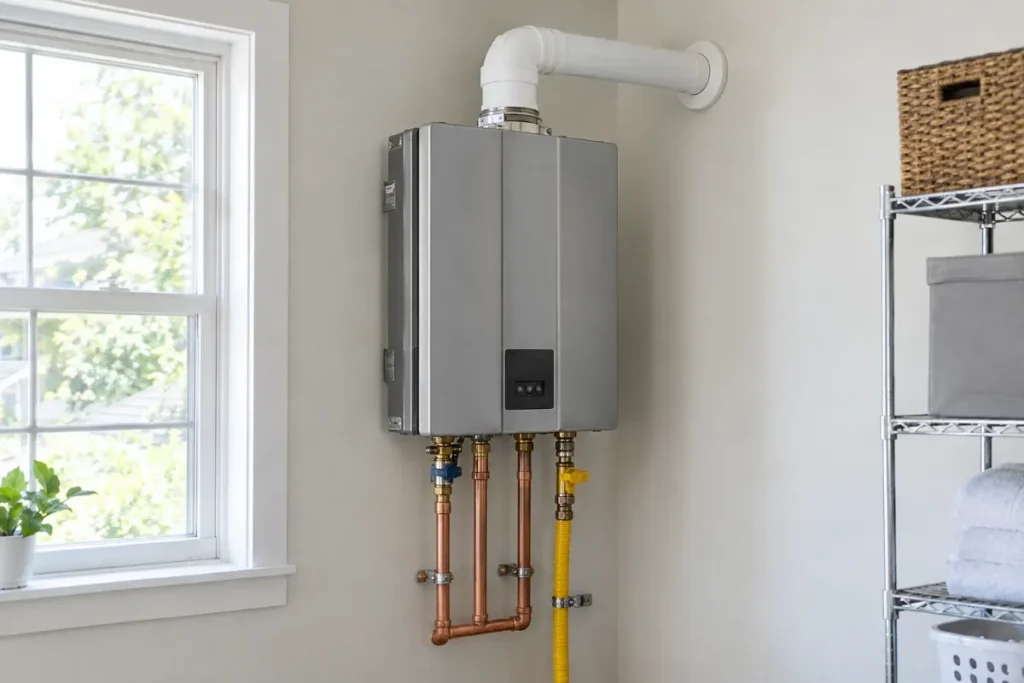
Gas units cost more to buy and more to install, because they need combustion venting and enough gas supply to fire a burner that can run far hotter than the one in a tank heater. Electric units are cheaper up front, but many homes need electrical work to carry the load.
The two guides are close for electric units and far apart for gas: HomeGuide’s natural gas range tops out $2,100 higher than Fixr’s. Fixr’s average project, a 150,000 BTU whole-house gas unit, comes to $2,811 installed (Fixr). Fixr’s figures are also older, from January 2025.
Estimate your tankless water heater cost
Use the tables above to estimate your cost. The interactive calculator needs JavaScript.
Our estimate: the calculator takes, for each fuel, the lowest installed figure and the highest installed figure published by HomeGuide or Fixr in the table above, and adds the HomeGuide ranges for the extra work you tick in the table below. It is a combination of published ranges, not a quote or a measured price.
The extra work that moves the price
If you are replacing an old tank, these are the lines that turn a mid-range quote into a high one. None of them appear in the basic estimate above.
| Work | HomeGuide | Fixr | When you need it |
|---|---|---|---|
| Larger or new gas line | $350 – $2,000 | Up to $800 | Gas unit, when the existing line is too small or there is none |
| New exhaust vent | $100 – $600 | Not given | Gas unit, the old tank flue cannot be reused |
| New electrical panel | $850 – $1,700 | Not given | Electric unit, when the panel has no spare capacity |
| Remove and dispose of the old tank | $75 – $500 | Up to $500 | Almost every replacement |
| Permit | $50 – $200 | Not given | Most jurisdictions, especially for gas work |
| Pipes, valves and fittings | $150 – $300 | Not given | Every install |
The national basic estimate from Homewyse (September 2026, $2,877 to $3,334 per heater) explicitly leaves out changes to existing plumbing, electrical and HVAC systems, permit fees and sales tax. If a quote comes in close to that figure, check which of the lines above it covers.
What the labor line pays for
Installation labor is quoted at $600 to $2,500, for roughly 3 to 10 hours of work by a plumber, and an electrician too if the circuit changes (HomeGuide). Fixr puts labor at $500 to $1,000 for an electric unit and $900 to $1,500 for gas or propane. For context, the median plumber in the United States earned $30.67 an hour in May 2025, according to the Bureau of Labor Statistics.
Our estimate: dividing the HomeGuide labor range by its published hours gives a billed rate of roughly $100 to $250 an hour, three to eight times the median wage. That gap is not all margin: it pays for the second worker, the van, insurance, licensing, permits run and time that is never billed. It is a calculation from the figures above, not a measured rate.
Tankless or a new tank?
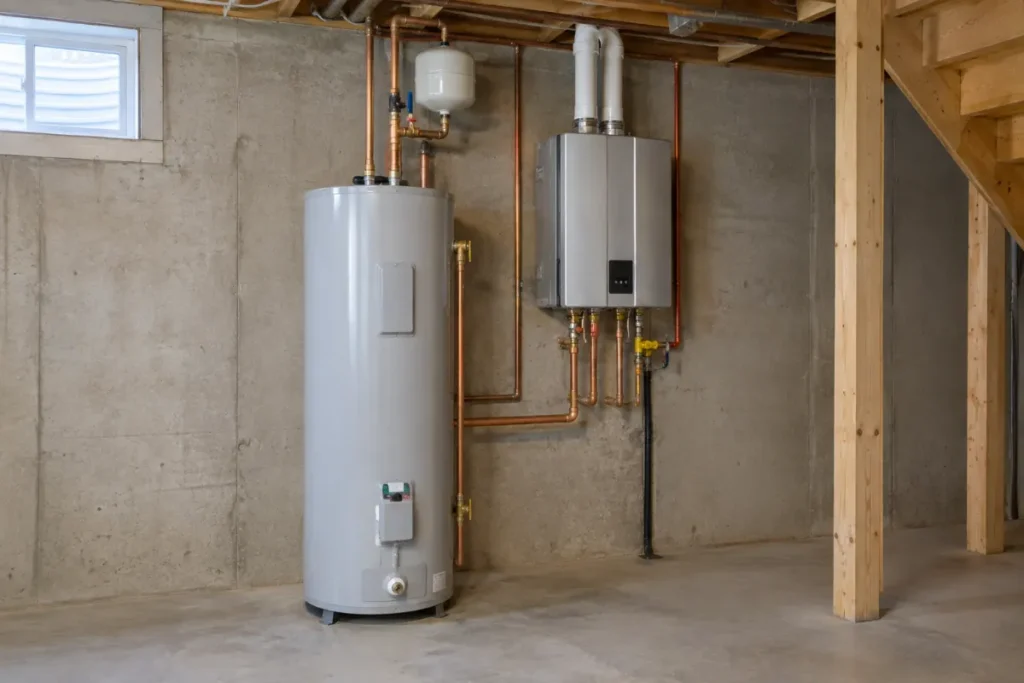
A conventional tank heater costs $600 to $3,100 installed (HomeGuide), so tankless costs more on day one. The argument for it is efficiency and lifespan, and the official figures are these:
- Efficiency. For homes using 41 gallons of hot water a day or less, a tankless heater can be 24% to 34% more energy efficient than a storage tank. For heavy users, around 86 gallons a day, the gain drops to 8% to 14% (U.S. Department of Energy).
- Lifespan. Most tankless units are expected to last more than 20 years; storage tanks last 10 to 15 (same source).
- Flow. A tankless unit delivers about 2 to 5 gallons per minute. A shower and a dishwasher at the same time can reach that limit in a large household (same source).
The efficiency gain is largest where hot water use is small. That is the uncomfortable part of the math: the households that save the most per gallon are the ones that use the fewest gallons, so the dollar saving may take many years to cover the higher install price. Weigh it against the lifespan, not against one year of bills.
No federal tax credit in 2026
The Energy Efficient Home Improvement Credit, which paid up to $600 for a qualifying gas water heater, does not apply to property placed in service after December 31, 2025 (IRS). A contractor quoting you a federal credit on a 2026 installation is out of date. State and utility rebates are separate and still exist in some areas; ask your utility before you sign.
How to keep the bill down
- Replace before the old tank fails. An emergency swap leaves no time to compare quotes, and you pay for speed.
- Match the fuel you already have. Switching from an electric tank to gas tankless, or the other way round, is where the gas line and panel costs pile up.
- Size the unit to your real peak use, not the biggest model on the shelf. A larger burner can mean a larger gas line.
- Get at least two written quotes that list the gas, vent, electrical and permit lines separately. Two totals without a breakdown cannot be compared.
Questions to ask before you sign
- Is my gas line or electrical panel big enough for this unit, and is that upgrade in the price?
- Can the existing vent be reused, or does the quote include a new one?
- Who pulls the permit, and is the fee included?
- Does the price include removing the old tank?
- Does the unit need descaling in hard water, and what does that service cost each year?
Sources
- U.S. Bureau of Labor Statistics, Occupational Outlook Handbook: Plumbers, Pipefitters, and Steamfitters, pay data for May 2025.
- U.S. Department of Energy, Energy Saver, Tankless or Demand-Type Water Heaters. The page has since been removed from energy.gov; the link is the archived copy of January 1, 2026.
- Internal Revenue Service, Energy Efficient Home Improvement Credit.
- HomeGuide, Tankless Water Heater Installation Cost, 2026.
- Fixr, Tankless Water Heater Installation Cost, updated January 31, 2025.
- Homewyse, Cost to Install Tankless Hot Water Heater, national estimate for September 2026.