$500 – $5,000That is the typical slab leak repair cost in 2026 for fixing one leaking pipe under a concrete slab, across three published cost guides. HomeGuide (October 2025) puts lining the pipe at $500 to $3,500 and breaking into the slab to replace the damaged section at $700 to $5,000; Fixr (May 2025) puts the usual job at $1,000 to $4,000, with an average of $2,500; and This Old House (April 2026) gives $630 to $4,400, with an average of $2,300. Rerouting the plumbing costs $1,500 to $15,000 depending on the guide and how much pipe is moved, and replacing the slab $3,600 to $10,800.
A slab leak is a leak in a water or drain pipe that runs under, or through, a concrete slab foundation. You rarely see it directly: you see a higher water bill, a warm spot on the floor or a meter that keeps moving when every tap is off. The bill has two parts, finding the leak and fixing it, and the repair method you choose moves the total more than anything else.
Slab leak repair cost by method
| Repair | HomeGuide | Fixr | This Old House |
|---|---|---|---|
| Sealing cracks in the slab | $100 – $200 | $100 – $200 | — |
| Patching (epoxy or hydraulic cement) | $250 – $800 | $250 – $800 | — |
| Replacing a damaged pipe section | $200 – $2,000 | $200 – $2,000 | $200 – $2,000 |
| Repairing the water main or water line | $400 – $5,000 | — | $300 – $1,400 |
| Breaking the slab or trenching to reach the pipe | $500 – $3,000 | $500 – $3,000 | — |
| Tunneling under the house | — | $900 – $2,000 | — |
| Pipe lining (no digging) | $500 – $3,500 | $500 – $2,000 | — |
| Under-slab plumbing repair (general) | — | — | $500 – $4,000 |
| Rerouting the plumbing | $3,900 – $7,500 | $4,000 – $15,000 | $1,500 – $15,000 |
| Replacing the slab | $5,400 – $10,800 | $4,000 – $8,000 | $3,600 – $8,000 |
Some of these lines stack. A direct-access repair usually means breaking the slab, replacing the pipe section and patching the concrete, so the three lines add up. Crack sealing and patching on their own do not fix a leaking pipe; HomeGuide notes that patching is only one element of the repair and will not solve the problem by itself.
The guides agree on the small items: HomeGuide and Fixr give the same ranges for sealing, patching and breaking the slab, and all three put a broken-pipe repair at $200 to $2,000. They disagree on the big jobs. Rerouting runs $3,900 to $7,500 at HomeGuide but up to $15,000 at Fixr and This Old House; Fixr says its top figure is for rerouting all the pipes from under the slab to the attic (Fixr). Slab replacement tops out at $8,000 at Fixr and This Old House against $10,800 at HomeGuide.
Our estimate: the $500 – $5,000 headline runs from the lowest to the highest per-leak figure across the three guides: HomeGuide’s $500 floor for lining and its $5,000 ceiling for breaking the slab and replacing the pipe. It contains Fixr’s $1,000 – $4,000 and This Old House’s $630 – $4,400. It is a combined range, not a measured figure, and it leaves out rerouting and slab replacement.
Estimate your slab leak repair cost
Use the tables above to estimate your cost. The interactive calculator needs JavaScript.
The three main ways to fix it
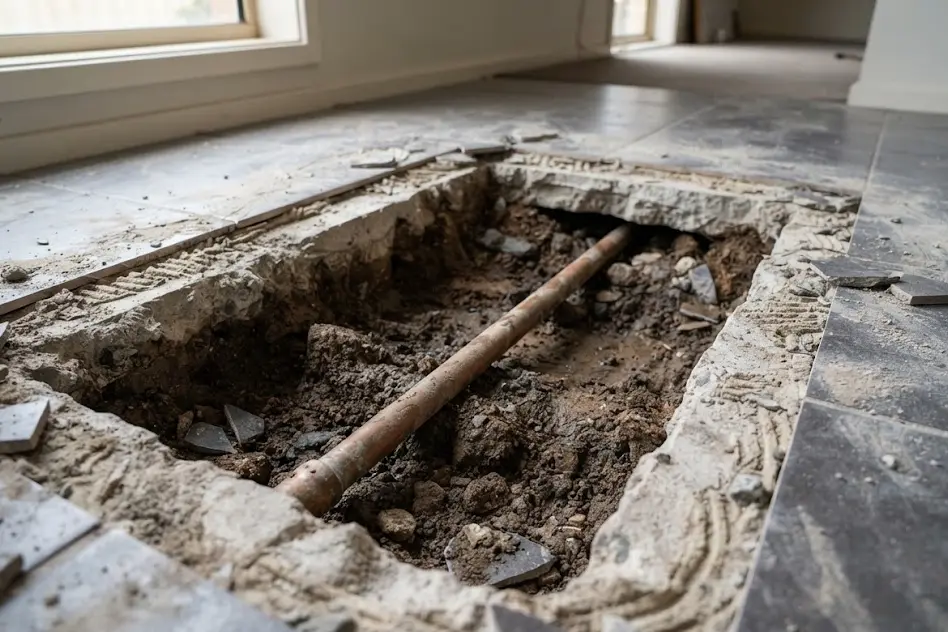
Direct access through the slab. The plumber opens the concrete over the leak, replaces the damaged section and fills the hole. Breaking the slab or digging a trench costs $500 to $3,000, and replacing the pipe itself $0.40 to $8.00 per linear foot, or $200 to $2,000 in total depending on the material (HomeGuide). It suits a single, well-located failure in pipe that is otherwise sound. The catch is the floor: whatever tile, wood or carpet sits over the spot has to come up.
Fixr also prices a way to reach the pipe without opening the floor: tunneling under the house, at $900 to $2,000. The crew digs under the foundation, drains the soil, repairs the pipe and fills the tunnel back in, so expensive flooring can stay. It only works where the soil is stable enough; homes on shifting or expansive soil may not be good candidates (Fixr).
Rerouting or repiping. Instead of opening the slab, the plumber caps the old line and runs a new one along another route. HomeGuide puts it at $3,900 to $7,500 on average: a longer job, but often less invasive than digging into the foundation (HomeGuide). Fixr gives $4,000 to $15,000 and notes the new pipes usually run through the attic, and that rerouting is often the answer when more than one pipe under the slab has a problem (Fixr). This Old House puts it at $1,500 to $15,000 (This Old House). It is the option to ask about when the pipes under the slab are old, because a new route takes that run out from under the concrete for good.
Epoxy or cured-in-place lining. A resin liner coats the inside of the damaged pipe, so nothing is dug up. HomeGuide puts it at $500 to $3,500 per repair, or $90 to $250 per linear foot for cured-in-place pipe lining (HomeGuide). Fixr gives $500 to $2,000, priced by the linear foot, and warns that lining is not always an option for pipes under a slab (Fixr). Per foot it is the most expensive method, but it avoids concrete work and floor replacement.
What finding the leak costs
Before anyone breaks concrete, the leak has to be located. The three guides price that step differently, partly because they describe different jobs: HomeGuide prices a foundation inspection that finds the leak points and judges the damage, while Fixr prices a leak detection test that can take minutes or over an hour, sometimes with drilling or a camera in the drain lines.
| Item | HomeGuide | Fixr | This Old House |
|---|---|---|---|
| Finding the leak | $300 – $750 (foundation inspection) | $100 – $400 (leak detection test) | $150 – $600 (slab leak detection) |
| Plumber, per hour | $45 – $150 | $45 – $200 (most pay $75 – $130) | — |
| Emergency service, per hour | $100 – $350+ | — | — |
Emergency rates apply on nights, weekends and holidays (HomeGuide). Fixr counts 1 to 3 hours for an inspection and expects a minimum labor charge of around $150 to $200 on small jobs, plus the inspection (Fixr). For reference, the median wage of plumbers, pipefitters and steamfitters was $30.67 per hour in May 2025 (U.S. Bureau of Labor Statistics); that is what the worker earns, not what a company bills.
Our estimate: adding HomeGuide’s $300 – $750 inspection to its $700 – $5,000 direct-access repair gives roughly $1,000 – $5,750 for a leak found and fixed through the slab, before any flooring. Using Fixr’s $100 – $400 detection test instead gives $800 – $5,400. These are our sums of published ranges, not measured figures.
How to tell if you have a slab leak
HomeGuide lists these signs: cracks in the foundation, a water bill that jumps without reason, sudden changes in water pressure, the sound of running water when all fixtures are off, and a warm area of floor over the hot water pipes. Visible water on the floor is the obvious one. Fixr adds a musty smell or mold on the floors and walls just above the slab, and puddles or unusually lush grass next to the foundation, where the escaping water ends up (Fixr).
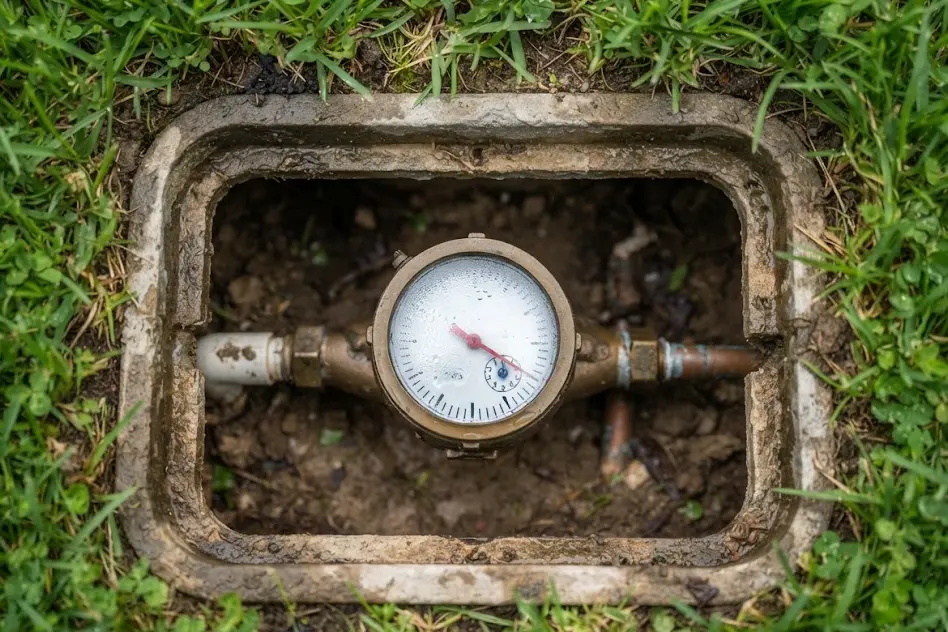
The cheapest test is your own water meter. The EPA’s WaterSense program suggests reading the meter before and after a two-hour period when no water is used; if it changes at all, you probably have a leak. It also suggests checking a winter month’s use: a family of four using more than 12,000 gallons a month could have serious leaks (EPA WaterSense). Rule out the easy culprits first. EPA’s toilet test is a few drops of food coloring in the tank: color in the bowl after 10 minutes means a leak.
- Turn off every tap and every appliance that uses water.
- Write down the meter reading.
- Use no water for two hours, then read it again.
- If it moved and the toilets pass the dye test, have a plumber locate the leak.
Small leaks add up. EPA estimates that the average household’s leaks waste more than 9,300 gallons a year, and that nine percent of homes have leaks wasting 50 gallons or more per day (EPA WaterSense).
Restoring the floor and the foundation
Where the leak is matters: a leak under a garage or utility closet costs less to reach than one under a kitchen or bathroom (HomeGuide). If the slab itself is badly damaged, HomeGuide puts replacing it at $6 to $12 per square foot, or $5,400 to $10,800 in total, and sometimes only the broken section needs replacing. Fixr ($4,000 – $8,000) and This Old House ($3,600 – $8,000) put the ceiling lower.
| Work after the repair | HomeGuide | Fixr | This Old House |
|---|---|---|---|
| Replacing a water-damaged subfloor | — | $500 – $1,000 | — |
| Foundation repair | — | — | $2,000 – $7,500 |
| Mold remediation | $1,500 – $6,000 | — | — |
| Plumbing permit | $30 – $500 | not always needed | — |
Water that sat under the floor can also mean mold, and a wood subfloor laid over the slab can warp or grow mold and need replacing once the area is dry (Fixr). Debris removal may or may not be in the quote (HomeGuide), and Fixr notes a permit is not always required, so check with your municipality. HomeGuide says the repair itself usually takes 1 to 3 days; if flooring or cabinets were damaged, the whole job can stretch to several weeks while new materials arrive. Fixr puts trenchless repairs at a couple of hours, tunneling at 4 to 6 hours and breaking the slab at 1 to 2 days, with rerouting taking the longest.
Does homeowners insurance cover a slab leak?
It depends on the cause and on your policy. According to HomeGuide, a policy may cover slab leak repair when the leak was directly caused by a covered event, such as an earthquake, a severe flood, frozen pipes or a tree falling on the house. This Old House makes the same point and adds that a repair will not be covered as general home maintenance. Fixr is blunter: in most cases slab leaks are not covered, and claiming the repair after the fact usually ends in a denial. Read your own policy and call your insurer before work begins.
How to keep the bill down
- Do the two-hour meter test as soon as the water bill looks wrong, rather than waiting for visible damage.
- If the leak is slow and you can shut off the water, book during business hours; emergency rates run $100 to $350 or more per hour.
- Get at least three in-person estimates, and be wary of anyone recommending a full slab replacement without a thorough inspection (HomeGuide).
- Ask for lining, rerouting and direct access to be priced side by side.
- Check that disposal and the permit are in the written quote before comparing totals.
Questions to ask before you sign
- How did you locate the leak, and how sure are you of its position?
- Why this method over lining, rerouting or direct access in my house?
- Is the quote itemized, and does it include labor, materials, disposal and the permit?
- Who restores the concrete and the flooring, and is that in the price?
- Are you licensed, insured and bonded, and what does your warranty cover?
- Do you have experience with homeowners insurance claims?
Sources
- U.S. Environmental Protection Agency, WaterSense, Fix a Leak Week.
- U.S. Bureau of Labor Statistics, Occupational Outlook Handbook: Plumbers, Pipefitters, and Steamfitters, pay data for May 2025.
- HomeGuide, How Much Does a Slab Leak Repair Cost?, October 29, 2025.
- Fixr, Slab Leak Repair Cost, updated May 1, 2025.
- This Old House, How Much Does Slab Leak Repair Cost? (2026 Guide), updated April 7, 2026 (cost data from HomeAdvisor).