$3,500 – $18,000That is the typical walk-in tub cost in 2026, with professional installation. Fixr puts most projects at $3,500 to $10,000, with a national average of $6,000. HomeGuide gives $4,000 to $18,000 for a standard tub, and This Old House prices a standard 60-by-32-inch tub at about $4,600 installed. Luxury and two-seat models, or a bathroom that has to be rebuilt around the tub, can reach $25,000 to $30,000.
A walk-in tub is usually bought for one reason: getting in and out of the bath has become risky. That makes the price only half the question. The other half is who pays. Original Medicare generally does not, but Medicaid waiver programs, VA grants, a rural home repair grant and the medical expense deduction can each cover part of the bill for people who qualify. The sections below cover what each type of tub costs, what the installation adds, what it costs to run, and where financial help may come from.
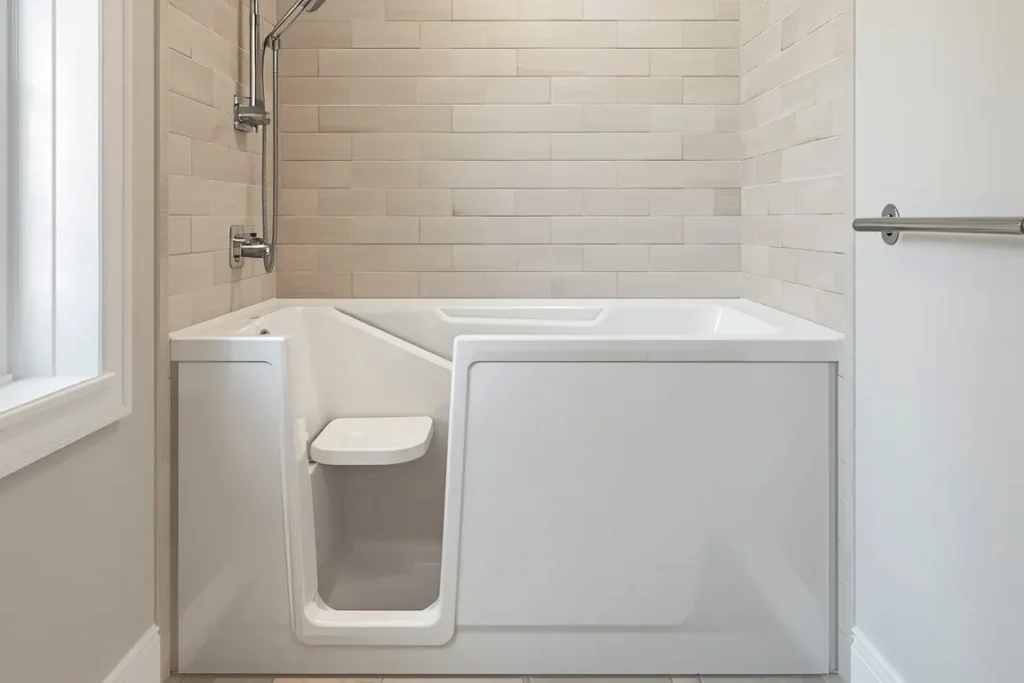
Walk-in tub cost by type
| Type | HomeGuide (tub only) | Fixr (installed) | This Old House (tub only) |
|---|---|---|---|
| Soaker (basic, no jets) | $3,000 – $6,000 | $3,000 – $7,000 | $2,000 – $4,000 |
| Whirlpool / hydrotherapy (water jets) | $5,000 – $12,000 | $4,000 – $12,000 | $4,750 – $7,500 |
| Air jet (aerotherapy) | $5,000 – $11,000 | included in the row above | $5,000 – $9,000 |
| Air and water jets | $6,000 – $13,000 | — | — |
| Tub and shower combo | $2,500 – $10,000 | $3,200 – $10,000 | $3,200 – $9,500 |
| Bariatric | $5,000 – $13,000 | $4,500 – $11,500 | $6,000 – $10,300 |
| Wheelchair accessible | see bariatric row | $4,500 – $12,000 | $5,000 – $12,000 |
| Two-seater | $7,700 – $20,000 | $6,000 – $20,000 | $10,700 – $13,700 |
| Luxury (heated seats, lighting, aromatherapy) | $8,000 – $25,000+ | $8,000 – $30,000+ | $7,000 – $20,000 |
The three guides agree on the order: a plain soaker is the cheapest, jets add several thousand dollars, and two-seat and luxury tubs sit at the top. They disagree most on the upper end. This Old House’s whirlpool range tops out at $7,500 for the tub, while HomeGuide and Fixr both go to $12,000. Fixr adds that upgrading to a model with massage jets usually costs $3,000 to $8,000 more than a basic tub (Fixr).
Our estimate: the $3,500 – $18,000 headline range runs from the low end of Fixr’s typical installed range to the top of HomeGuide’s installed range for a standard tub. It is a span of published figures, not a measured price. Fixr’s own extremes ($2,000 to $30,000) and This Old House’s ($1,800 to $20,000 or more) show how far a single project can fall outside it.
Estimate your walk-in tub cost
Use the tables above to estimate your cost. The interactive calculator needs JavaScript.
Tub price vs. installation cost
| Line | HomeGuide | Fixr | This Old House |
|---|---|---|---|
| Tub only | $3,000 – $13,000 (standard); $6,000 – $20,000+ (high-end) | — | $2,000 – $20,000 by type |
| Installation labor | — | $1,000 – $3,500 | $1,500 – $3,500; $5,000+ with new drains, flooring or electrical work |
| Installed total | $4,000 – $18,000 (standard); $8,000 – $25,000+ (high-end or complex) | $3,500 – $10,000; average $6,000 | about $4,600 for a standard tub; $1,800 – $20,000+ |
A basic installation covers removing and hauling away the old tub, setting the new one, and connecting the plumbing and any electrical lines (Fixr). This Old House’s component breakdown for a standard 60-by-32-inch tub, based on contractor pricing data, comes to $4,632: $3,427 in materials and $1,205 in labor, with the door, the liner and the tub itself as the largest lines (This Old House). A straightforward swap often takes one day, and most installations take one to two (HomeGuide).
Labor rates vary by trade. Plumbers charge $75 to $150 an hour, about $90 on average, and electricians $70 to $130 (Fixr). For comparison, the median plumber earned $30.67 an hour and the median electrician $30.38 in May 2025, according to the Bureau of Labor Statistics (BLS, plumbers; BLS, electricians). The billed rate also pays for licensing, insurance, the truck and tools.
What can add to the installation bill
| Extra | Cost | Source |
|---|---|---|
| Larger pipes and drains for faster filling and draining | $350 – $2,000 | HomeGuide |
| Electrician to wire jets, heaters or pumps | $50 – $130 an hour (HomeGuide); $70 – $130 (Fixr) | HomeGuide, Fixr |
| New, larger or tankless water heater | $1,400 – $5,600 | HomeGuide |
| Point-of-use water heater | $300 – $1,000 | Fixr |
| Permit (when plumbing or electrical changes) | $150 – $1,000 | Fixr |
| Extension panels for a tub shorter than the alcove | $250 – $300 | HomeGuide |
| Grab bars installed separately | $100 – $350 (HomeGuide); $25 – $350 each (Fixr) | HomeGuide, Fixr |
| Replacing a shower with a walk-in tub | $3,000 – $15,000 (Fixr); $3,000 – $8,000 (This Old House) | Fixr, This Old House |
| Moving walls or expanding the bathroom | $5,000 – $15,000+ (This Old House); $100 – $500 per sq. ft. (HomeGuide) | This Old House, HomeGuide |
Electrical work. Jets, heated seats and in-line heaters need power next to a full tub of water. This Old House stresses that any installation combining water and line voltage needs a licensed electrician and a ground fault circuit interrupter (GFCI) to protect against shock (This Old House). A soaker with no electrical features avoids this line entirely.
The water heater. A walk-in tub holds 40 to 80 gallons, against 25 to 45 for a standard bathtub. A common rule of thumb is a water heater tank of about two-thirds of the tub’s listed capacity: roughly 40 gallons for a 60-gallon tub and 53 gallons for an 80-gallon tub. It is a rough guide, since actual needs depend on the rest of the household’s hot water use (Retirement Living). If your heater is too small, replacing it costs $1,400 to $5,600 installed (HomeGuide); our water heater replacement cost guide breaks that down by type.
Demolition, walls and the permit. Removing the old tub is often included in a quote, but complex tear-outs, such as cement backer board, cost more. A simple swap may not need a permit; significant plumbing or electrical changes usually do (Fixr). In This Old House’s breakdown, the tile and the surround around a standard tub add about $340 together (This Old House). If the whole bathroom is being redone at the same time, a full remodel with a walk-in tub runs $10,000 to $25,000 (This Old House); see our bathroom remodel cost guide for the wider job.
Cost by tub material
| Material | Fixr | This Old House |
|---|---|---|
| Fiberglass (gel-coated) | $2,000 – $6,000 | $2,000 – $5,000 |
| Gelcoat | — | $3,500 – $7,000 |
| Acrylic | $4,000 – $10,000 | $5,000 – $10,000 |
| Porcelain or cast iron | $10,000 – $15,000+ | $10,000 – $15,000 |
Most walk-in tubs are acrylic. Fiberglass is the cheapest but the least durable, with a finish prone to fading and cracking; porcelain and cast iron last longest and can be reglazed (Fixr). They also retain heat well but are the heaviest (This Old House).
Door style, size and fit
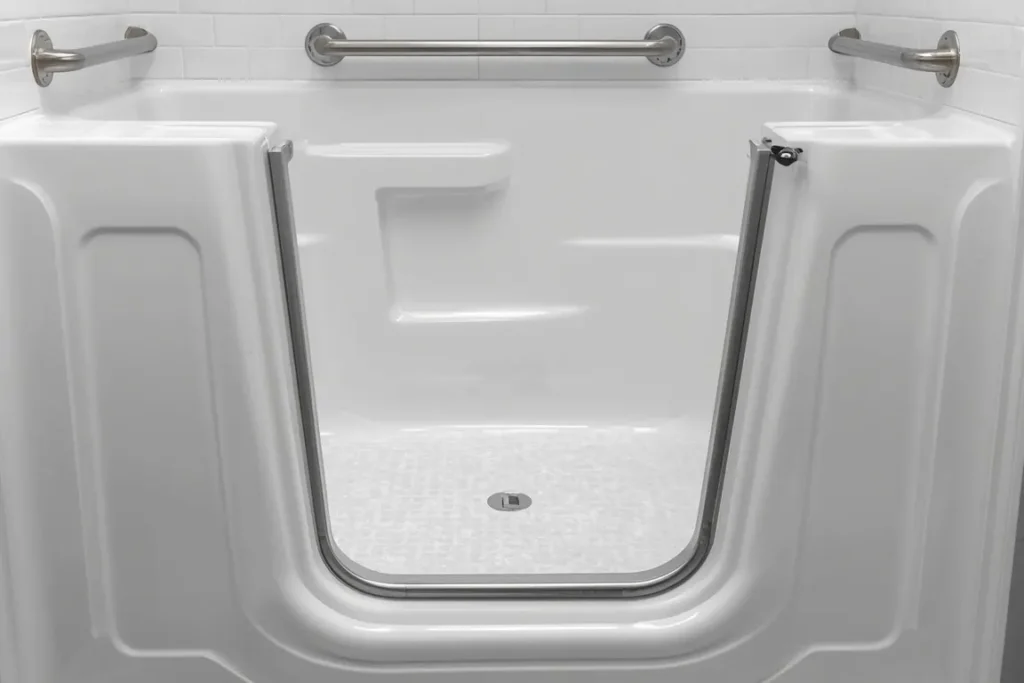
The door is what makes a walk-in tub, and it is also one of its biggest cost lines. Inward-swinging doors are the most common and usually the cheapest, but they take up room inside the tub. Outward-opening doors are easier to use and add $500 to $2,000 because they need more complex seals. Wide-entry doors with an ultra-low threshold, for wheelchair users, add $1,000 to $3,000 (This Old House). Doors are hinged on the left or the right as well as opening in or out, and step-in thresholds are typically 2 to 8 inches high (Retirement Living).
Size drives both price and installation. Walk-in tubs are typically about 52 inches long, but range from compact 38-inch models with limited accessibility to 84-inch tub and shower combinations (Retirement Living). A tub that fits your existing bathtub’s footprint costs less to install because it needs fewer changes to plumbing, walls and flooring (Fixr). A shorter tub in a standard alcove may need extension panels to close the gap at one or both ends (HomeGuide).
What it costs to run
A walk-in tub costs more to use than a shower. An occupied tub uses about 50 to 70 gallons per bath, while a 10-minute shower with a 2.5-gallon-per-minute head uses about 25 gallons, and heating the larger volume takes more energy (Retirement Living). How much that adds to your bills depends on your local water and energy rates and how often you bathe.
Our estimate: 50 to 70 gallons per bath minus about 25 gallons per shower means each bath taken instead of a shower uses roughly 25 to 45 more gallons of water, most of it heated. This is a calculation from the figures above, not a measurement.
There is also a time cost. You get in before the tub fills and stay seated until it drains. Filling takes 6 to 15 minutes, or about 3 with a quick-fill faucet, and draining 5 to 10 minutes, or about 2 with a speed drain (HomeGuide). That is why quick-fill faucets ($150 to $500), rapid-release drains ($200 to $400) and anti-scald faucets ($100 to $350) are common add-ons (Fixr).
Upkeep is the last running cost. If the user cannot clean the tub, professional cleaning runs $75 to $150 (Fixr). Professional repairs to jets, doors or the surface cost $250 to $800 or more, and worn door gaskets are a common source of leaks (HomeGuide). Many manufacturers void the warranty if a certified professional did not install the tub (Fixr).
Does Medicare pay for a walk-in tub?
Generally, no. Medicare Part B covers durable medical equipment (DME) that is used for a medical reason, is typically only useful to someone who is sick or injured, and is ordered by a doctor for use at home (Medicare.gov). Walk-in tubs are not on its list of covered equipment, and the national reference list Medicare uses to decide what counts as DME denies the closest bathing items, including bathtub lifts, bathtub seats and grab bars, as not primarily medical in nature (CMS, National Coverage Determination 280.1).
The one narrow exception on that list is whirlpool bath equipment, which can be covered for a homebound patient whose condition is expected to get substantial therapeutic benefit from it, with every claim referred to medical staff (CMS). That is not a route to paying for a walk-in tub. Fixr notes that some Medicare Advantage plans may offer partial coverage (Fixr); if you have one, ask the plan in writing before you buy. One-on-one, unbiased Medicare counseling is available through your State Health Insurance Assistance Program (SHIP).
Other ways to pay for a walk-in tub
| Program | Who it is for | How much |
|---|---|---|
| Medicaid home and community-based services (HCBS) waivers | People who would otherwise need institutional care, in states that offer home accessibility adaptations | Set by each state |
| VA Home Improvements and Structural Alterations (HISA) | Veterans, for medically necessary changes to their home | Lifetime $6,800 (service-connected, or rated 50%+) or $2,000 (other disabilities) |
| VA Specially Adapted Housing (SAH) / Special Home Adaptation (SHA) | Veterans with specific severe service-connected disabilities | Up to $126,526 (SAH) or $25,350 (SHA) for fiscal year 2026 |
| USDA Section 504 home repair grant | Rural homeowners aged 62+ with very low income | Grant up to $10,000 lifetime; loans up to $40,000 at 1% |
| Medical expense tax deduction | Taxpayers who itemize | Medical costs above 7.5% of adjusted gross income |
Medicaid. Under HCBS waivers, states can pay for home accessibility adaptations that a person’s service plan requires for their health and safety or for greater independence at home, including modifications to bathroom facilities and specialized plumbing and electrical work. Improvements of general utility with no direct medical or remedial benefit are excluded (CMS). Each state decides which services it offers, so the answer depends on where you live.
Veterans. HISA covers medically necessary changes that give access to essential bathroom facilities, with roll-in showers as the example given, and requires a prescription from a VA physician and an itemized estimate. It explicitly excludes spa, hot tub and Jacuzzi-type tubs (VA), so a jetted walk-in tub is unlikely to qualify; ask your local Prosthetic and Sensory Aids Service before choosing a model. The larger SAH and SHA grants are for veterans with qualifying service-connected disabilities such as the loss of use of limbs (VA).
Rural homeowners. USDA’s Section 504 grants must be used to remove health and safety hazards, and must be repaid if the home is sold within three years (USDA Rural Development).
Taxes. The IRS lets you count special equipment or home improvements as medical expenses when their main purpose is medical care. Improvements that adapt a home to a disability, such as bathroom modifications and support bars, usually do not raise the home’s value and can be included in full; if an improvement does raise the value, only the cost above that increase counts. Only the part of your total medical expenses above 7.5% of adjusted gross income is deductible, and only if you itemize (IRS Publication 502). A tax professional can tell you whether this applies to you.
To find local home modification programs, your Area Agency on Aging is the starting point. The Eldercare Locator, a public service of the Administration for Community Living, connects you to it at 1-800-677-1116.
Walk-in tub vs. walk-in shower
A walk-in shower is the main alternative, and often the cheaper one. Converting a tub to a walk-in shower costs $3,500 to $15,000 on average, or $1,000 to $8,000 with a prefabricated stall kit, and the shower can be curbless (HomeGuide). HomeGuide notes that a walk-in shower is more accessible than a standard bathtub and can cost less than a walk-in tub. It also avoids sitting through a fill and drain cycle, and a 10-minute shower uses half or less of the water an occupied walk-in tub takes (see the running costs above). Our walk-in shower cost guide compares prefab and custom options in detail.
If neither remodel fits the budget, smaller aids can make an existing tub safer:
| Alternative | Price range |
|---|---|
| Basic shower chair | $30 – $80 |
| Transfer bench | $50 – $400 |
| Sliding or swivel shower chair | $230 – $600 |
| Wall-mounted folding shower chair | $670 – $800 |
| Bathtub lift | $350 – $3,000 |
Medicare’s equipment list denies bathtub lifts and bathtub seats as convenience items (CMS), so expect to pay for these yourself unless another program helps.
Why bathroom safety is worth budgeting for
Falls are the leading cause of injury-related death among adults 65 and older, and the rate is rising: the age-adjusted fall death rate climbed 21%, from 64.7 per 100,000 older adults in 2018 to 78.4 in 2024 (CDC). For the bathroom, the National Institute on Aging recommends grab bars on both the inside and outside of the tub and shower, nonskid mats or strips on any surface that may get wet, and a light left on at night (National Institute on Aging). A walk-in tub is one way to apply that advice; the CDC also suggests talking to a doctor about fall risk, since medicines and poor strength or balance can raise it (CDC).
How to keep the bill down
- Choose a tub that fits the existing bathtub space, so walls, plumbing and flooring stay where they are.
- Pay only for the features the user will actually use. Jets alone can add thousands of dollars.
- Check your water heater’s capacity against the tub’s before you order, so the replacement is not a surprise.
- Apply for Medicaid, VA or USDA help before signing a contract; programs set their own approval steps.
- Get at least three itemized quotes that show the tub, labor, permit, removal and any electrical or water heater work on separate lines.
- Avoid large upfront payments; pay as work is completed, according to the contract.
Questions to ask before you sign
- Is the price for the tub alone or fully installed, including removal of the old tub and the permit?
- Does the door open inward or outward, which side is it hinged on, and how high is the threshold?
- How many gallons does the tub hold, and is my water heater big enough to fill it?
- Does this model need a dedicated circuit or GFCI protection, and is a licensed electrician doing that work?
- How long does it take to fill and to drain?
- What does the warranty cover on the door seal, the shell and the pumps, and does it require a certified installer?
Sources
- Medicare.gov, Durable medical equipment (DME) coverage.
- Centers for Medicare & Medicaid Services, National Coverage Determination 280.1: Durable Medical Equipment Reference List, version effective June 9, 2025.
- Centers for Medicare & Medicaid Services, State Health Official letter #21-001: Opportunities in Medicaid and CHIP to Address Social Determinants of Health, January 7, 2021.
- U.S. Department of Veterans Affairs, Home Improvements and Structural Alterations (HISA), last updated February 12, 2025.
- U.S. Department of Veterans Affairs, Disability housing grants for Veterans, last updated November 18, 2025.
- USDA Rural Development, Single Family Housing Repair Loans & Grants.
- Internal Revenue Service, Publication 502 (2025), Medical and Dental Expenses, page reviewed April 30, 2026.
- Centers for Disease Control and Prevention, Older Adult Falls Data, September 4, 2026.
- National Institute on Aging, Preventing Falls at Home: Room by Room, content reviewed September 12, 2022.
- Administration for Community Living, Eldercare Locator; State Health Insurance Assistance Program.
- U.S. Bureau of Labor Statistics, Occupational Outlook Handbook: Plumbers, Pipefitters, and Steamfitters and Electricians, pay data for May 2025.
- HomeGuide, How Much Does a Walk-in Tub Cost?, August 27, 2025.
- Fixr, How Much Does It Cost to Install a Walk-in Tub?, updated January 28, 2026.
- This Old House, How Much Does Walk-In Tub Installation Cost?, updated June 12, 2026.
- Retirement Living, How Many Gallons of Water Does a Walk-In Tub Hold?, updated August 22, 2026.