$300 – $5,000That is the typical bed bug treatment cost in 2026, according to three published cost guides: a single room starts at about $300 and runs up to $500 to $800, and a whole home costs $1,500 to $5,000 or more (HomeGuide, This Old House, Today’s Homeowner). Heat treatment runs $1 to $3 per square foot, while whole-home fumigation is the most expensive option, at up to $16,000 (HomeGuide).
Bed bugs are not known to spread disease, but the CDC notes that removing them from a home can be expensive and inconvenient (CDC). How expensive depends mostly on how far they have spread, which method the company uses and how many visits it takes. The figures below break down each of those lines, plus the preparation work that can make the treatment cheaper or wasted.
Bed bug treatment cost by number of rooms
| Area treated | HomeGuide | This Old House | Today’s Homeowner |
|---|---|---|---|
| One room | $300 – $500 | $300 – $800 | $300 – $650 |
| Two rooms | $750 – $900* | $700 – $1,600 | $700 – $1,000 |
| Three rooms | $1,100 – $1,300* | $1,000 – $2,400 | $1,050 – $1,450 |
| Whole home | $2,500 – $5,000 | $1,500 – $5,000+ | $1,500 – $5,000 |
The three guides agree on the floor, about $300 for one room, and on a whole-home ceiling near $5,000. They disagree on the middle: This Old House gives the widest spread, up to $2,400 for three rooms, while HomeGuide and Today’s Homeowner stay under $1,500. This Old House also prices by severity: $225 to $800 for a mild infestation, $325 to $2,500 for a moderate one and $3,500 to $5,000 or more for a severe one (This Old House). Homes on raised foundations can cost more, because bed bugs can shelter under the house and need extra treatment, according to HomeGuide’s older guide from May 2024 (HomeGuide).
Estimate your bed bug treatment cost
Use the tables above to estimate your cost. The interactive calculator needs JavaScript.
Our estimate: each calculator range runs from the lowest to the highest figure the three guides give for that area. It is our own combination, not a measured price, and it assumes one treatment round; extra rounds add to the total.
Treating one room is only cheaper if the bugs really are confined to it. Researchers at the University of California found that about 85% of bed bugs are in or near the bed; the rest turn up in upholstered furniture, cabinets, baseboards, carpets and behind wall hangings (UC IPM). Texas A&M adds that the living room, with its sofas and sofa beds, is the next most common site after bedrooms (Texas A&M AgriLife Extension).
Cost by treatment method
| Method | Per square foot | Per room (Today’s Homeowner) | Per visit (This Old House) |
|---|---|---|---|
| Heat treatment | $1 – $3 | $150 – $395 | $400 – $5,500 |
| Chemical (insecticide) | $2 – $5 | $264 – $775 | $150 – $400 per room |
| Steam | – | – | $250 – $1,000 per room |
| Freezing | – | $396 – $1,250 | $300 – $1,500 |
| Fumigation | $4 – $8 | $528 – $1,056 | $2,000+ |
The guides do not agree on which method is cheapest per room. Today’s Homeowner puts heat below chemical treatment, while This Old House lists insecticides at $150 to $400 per room and heat at $400 to $5,500 per visit, a range that covers anything from one room to a whole house. Compare quotes on the same area rather than on the method name.
No single method is the whole answer. The EPA recommends integrated pest management for bed bugs, combining non-chemical and chemical methods, and says pesticides should be only one part of the plan (EPA). The University of California reaches the same conclusion: insecticides alone will not control an infestation (UC IPM). Expect a good quote to mix methods.
Heat treatment raises the temperature of a room or the whole house until the bugs and their eggs die. The EPA says infested areas need to reach at least 120°F for 90 minutes to make sure eggs are killed (EPA); the University of California cites a current recommendation of at least 140°F for two hours or 130°F for three hours for commercial heat services (UC IPM). Heat has no residual effect, so it does not protect against bugs brought back in, and heat-sensitive items have to be removed and treated another way (EPA).
Chemical treatment is what most companies start with; the CDC notes that professionals will typically spray insecticides (CDC). The most effective products are available only to licensed applicators, and they are applied to cracks, crevices, bed frames and baseboards rather than to mattresses or bedding. Resistance is the weak point: some bed bug populations can no longer be controlled with pyrethroid insecticides (UC IPM). The EPA notes that bed bug eggs resist many control methods, chemical and non-chemical (EPA), which is why chemical treatment usually needs follow-up visits.
Fumigation seals the house under a tent and fills it with gas. It is the most expensive route, at $4,000 to $16,000 for a whole home, and you have to move out for 24 to 72 hours while it runs (HomeGuide); This Old House puts it at $2,000 or more (This Old House). The University of California describes sulfuryl fluoride fumigation as highly effective but highly specialized and regulated, best kept for remedial control, and notes that it leaves no residual protection either (UC IPM).
Steam and freezing are chemical-free options for furniture, fabrics and items that cannot take high heat. Steam must reach at least 130°F and be applied without forceful airflow, or the bugs scatter (EPA). Cold works too, but the EPA warns it may need specialized equipment, and that bed bugs can go dormant, look dead for days and revive once warm (EPA).
Heat treatment cost by home size
| Home size | Heat treatment cost |
|---|---|
| 1,000 sq ft | $1,000 – $3,000 |
| 1,500 sq ft | $1,500 – $4,500 |
| 2,000 sq ft | $2,000 – $6,000 |
| 2,500 sq ft | $2,500 – $7,500 |
| 3,000 sq ft | $3,000 – $9,000 |
Whole-home heat is priced by square footage because the entire house is treated at once. HomeGuide’s older heat treatment guide (August 2023) says clutter lengthens the job, larger homes may need supplemental pesticide treatment, and companies often pair heat with a residual insecticide and mattress encasements, which adds to the bill (HomeGuide). In California, heat treatment providers must be licensed and bonded by the Structural Pest Control Board (UC IPM).
Inspection and dog detection cost
| Inspection | Average cost |
|---|---|
| Initial inspection | $50 – $200 |
| Follow-up inspection after treatment | $100 – $150 per visit |
Before paying for any of it, confirm what you have. The EPA suggests collecting a sample and showing it to your county extension agent, who can identify the pest at no cost (EPA). Bites alone prove nothing: the University of California warns that bed bug bites are difficult to impossible to tell apart from mosquito, flea or spider bites, and that only the bugs or their signs confirm an infestation (UC IPM).
Some companies offer dog teams, which are billed separately; we found no 2025 or 2026 price for them, so ask for it in writing. Dogs can find small infestations, but their accuracy in real homes has been highly variable. The University of California advises checking a canine team’s third-party certification and training before hiring it, and having any alert confirmed by a detailed inspection from a trained professional (UC IPM). A dog alert should never be the only basis for a whole-home quote.
How many visits you will pay for
Most homes need two or three treatments, one to two weeks apart, to kill the bugs and the eggs that hatch afterwards, according to HomeGuide’s older guide from May 2024 (HomeGuide); This Old House, citing providers, says heat or steam can take three to four rounds (This Old House). The timing follows the insect: eggs hatch in about 10 to 15 days at room temperature (UC IPM). The EPA says treatment can take weeks to months depending on the extent of the infestation, and recommends checking for at least a year afterwards to be sure they are gone (EPA).
| Service schedule | Today’s Homeowner (total) | This Old House (per visit) |
|---|---|---|
| One-time | $850 – $1,150 | $300 – $1,100 |
| Quarterly | $1,700 – $2,300 | $80 – $2,200 |
| Monthly | $4,700 – $6,800 | $100 – $7,000 |
| Semi-monthly | $5,100 – $7,800 | $200 – $5,000 |
The per-visit ranges from This Old House are very wide because they come from only two companies, so treat them as a sign of how much plans vary rather than as a typical price. HomeGuide puts annual bed bug treatment and prevention plans from national companies at $500 to $1,500 a year (HomeGuide).
Our estimate: a moderate infestation in three rooms, with an initial inspection and one follow-up check, would cost about $1,150 to $2,750: $1,000 to $2,400 for treating three rooms (the lowest and highest figures across the three guides), plus $50 to $200 for the inspection and $100 to $150 for the follow-up visit. This is our own sum, not a measured figure, and it assumes one treatment round. Each extra round adds to the total.
Preparation: the work that saves money
The EPA says preparing the home properly speeds up the process and reduces control costs, whether you hire a professional or not (EPA). Most of it costs time rather than money:
- Cut clutter, get rid of cardboard boxes where bugs hide, and bag trash straight into an outside bin rather than carrying it through clean rooms (EPA).
- Run clothing and bedding through a dryer on high heat for 30 minutes; washing alone may not kill the bugs (EPA).
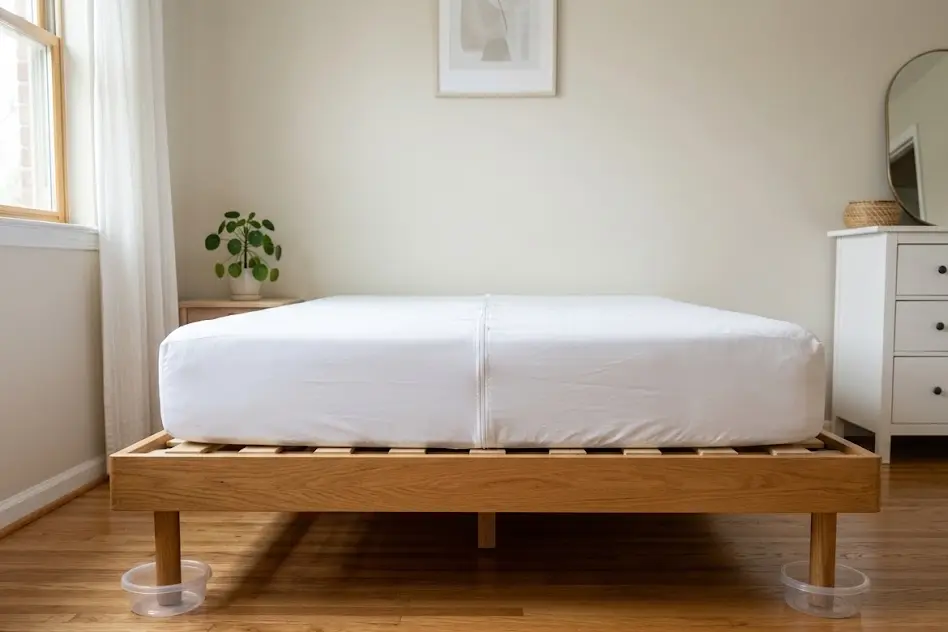
- Move the bed at least 6 inches from the wall, fit encasements with zippers that close completely on the mattress and box spring, and put interceptors under each leg. Plan to keep the interceptors for at least a year (EPA).
- Vacuum thoroughly, then seal the vacuum bag in a plastic bag and put it in the outside trash (EPA).
- For heat treatment, leave clothes in drawers and closets so they are heated too, and turn off air conditioning and fans, according to HomeGuide’s older heat treatment guide from August 2023 (HomeGuide). Follow the company’s own prep sheet if it differs.
One expense you can usually skip is a new bed. Texas A&M’s extension entomologist says throwing out beds or bedding is generally unnecessary, that a new mattress brought into an infested home will quickly be re-infested, and that the money is better spent on a professional (Texas A&M AgriLife Extension). If you do discard furniture, the EPA asks you to destroy or mark it so nobody else takes it home (EPA).
DIY fixes that waste money or cause harm
Several cheap fixes do not work, and some are dangerous. According to the EPA:
- Never use a pesticide indoors that is labeled for outdoor use. It is very dangerous and will not solve the problem (EPA).
- Foggers, or bug bombs, should never be the only method: the spray does not reach the cracks and crevices where bed bugs hide, and using too many can cause an explosion (EPA). The University of California and Texas A&M both describe over-the-counter foggers as ineffective against bed bugs (UC IPM, Texas A&M).
- Rubbing alcohol, kerosene and gasoline can harm your family and ignite with a spark (EPA).
- Turning up the thermostat or running a propane space heater or fireplace does not kill bed bugs and is dangerous (EPA).
- Pool or food-grade diatomaceous earth should not be used; it can harm you when inhaled (EPA).
If you do buy a product, the EPA says to use only EPA-registered pesticides that list bed bugs on the label, and to read the label every time (EPA).
Renters and apartments
Who pays depends on where you live. The EPA says 21 states have some level of law or regulation on bed bugs, mostly aimed at hotels and landlords, and tells renters that landlords may have a responsibility to take part in treatment, so check your local housing codes (EPA, EPA). The University of California advises tenants to contact the landlord or property owner, noting that tenants have rights (UC IPM).
Apartments also change the scope. Bed bugs move between units, and Texas A&M recommends assuming the units on both sides, above and below are infested until inspection shows otherwise (Texas A&M AgriLife Extension). The EPA’s guidance for landlords says to inspect adjacent units and not to blame tenants, because a culture of blame delays reporting and larger infestations cost far more to control (EPA).
What the labor line pays for
The median pest control worker in the United States earned $21.75 an hour, or $45,250 a year, in May 2025, according to the Bureau of Labor Statistics, which also notes that state laws require pest control workers to be licensed. The wage is a small part of a bed bug bill. The price also covers the heating equipment, insecticides that only licensed applicators can buy (UC IPM), the follow-up visits and the license itself. A first treatment takes 1 to 6 hours, while a whole-home fumigation can take 1 to 3 days or more, according to HomeGuide’s older guide from May 2024 (HomeGuide). Today’s Homeowner lists hourly rates of $145 to $225 (Today’s Homeowner).
How to keep the bill down
- Act at the first sign. Early detection makes infestations easier to control (CDC), and a one-room job costs a fraction of a whole-home one.
- Get the pest identified for free by your county extension office before paying for treatment.
- Do the preparation work yourself and do it fully; the EPA says it lowers control costs.
- Keep your mattress: encase it instead of replacing it.
- Skip foggers and outdoor sprays. They waste money and can make things worse.
- If you rent, report it to your landlord right away and check your state and city rules on who pays.
- Compare written quotes on the same basis: the same rooms, the same method and the same number of follow-up visits.
Questions to ask before you sign
- Which rooms will you treat, and why not the others?
- Which methods will you combine, and what will you do about items that cannot take heat?
- How many visits are included, how far apart, and what does an extra one cost?
- If a dog team inspects, is it third-party certified, and will a technician confirm any alert?
- What preparation do you need from me, and when can we go back in after treatment?
- What happens if bed bugs reappear after the last visit, and is that in writing?
Sources
- U.S. Environmental Protection Agency, Controlling Bed Bugs Using Integrated Pest Management, Do-it-yourself Bed Bug Control, Preparing for Treatment Against Bed Bugs, Safety Issues in Controlling Bed Bugs, Should I Use a Fogger?, What Landlords Need to Know about Bed Bugs and Bed Bug Laws and Regulations.
- Centers for Disease Control and Prevention, About Bed Bugs, April 26, 2024.
- University of California Statewide IPM Program, Pest Notes: Bed Bugs, UC ANR Publication 7454.
- Texas A&M AgriLife Extension, Bed bugs: Do-it-yourself control options.
- U.S. Bureau of Labor Statistics, Occupational Outlook Handbook: Pest Control Workers, pay data for May 2025.
- HomeGuide, Exterminator Cost, January 9, 2026; older guides Bed Bug Exterminator Cost, May 5, 2024, and Bed Bug Heat Treatment Cost, August 9, 2023.
- This Old House, How Much Does a Bed Bug Exterminator Cost?, updated June 11, 2026.
- Today’s Homeowner, How Much Does a Bed Bug Exterminator Cost?, March 26, 2025.