$100 – $450That is the typical outlet installation cost in 2026 for one new outlet, parts and labor included. Replacing an existing outlet costs less, about $80 to $200, while a 240-volt outlet for a dryer or range runs $250 to $800 because it usually needs its own circuit. Four published cost guides land inside the headline range, though they disagree on where in it a simple job falls.
The headline range is Angi’s (updated August 3, 2026, read from an archived copy because the site blocks automated visits), with an average of $300. It contains the ranges of the other three guides: HomeGuide (August 29, 2025) gives $150 to $350, Fixr (August 29, 2025) gives $120 to $200, and Homewyse (September 2026 estimate) gives $304 to $368 for a GFCI outlet wired from a nearby junction box. Below you will find the price of each kind of outlet, what electricians charge for a short visit, when a new circuit or a permit enters the bill, and which outlet jobs safety bodies say should go to a qualified electrician.
Outlet installation cost by job
| Job (per outlet) | HomeGuide (Aug 2025) | Angi (Nov 2025 – Aug 2026) | Fixr (Aug 2025) | Homewyse (Sep 2026) |
|---|---|---|---|---|
| New outlet, overall typical range | $150 – $350 | $100 – $450 (most pay $130 – $300) | $120 – $200 | $304 – $368 |
| New standard 120V outlet | $150 – $300 | — | from $85 | — |
| New GFCI outlet | $150 – $350 | $150 – $300 | up to $275 | $304 – $368 |
| Replace an existing outlet | $80 – $200 | — | from about $100 | — |
| Swap a standard outlet for a GFCI | $90 – $200 | $100 – $200 | — | $282 – $341 |
| Outdoor GFCI outlet with weatherproof cover | $180 – $350 | $60 – $300 | $250 – $400 | — |
| Outdoor outlet needing a new line or panel work | — | $1,000 – $1,400 | $1,000 – $1,400 | — |
The guides agree that an outlet is a labor job: the part is a few dollars, and the rest is the electrician’s time. They differ on how much time they assume. Fixr’s national average is only $141 (Fixr), while Homewyse budgets 2.1 hours of labor at $264 to $320 for a new outlet wired from an existing junction box within 15 feet, and adds a two-hour minimum charge to a simple replacement, which is why its replacement figure is close to its new-outlet figure (Homewyse). Angi says replacement and new-outlet prices are often about the same, with the replacement labor sometimes $10 to $20 lower (Angi). The two outdoor figures for Angi are not a contradiction: $60 to $300 is the outdoor-outlet guide’s range for a typical job, and $1,000 to $1,400 is the outlet guide’s figure for an outlet set away from the house with a buried line.
Estimate your outlet installation cost
Our estimate: the published ranges above multiplied out for your inputs. Not a quote. Per-outlet ranges from HomeGuide (Aug 2025), Angi (Nov 2025 to Aug 2026, archived copies), Fixr (Aug 2025) and Homewyse (Sep 2026), as shown in the tables in this article. The 240V option already includes its circuit. A local quote can differ. State adjustment: BLS construction wages (May 2025), applied to an assumed 50% labor share. How we calculate
Our estimate: each calculator line runs from the lowest to the highest figure the guides in this article give for that job. For example, the new GFCI line spans HomeGuide’s and Angi’s $150 low to Homewyse’s $368 high, and the 240V line spans Angi’s $175 low to HomeGuide’s $800 high. The new standard outlet line runs from Fixr’s $85 low to HomeGuide’s $300 high. The replacement line uses HomeGuide only, because the other guides give a starting price or no range. The USB line uses HomeGuide only, the one guide with an installed price. The extras come from the sections on circuits, AFCI protection, permits and wall repair below. This is our own combination, not a measured figure, and it multiplies per-outlet prices by the number of outlets even though a single visit for several outlets may cost less per outlet.
Replacing an outlet vs. adding a new one
A replacement swaps the device in an existing box: the wires are already there. HomeGuide puts it at $80 to $200 (HomeGuide), and Fixr says the electrician will usually bill at least half an hour to an hour, so the price can start around $100 (Fixr). Angi lists 10 to 30 minutes for swapping in a GFCI, against 30 minutes to 3 hours for wiring an outlet in a new spot (Angi).
A new outlet needs power brought to it, and there are two ways to do that. The cheaper one is extending an existing circuit from a nearby outlet or junction box; that is the job Homewyse prices at $304 to $368 (Homewyse). The dearer one is a new dedicated circuit run from the panel, which HomeGuide puts at $250 to $900 installed (HomeGuide). Angi gives the same $250 to $900 for a 15- to 20-amp circuit in a garage, but $570 to $1,100 for dedicated circuits in general, which include 30- to 50-amp circuits for large appliances (Angi, May 3, 2026). Whether a circuit can take another outlet is a load question for the electrician, not something to guess from the number of outlets already on it.
Distance and access drive the rest. Running new wire costs $7 to $10 per linear foot according to both HomeGuide and Angi. HomeGuide adds that wiring is easiest through an unfinished attic or basement, or in open walls before drywall goes up, and gets harder when the wire has to climb several floors, be fished between finished walls, or cross concrete. If the panel has no room for a new circuit, the job can grow into a panel upgrade; see our guide to electrical panel upgrade cost.
GFCI, AFCI and tamper-resistant outlets
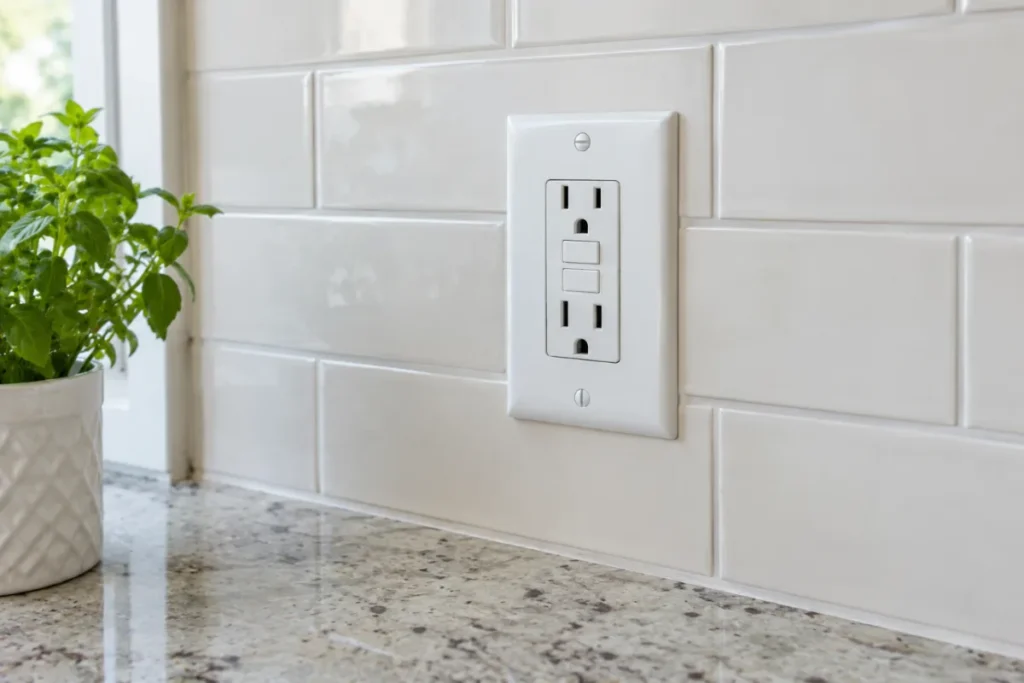
A GFCI (ground-fault circuit interrupter) cuts power when the current leaving a circuit differs from the current coming back by as little as 0.006 amperes, fast enough to prevent a lethal shock, according to the Consumer Product Safety Commission. A GFCI outlet also protects the outlets downstream of it on the same circuit (CPSC), which is why Angi notes that you may only need one at the start of each circuit (Angi). The device itself costs $12 to $40 at HomeGuide, $10 to $20 at Fixr and $15 to $50 at Angi, so most of a GFCI’s installed price is still labor.
Which outlets need GFCI protection is set by the National Electrical Code (NEC, published by the National Fire Protection Association as NFPA 70). The CPSC lists when the requirement was added for each location: outdoors in 1973, bathrooms in 1975, garages in 1978, kitchens in 1987, crawl spaces and unfinished basements in 1990, wet bar sinks in 1993, and laundry and utility sinks in 2005. It also notes that the NEC typically applies to new construction and major renovations (CPSC fact sheet, September 2010). The Electrical Safety Foundation International sums up the current list as kitchens, bathrooms, garages, basements, crawlspaces and outdoors (ESFI). The rules that apply to your house are the ones your state or city has adopted, so ask the electrician or the local building department rather than relying on a general list. GFCIs should be tested after installation and at least once a month (CPSC). If you are planning a kitchen or bathroom project, see our kitchen remodel and bathroom remodel cost guides.
An AFCI (arc-fault circuit interrupter) targets a different danger: arcing from damaged, overheated or stressed wiring, a common cause of electrical fires. ESFI notes that the NEC has included expanded AFCI requirements for new homes since its 2008 edition, but that they only take effect where a state or city adopts them (ESFI). AFCI protection comes as an outlet ($20 to $32 for the part at Fixr, $20 to $30 at Angi) or as a breaker in the panel. Homewyse prices adding an AFCI breaker to a compatible panel at $118 to $143 (Homewyse), and This Old House says AFCI or GFCI breakers add $35 to $60 per breaker over a standard one (This Old House, March 31, 2026).
Tamper-resistant outlets have shutters that block objects other than a plug. The U.S. Fire Administration recommends them if you have young children (USFA). They cost little more than a standard outlet: $1 to $6 at Fixr and $5 to $10 at Angi, part only. HomeGuide notes that most standard outlets are tamper-resistant.
240-volt outlets for a dryer, range or EV
| Job | Cost | Source |
|---|---|---|
| New 240V outlet (dryer, range, garage) | $250 – $800 | HomeGuide, Aug 2025 |
| 240V outlet installation | $175 – $300 (average $220) | Angi, Feb 2025 |
| Dedicated circuit, 20 to 50 amps | $570 – $1,100 (average $700) | Angi, May 2026 |
| Change a 3-prong to a 4-prong outlet | $300 – $500 | Fixr, Aug 2025 |
| Change a 3-prong to a 4-prong outlet | $150 – $500 | HomeGuide, Aug 2025 |
The guides disagree a lot here, and the reason is the circuit. HomeGuide’s $250 to $800 assumes a new circuit run from the panel, and it lists clothes dryers, ranges, water heaters, EV chargers, central air conditioners and hot tubs among the appliances that typically need one. Angi’s older 240V guide gives $175 to $300 and says almost all of that is labor, while its newer dedicated-circuit guide puts a 30- to 50-amp circuit at about $700 on its own. If an electrician quotes near the bottom, ask whether a new circuit is included.
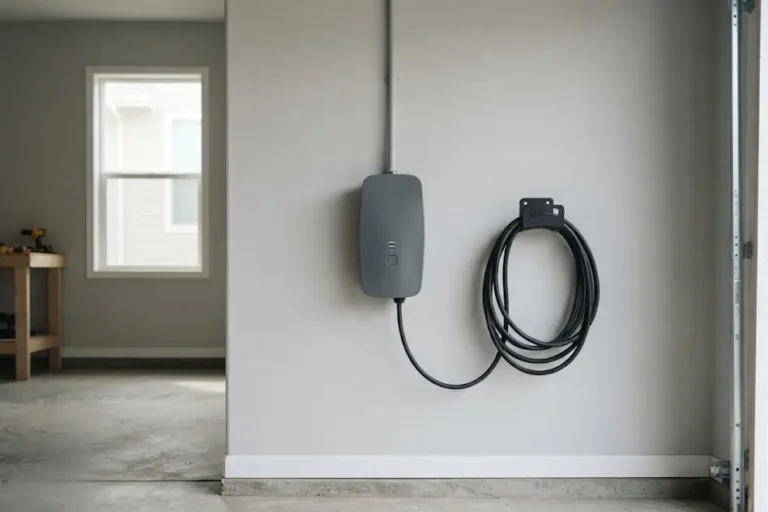
Fixr explains that the electrical code moved new dryer and range connections to four prongs in 1996, so older homes often have three-prong outlets (Fixr). Rather than rewiring, HomeGuide notes that the appliance cord can often be swapped to match the outlet, for $15 to $30 in parts (HomeGuide). For electric vehicles, the Department of Energy says Level 2 home charging runs on 240 volts, that some homes lack the electrical capacity for it, and that an electrician can tell you whether yours does and add circuits if needed. Even the slower Level 1 charging, with the cord that comes with the vehicle, assumes an outlet on a dedicated branch circuit near where you park (U.S. Department of Energy, Alternative Fuels Data Center).
Outdoor, USB and other specialty outlets
| Outlet | HomeGuide (Aug 2025), installed | Fixr (Aug 2025), part only | Angi (Aug 2026), part only |
|---|---|---|---|
| USB charging outlet | $170 – $350 (smart or USB) | $20 – $40 | $20 – $40 |
| Smart (Wi-Fi) outlet | $170 – $350 | $20 – $80 | $25 – $50 |
| Floor outlet | $175 – $700 | $1 – $50 | $30 – $50 (kit) |
| Ceiling outlet | $200 – $500 | — | $3 – $5 |
| TV outlet above a fireplace | $250 – $500 | — | $3 – $5 |
| Move an existing outlet (installed) | $40 – $250+ | $50 – $200 | $25 – $300 |
For a USB or smart outlet, the labor is the same as for any outlet in an existing box; you pay mainly for the device. Floor and ceiling outlets cost more because of the location: a floor outlet needs a sturdier, sealed box with a cover, and a ceiling outlet means working overhead (HomeGuide).
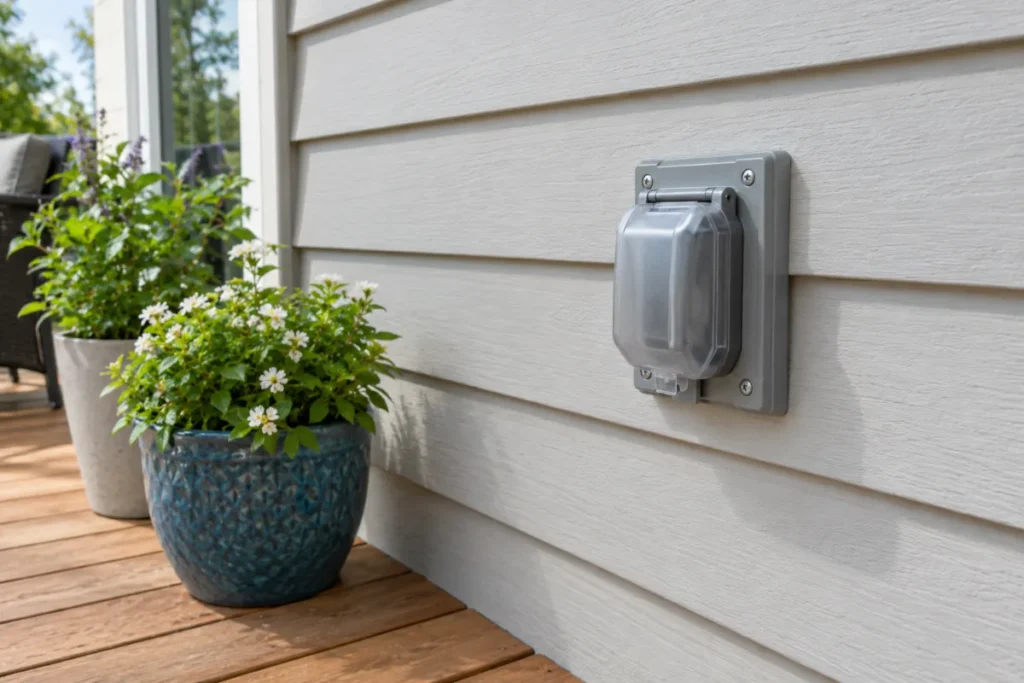
Outdoor outlets must be GFCI-protected and need a weatherproof cover, according to HomeGuide and Angi, which prices the cover at $10 to $20 and notes that an in-use cover, which stays closed with a cord plugged in, costs about the same. Fixr describes the simplest route as adding an outdoor outlet back-to-back with an indoor one on the same wall; an older home that needs new wiring or panel changes pushes the job to $1,000 to $1,400 (Fixr).
Upgrading two-prong outlets
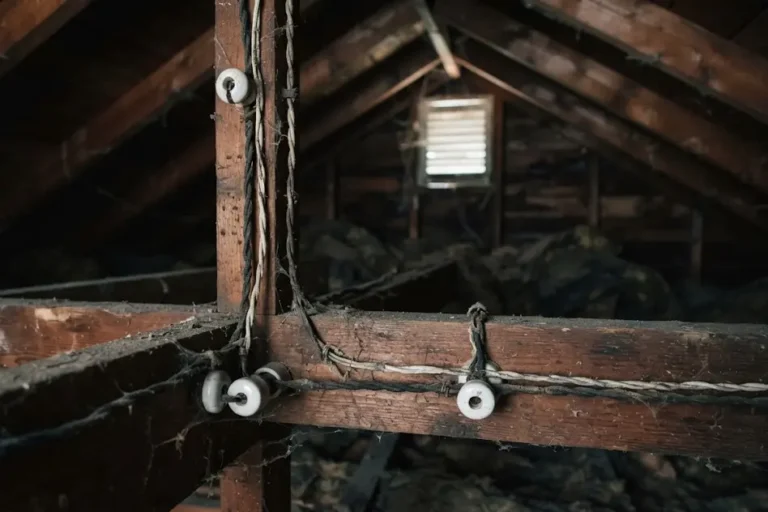
Two-slot outlets have no ground wire. Swapping one for a three-prong outlet without dealing with the ground is unsafe and against code, HomeGuide warns, unless the new outlet is GFCI-protected or a ground wire is run to it. The two proper fixes have different prices (HomeGuide; Fixr):
- Run a new ground wire: $100 to $300 per outlet at HomeGuide, $100 to $150 at Fixr. Grounding a whole house costs $2,000 to $10,000 or more at HomeGuide, depending on whether the old wiring can stay.
- Install a GFCI outlet instead: $90 to $200 at HomeGuide. It protects against shock but does not create a ground. The CPSC says a GFCI can replace an ungrounded two-slot outlet, but it must carry the “No equipment ground” label supplied with it (CPSC).
- Protect the whole circuit at the panel: a GFCI circuit breaker costs $120 to $380 at HomeGuide and covers every outlet on that circuit.
Until then, never force a three-prong plug into a two-slot outlet (USFA). Fixr notes that two-slot outlets are not found in homes built after 1962, so a house full of them is an older installation; ask the electrician to look at the wiring itself, not only the outlets.
Electrician rates and minimum charges
| Source | Hourly rate | Minimum charge |
|---|---|---|
| HomeGuide (Aug 2025) | $50 – $130 | Usually one hour, plus a $100 – $200 trip fee |
| Angi (Aug 2026) | $50 – $100; master electrician $90 – $150; less experienced $40 – $85 | At least $100 – $200 per visit |
| Fixr (Aug 2025) | $40 – $100 | Often one hour, sometimes half an hour |
| Homewyse (Sep 2026) | 2.1 hours for $264 – $320 (new outlet) | Two hours in its replacement estimate |
The minimum charge is what makes a single outlet look expensive: a swap that takes 20 minutes is billed as a full visit. That is also why every guide suggests bundling small electrical jobs into one visit. Angi’s own table shows the per-outlet price staying roughly flat as the count rises ($130 to $300 for one outlet, $1,350 to $3,000 or more for ten), so the saving from bundling is mainly the minimum charge and trip fee you pay once instead of several times (Angi).
For an official reference point, the median electrician in the United States earned $30.38 an hour ($63,190 a year) in May 2025; the lowest-paid 10 percent earned less than $42,640 a year and the highest-paid 10 percent more than $108,510, according to the Bureau of Labor Statistics. What a company bills per hour is higher than what the electrician takes home; Angi notes, for example, that minimum fees cover travel, supplies and gas.
Our estimate: Homewyse’s $264 to $320 for 2.1 hours works out to about $126 to $152 per billed hour, roughly four to five times the BLS median wage of $30.38. This is our own division of published figures, not a measured rate, and Homewyse’s labor line also covers planning, buying materials and cleanup.
Permits, inspection and wall repair
A new outlet usually needs an electrical permit. HomeGuide says most cities require one for a new outlet, while replacing an existing outlet or upgrading it to a GFCI or USB model does not (HomeGuide); the rules are local, so confirm with your building department. Fees run $50 to $350 at HomeGuide, $50 to $100 in Angi’s outlet guide and $50 to $400 in its GFCI guide, depending on the size of the job (Angi; Angi GFCI). Homewyse leaves permits out of its estimates. HomeGuide suggests combining several small projects under one permit to keep the cost down.
Fishing wire through finished walls can leave holes. HomeGuide puts drywall repair at $300 to $500 for small holes and $500 to $800 or more for larger ones; Angi lists $300 to $900. For the single hole left where an outlet box was moved, Fixr says some electricians patch it themselves and others send you to a handyman, at $50 to $100 an hour for about an hour of work (Fixr). Ask before work starts whether patching and painting are in the quote.
Can you install an outlet yourself?
The sources do not give one answer, and this is not legal advice. HomeGuide says you do not need a licensed electrician to install an outlet, but that electrical work is dangerous and that most cities require a permit for a new one (HomeGuide). The CPSC says GFCI outlets may be installed by homeowners who have the knowledge and skills to follow proper wiring practice and the device’s instructions, and that anyone in doubt should call a qualified electrician (CPSC). ESFI is stricter: it says GFCIs should only be installed by a licensed, qualified electrician (ESFI). This Old House describes replacing an outlet as a task that may be manageable for experienced homeowners (This Old House), and Fixr advises against doing it yourself at all.
Where the guides do agree is on the harder jobs. Angi says a new outlet in a new location needs an electrician (Angi GFCI) and that 240-volt work is not a do-it-yourself job (Angi 240V), and HomeGuide calls a three-prong outlet on ungrounded wiring dangerous unless it is GFCI-protected or grounded. Most states require electricians to be licensed (BLS), and whether a homeowner may do electrical work on their own house is decided by state and local rules. Those rules also differ in which NEC edition they enforce: as of August 3, 2026, the NFPA counted the 2026 edition in effect in six states, the 2023 edition in 20, the 2020 edition in 15, the 2017 edition in three and the 2008 edition in two, with other states leaving adoption to local governments (NFPA).
Signs an outlet needs an electrician
In 2021, an estimated 24,200 residential building electrical fires were reported to U.S. fire departments, causing an estimated 295 deaths, 900 injuries and over $1.2 billion in property loss (U.S. Fire Administration). Call an electrician if you notice any of these:
- The outlet or its cover feels hot, or you get a shock when plugging in or unplugging (Fixr; Angi).
- The outlet gives no power, or its breaker keeps tripping (Fixr).
- Plugs no longer fit snugly; the USFA says such outlets should be replaced (USFA).
- A GFCI does not cut power when you press its test button, or does not come back on with reset (CPSC).
Where you are short of outlets, the USFA advises plugging major appliances directly into a wall outlet, never through an extension cord, and not overloading outlets or power strips.
How to keep the bill down
- Group outlets, switches and other small electrical jobs into one visit so you pay the minimum charge and trip fee once.
- Put the new outlet near an existing circuit with spare capacity when you can; extending a circuit costs far less than a new $250 to $900 dedicated circuit.
- Have outlets added while walls are open during a remodel, before drywall goes up.
- For a 240-volt appliance with the wrong plug, ask whether changing the appliance cord ($15 to $30 in parts) solves it before paying to rewire the outlet.
- For two-prong outlets, compare a labeled GFCI outlet or a GFCI breaker with the cost of running new ground wires.
- Get at least three written quotes from licensed electricians and check that each one covers the same work, permit and wall repair.
Questions to ask before you sign
- Will the new outlet go on an existing circuit, or does it need a dedicated one?
- Does the price include the permit and inspection?
- What is your minimum charge or trip fee, and could other small jobs be done in the same visit?
- Does this location need GFCI or AFCI protection under the code our city enforces?
- Who patches and paints any drywall you open, and is that in the quote?
- Does my panel have room for another circuit, or will it need work first?
- Are you licensed and insured, and what warranty do you give on the work?
Sources
- U.S. Bureau of Labor Statistics, Occupational Outlook Handbook: Electricians, pay data for May 2025.
- U.S. Consumer Product Safety Commission, GFCI Fact Sheet (Pub. 099), September 2010.
- U.S. Fire Administration, Appliance and Electrical Fire Safety, page last reviewed May 4, 2023.
- U.S. Department of Energy, Alternative Fuels Data Center, Charging Electric Vehicles at Home.
- National Fire Protection Association, NEC enforcement maps, status as of August 3, 2026.
- Electrical Safety Foundation International, Ground Fault Circuit Interrupters (GFCI) and Arc Fault Circuit Interrupters (AFCIs), undated pages.
- HomeGuide, How Much Does It Cost to Install an Electrical Outlet?, August 29, 2025.
- Fixr, Cost to Install Electrical Outlet, updated August 29, 2025.
- Homewyse, Cost to Install an Electrical Outlet and Cost to Replace an Electrical Outlet, September 2026 estimates.
- Angi, read from archive.org copies: How Much Does It Cost to Install an Outlet? (updated August 3, 2026), GFCI outlet cost (November 20, 2025), outdoor outlet cost (November 25, 2025), dedicated circuit cost (May 3, 2026) and 240V outlet cost (February 10, 2025).
- This Old House, What Is the Cost to Upgrade an Electrical Panel?, updated March 31, 2026.