$16,080 – $30,400That is the typical solar panel installation cost in 2026 for a 6- to 10-kW rooftop system, before any incentive. EnergySage prices a 6-kW system at $16,080 and Fixr prices a 10-kW system at $30,400. Per watt, the two guides average $2.60 and $3.04, and the Department of Energy’s 2025 benchmark for an 8-kW home system is $2.95 per watt. The federal 30% credit no longer applies to a system finished in 2026, so it will not lower these prices.
Our estimate: the headline range runs from EnergySage’s price for a 6-kW system ($16,080) to Fixr’s price for a 10-kW system ($30,400). It is our own combination of the lowest and highest figures for that size band in the two 2026 guides, not a measured figure.
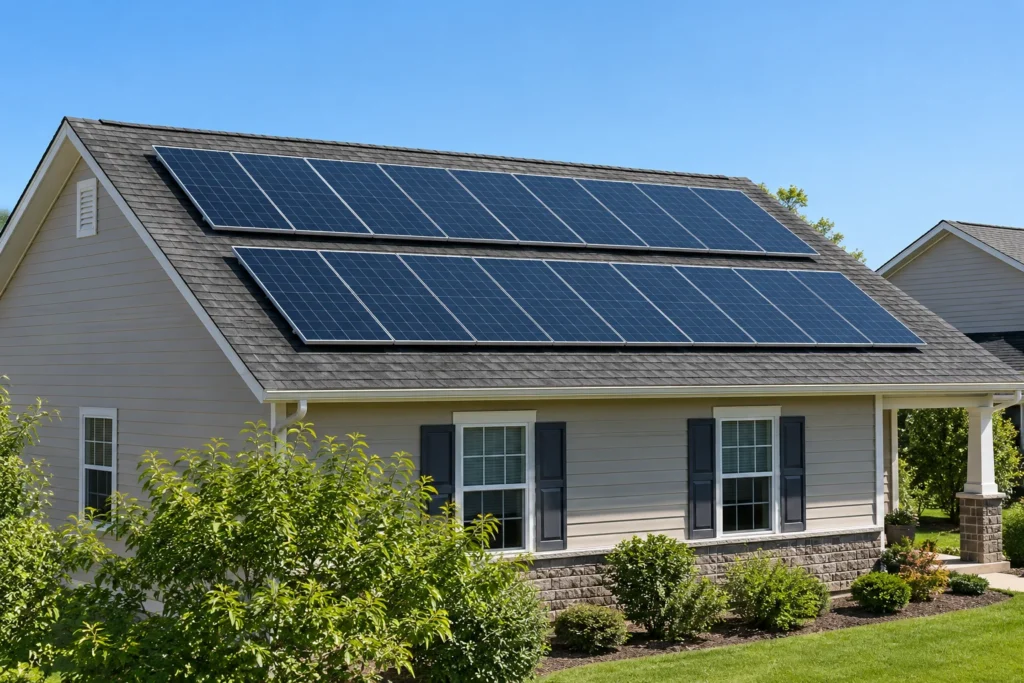
Solar is priced by the watt, so the size of the system drives almost everything. A bigger system costs more in total, but the guides agree it usually costs less per watt. Below you will find the price by system size, the price per watt from five sources, how much it varies by state, where the money goes, and what has changed now that the federal credit has ended.
Solar panel installation cost by system size
| System size | EnergySage | Fixr | HomeGuide (older) |
|---|---|---|---|
| 4 kW | $11,560 | $12,200 | $12,000 – $18,000 |
| 5 kW | $13,900 | $15,200 | $15,000 – $22,500 |
| 6 kW | $16,080 | $18,200 | $18,000 – $27,000 |
| 8 kW | $20,960 | $24,300 | $24,000 – $36,000 |
| 10 kW | $25,800 | $30,400 | $30,000 – $45,000 |
| 12 kW | $30,720 | $36,500 | $36,000 – $54,000 |
The two 2026 guides agree on the shape of the curve, but Fixr is higher at every size. EnergySage’s page also has a section on why its own marketplace prices run lower than national prices (EnergySage), so read its column as the lower of the two 2026 guides. For the typical home, EnergySage reports an average 12-kW system price of $31,135, a little above the $30,720 in its size table because the average counts every quote, not only 12-kW ones. HomeGuide’s older ranges overlap Fixr’s at the bottom and run much higher at the top.
Fixr’s overall national figure is $23,100 for a 7.6-kW system, with most homeowners paying $19,100 to $23,800 (Fixr).
Estimate your solar panel installation cost
Our estimate: the published ranges above multiplied out for your inputs. Not a quote. Per-kW prices from EnergySage (June 2026), Fixr (January 2026), the Department of Energy 2025Q1 benchmark, This Old House (June 2026) and HomeGuide (July 2024, older), all before incentives. Extras from Fixr (January 2026), This Old House (March 2026) and EnergySage (June 2026). Labor is about 7% of the price in all three 2026 guides. State adjustment: BLS construction wages (May 2025), applied to an assumed 7% labor share. How we calculate
Our estimate: each calculator option multiplies your system size by one source’s price per kW. EnergySage’s $2,470 to $2,890 is the lowest and highest price per watt in its size table (15 kW and 4 kW). Fixr’s $2,510 to $3,130 is its “most projects” range of $19,100 to $23,800 divided by its 7.6-kW system. The DOE figure is its $2.78 to $2.95 per watt, This Old House’s is the lowest and highest state average in its 10-kW table ($2.29 to $3.66), and HomeGuide’s is its $3.00 to $4.50. This is our own combination, not a measured figure.
Cost per watt: what each source says
| Source | Price per watt | What it covers |
|---|---|---|
| EnergySage (June 2026) | about $2.60; $2.47 (15 kW) to $2.89 (4 kW) | Average of quotes on its marketplace |
| Fixr (January 2026) | about $3.04 | Average across system sizes |
| Department of Energy (2025Q1) | $2.78 minimum sustainable price; $2.95 modeled market price | 8-kW rooftop system, panels only, in 2024 dollars, no subsidies |
| This Old House (June 2026) | $2.29 – $3.66 | State averages for a 10-kW system, before the credit |
| HomeGuide (older, July 2024) | $3.00 – $4.50 | Installed, before incentives |
The Department of Energy builds its benchmark from cost data collected by three national laboratories. It publishes two prices: the minimum sustainable price, which is what a company needs to charge to stay solvent in a balanced, competitive market, and the modeled market price, which is the actual current price and can differ because of temporary distortions such as tariffs. The benchmark does not include any subsidy paid to the system owner (U.S. Department of Energy). Its representative home system has twenty 400-watt modules, each paired with a microinverter, for 8 kW in total.
Our estimate: 8 kW is 8,000 watts, so the DOE’s $2.78 to $2.95 per watt works out to about $22,240 to $23,600 for the 8-kW system. This is our own multiplication of the published per-watt prices, not a figure the DOE publishes. It sits between the 8-kW prices of EnergySage ($20,960) and Fixr ($24,300).
This Old House also prices the panels one by one: its 2025 survey of 1,000 solar customers puts the national average for one professionally installed panel at $1,200, so a full-size system of 20 to 30 panels costs $24,000 to $36,000 (This Old House). Treat that range with care: the same page describes it as the price after the 30% federal credit, which the IRS says no longer applies to 2026 installs. It also reports that most homeowners in its survey said they paid about $16,129, with an average of 14 panels.
How much system do you need?
Size depends on how much electricity you use. This Old House sorts it this way: under 8,000 kWh a year may need a 5- to 6-kW system, 8,000 to 12,000 kWh a year often needs 7 to 10 kW, and above 12,000 kWh a year may need 10 to 12 kW or more (This Old House). Both Fixr and This Old House warn that an oversized system adds up-front cost without adding meaningful savings, and Fixr advises having a professional size the array from your usage, roof and sun exposure (Fixr).
Solar panel installation cost by state
| State | EnergySage | Fixr | This Old House |
|---|---|---|---|
| Florida | $2.12 | $2.61 | $2.53 |
| Texas | $2.25 | $2.85 | $2.64 |
| Arizona | $2.26 | $2.79 | $2.44 |
| California | $2.52 | $3.33 | $3.06 |
| New York | $2.77 | $3.33 | $3.35 |
| Massachusetts | $2.90 | $3.12 | $3.53 |
In all three guides Florida, Texas and Arizona are cheaper per watt than New York, but for individual states the guides disagree widely. Alabama is $3.82 per watt at EnergySage, $3.42 at Fixr and $2.35 at This Old House. Use state figures as a rough guide to the direction of local prices, not as a quote. Climate and electricity use change the size of the system you need, so two states with similar prices per watt can still have very different totals (EnergySage).
Where the money goes
| Share of the total price | EnergySage | Fixr | This Old House |
|---|---|---|---|
| Solar panels | 12% | 12% | 18% |
| Inverters | 10% | 10% | 19% (with other equipment) |
| Installation labor | 7% | 7% | 7% |
| Permits and interconnection | 8% | 4% | 5% |
| Sales, marketing and customer acquisition | 18% | 15% | in soft costs |
| Soft costs in total (overhead, marketing, design, profit) | — | — | 51% |
The panels themselves are a small slice of the bill, and the crew’s labor is smaller still. Most of the price goes to the equipment around the panels, the cost of selling the job, overhead, profit and the paperwork to connect to the grid (EnergySage; Fixr). This Old House advises getting at least three estimates, since prices can vary by thousands of dollars for the same size of system (This Old House).
The extras that raise the price
| Extra | Cost | Source |
|---|---|---|
| Battery storage | $7,000 – $18,000+ (about $15,000 on average) | Fixr, January 2026 |
| One solar battery | $5,097 on average, depending on capacity, type and brand | This Old House, June 2026 survey |
| Electrical panel upgrade, 100 to 200 amps | $1,300 – $3,000 | This Old House, March 2026 |
| Trimming or removing shading trees | $300 – $1,500 | EnergySage, June 2026 |
| Permit and inspection fees | from $100 in smaller towns to over $1,000 in larger cities | This Old House, June 2026 |
| Taking panels off and putting them back for a later roof job | about $3,800 (Fixr); $1,000 – $3,000+ (This Old House) | Fixr, January 2026; This Old House, June 2026 |
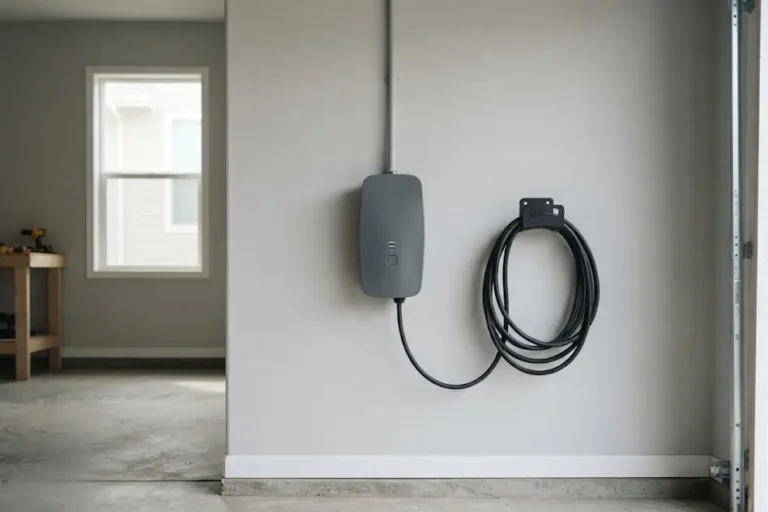
| Adding an EV charger to the job | $600 – $2,000 | Fixr, January 2026 |
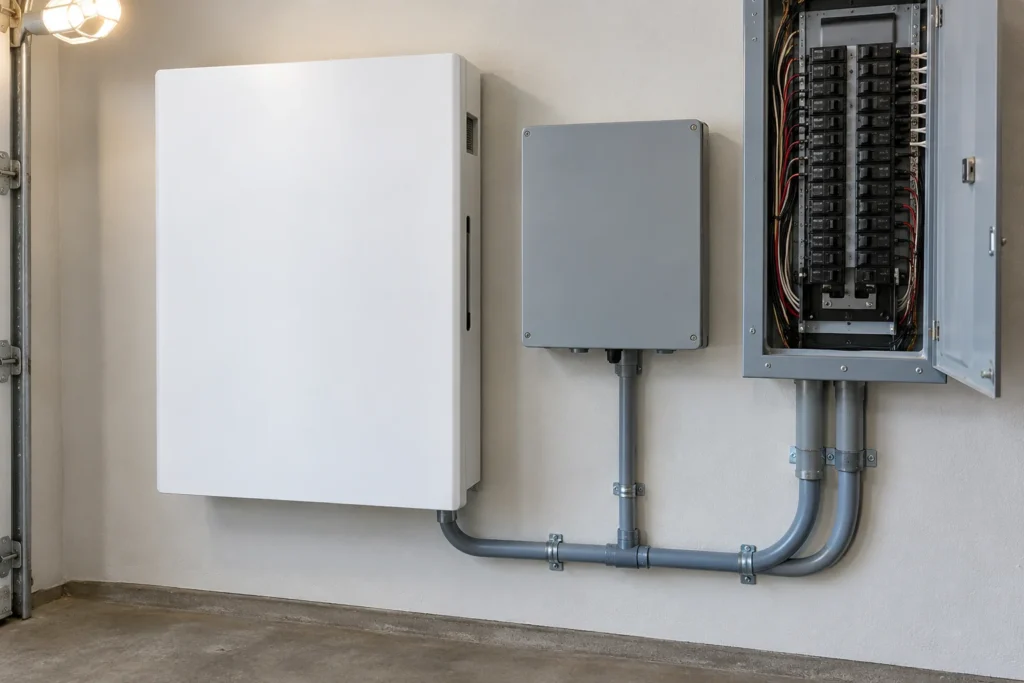
Battery. A battery stores your panels’ daytime output for the evening and can provide backup power in an outage (This Old House). It is also the biggest single add-on. The Department of Energy’s benchmark prices a system with a 13.5-kWh battery at $4.33 to $4.59 per watt for 8 kW, against $2.78 to $2.95 without one (U.S. Department of Energy).
Our estimate: at 8,000 watts, $4.33 to $4.59 per watt is about $34,640 to $36,720, which is roughly $12,400 to $13,100 more than the $22,240 to $23,600 for panels alone. It is our own subtraction of the published benchmark prices, not a figure the DOE publishes, and it falls inside Fixr’s $7,000 to $18,000 range. For other ways to keep power on, see our guide to generator installation cost.
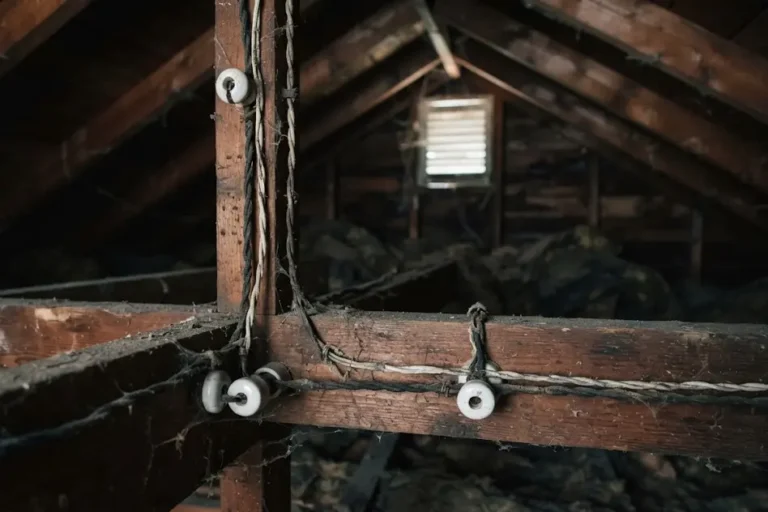
Electrical panel. EnergySage says your panel should be at least 200 amps to go solar, and that an upgrade can add a few thousand dollars (EnergySage). Fixr adds that older homes may need a 200-amp upgrade or extra wiring (Fixr). Our guides to electrical panel upgrade cost and house rewiring cost cover those jobs, and the same panel work applies if you also plan an EV charger.
Roof. Fixr says the roof should have at least 10 years of life left before panels go on, and that repairs or a replacement can add thousands (Fixr). The reason is the table above: if the roof is redone later, the panels come off and go back on. Check the age and condition of yours first with our guides to how long a roof lasts and roof replacement cost.
Inverter. A string inverter typically lasts only 10 to 12 years, so you should plan on replacing one a couple of times during a 30-year array’s life, says This Old House. It prices string inverters at $1,000 to $3,000 and microinverters at $2,700 to $10,200, based on 2025 data from EnergySage and Angi (This Old House).
No federal tax credit for solar in 2026
The Residential Clean Energy Credit was 30% of the cost of new qualified property, including solar electric panels and battery storage of at least 3 kWh, installed from 2022 through December 31, 2025. The IRS states that the credit is not available for any property placed in service after December 31, 2025 (IRS). The IRS’s frequently asked questions close the loophole people ask about: an expenditure is treated as made when the original installation is completed, so paying for a system before the end of 2025 does not qualify if the installation finishes in 2026 (IRS, FS-2025-05).
That has two practical effects. First, any quote that shows an “after credit” price for a 2026 installation is subtracting a credit you cannot claim. Some cost guides still show it: HomeGuide’s page, dated 2024, says a 30% credit is available on most systems installed between 2022 and 2032 (HomeGuide), and This Old House’s June 2026 page still describes the credit as available (This Old House). Both conflict with the IRS. Second, Fixr notes that systems owned by a third party, such as leases and power purchase agreements, may still qualify under commercial credits, with the savings sometimes passed on through lower rates (Fixr). Ask any company offering that how the savings are written into the contract.
State, local and utility incentives are separate programs and vary by location. Fixr and HomeGuide both point to the Database of State Incentives for Renewables & Efficiency (DSIRE) for what is available where you live (Fixr; HomeGuide).
Is solar still worth it without the credit?
Two of the guides still quote an average payback of about 10 years: EnergySage says it takes an average of about 10 years to earn back the money you spend, and Fixr puts the average payback at about 10 years (EnergySage; Fixr). Neither page shows what incentives it assumes, so check it against your own numbers. The U.S. Energy Information Administration put the average residential price of electricity at 18.31 cents per kWh in July 2026, but the figure varies a lot by state: 33.61 cents in California, 15.88 in Texas and 12.72 in Louisiana (EIA, Table 5.6.A).
Our estimate: an installer on a This Old House project describes an 8-kW system on one home as producing about 10,000 to 11,000 kWh a year (This Old House). Take 10,000 kWh at the July 2026 U.S. average of 18.31 cents: that is about $1,831 a year of electricity. Against the $22,240 to $23,600 we calculated from the DOE benchmark, with no credit, the simple payback is about 12 to 13 years ($22,240 ÷ $1,831 ≈ 12.1; $23,600 ÷ $1,831 ≈ 12.9). It assumes every kWh is worth the retail price, that production is 10,000 kWh, and uses a single July price rather than a yearly average. It is not a measured figure, and the result will be shorter in states with expensive electricity and longer where it is cheap.
How to keep the bill down
- Get at least three quotes and compare them per watt, not just in total. Fixr and This Old House both recommend three or more estimates (Fixr; This Old House).
- Size the system to your real usage. An oversized system raises the price without adding meaningful savings (Fixr).
- Fix the roof first, so you do not pay to take the panels off and put them back later (Fixr).
- Look at how you pay. Paying cash usually gives the lowest total cost, while a loan adds interest and some installers add origination fees to financed systems (Fixr). This Old House puts solar loan interest at $3,000 to $8,000 over the life of the loan (This Old House).
- Check state, local and utility incentives, since the federal credit is gone. Fixr notes that many states, cities and utilities offer rebates or tax credits, depending on where you live (Fixr).
Questions to ask before you sign
- What is the price per watt, and is the quote before or after any incentive? Which incentive, exactly?
- Does the price include permits, inspections and the utility interconnection fee?
- How many panels, of how many watts each, and what type of inverter?
- Is my roof and electrical panel good enough, and what happens to the price if they are not?
- Do I own the system, or is it a lease or power purchase agreement, and how do the payments change over time?
- What does the warranty cover, and who pays to remove and reinstall the panels if the roof needs work?
Sources
- Internal Revenue Service, Residential Clean Energy Credit.
- Internal Revenue Service, FAQs for modification of sections 25C, 25D, 25E, 30C, 30D, 45L, 45W, and 179D under Public Law 119-21, FS-2025-05, August 21, 2025.
- U.S. Department of Energy, Solar Photovoltaic System Cost Benchmarks, 2025Q1 benchmarks in 2024 dollars.
- U.S. Energy Information Administration, Electric Power Monthly, Table 5.6.A, July 2026 data.
- EnergySage, Solar Panel Cost in 2026, updated June 30, 2026; state data updated October 16, 2026.
- Fixr, How Much Do Solar Panels Cost? [2026 Data], updated January 30, 2026.
- This Old House, How Much Do Solar Panels Cost in 2026?, updated June 12, 2026, and What Is the Cost to Upgrade an Electrical Panel?, updated March 31, 2026.
- HomeGuide, How Much Do Solar Panels Cost?, an older guide (July 8, 2024). Used only for before-incentive prices.