$5,100 – $25,000That is the typical generator installation cost in 2026 for a whole-house standby generator, unit and labor included, across three published cost guides. HomeGuide puts the average job at $6,000 to $11,000, The Spruce at $5,090 to $19,050 and ConsumerAffairs at $10,000 to $25,000 for most homes. A portable generator costs $500 to $2,500, plus $400 to $1,300 for a transfer switch to connect it to your panel (HomeGuide).
The price of the machine is only part of the bill. Labor alone runs $3,000 to $5,000 for an average standby job, and it depends on how far the generator sits from your electrical panel and gas meter, what fuel it burns and what permits your town requires (HomeGuide). ConsumerAffairs reports that distance to the utility connections causes the biggest swings in installation pricing (ConsumerAffairs). The sections below break down each line so you can read a quote with confidence.
Whole-house generator cost breakdown
| Item | HomeGuide | ConsumerAffairs | The Spruce |
|---|---|---|---|
| Standby generator (unit) | $3,000 – $6,000 | $5,000 – $23,500 | By size (see below) |
| Installation labor | $3,000 – $5,000 | $1,500 – $5,000 | $2,375 – $6,500 |
| Automatic transfer switch | $600 – $2,500 | $600 – $1,200 | $1,435 – $2,565 |
| Permits | $80 – $450 | $80 – $500 | $50 – $200 |
| Total installed | $6,000 – $11,000 | $10,000 – $25,000 | $5,090 – $19,050 |
The three guides do not agree, and the gap is large. HomeGuide, which bases its figures on estimates homeowners get from contractors, has the lowest typical total (HomeGuide). ConsumerAffairs is the highest, at $10,000 to $25,000 for most homes, and says a basic setup can start at $4,500 while complex jobs with large generators and extensive site work pass $55,000 (ConsumerAffairs). Most of the gap is in the price of the unit itself, so the size you choose matters more than anything else on the quote.
Our estimate: the $5,100 – $25,000 headline range runs from the lowest typical total in the table above ($5,090 from The Spruce, rounded to the nearest $100) to the highest ($25,000 from ConsumerAffairs). It is the span of three published ranges, not a measured price, and it leaves out the very large estate installations that ConsumerAffairs prices separately.
| Project size | What it covers | Installed cost |
|---|---|---|
| Small | Emergency backup only (lights, refrigerator, medical equipment), or a very small house | $4,500 – $10,600 |
| Average | Whole-home coverage for an average 1,800 sq ft home | $5,000 – $19,700 |
| Large | Whole-home coverage for a 3,000 sq ft home | $7,600 – $25,400 |
| Very large | Luxury estate with pool pumps, pool heaters and similar loads | $15,800 – $56,900 |
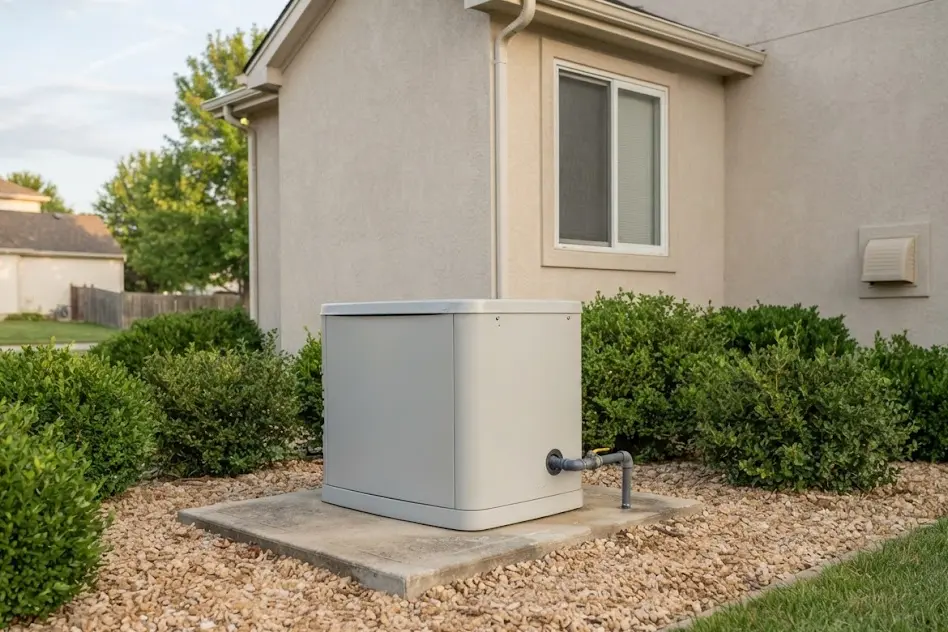
A standby generator is wired permanently into the electrical panel and starts on its own when the power goes out. HomeGuide puts its life at 15 to 30 years, or 10,000 to 30,000 hours of use with proper maintenance (HomeGuide).
Estimate your generator installation cost
Our estimate: the published ranges above multiplied out for your inputs. Not a quote. Installed totals by project size and both add-ons from ConsumerAffairs (September 2026). HomeGuide (December 2025) and The Spruce (May 2025) give lower typical totals; see the tables above. State adjustment: BLS construction wages (May 2025), applied to an assumed 50% labor share. How we calculate
The calculator uses the ConsumerAffairs installed totals because they are the only published ranges by home size; they sit higher than the HomeGuide and The Spruce totals in the first table. The two add-ons are what ConsumerAffairs says can be added on top: $1,000 to $2,200 to upgrade an older 100-amp panel to 200 amps, and $500 to $2,000 to run a natural gas line from the street or install propane tanks and lines (ConsumerAffairs).
Portable vs. standby generator
| Portable | Standby | |
|---|---|---|
| Unit price | $500 – $2,500 | $3,000 – $6,000 |
| Connection to the panel | Transfer switch $400 – $1,300, or interlock $400 – $850 installed | Automatic transfer switch $600 – $2,500 |
| Starts on its own | No | Yes |
| Fuel | Refilled by hand | Natural gas line or propane tank |
A portable generator is the cheaper way to keep the refrigerator, sump pump and a few lights running. A 7 to 10 kW unit can carry about 10 lights, a refrigerator, a sump or well pump, a microwave, a TV and the furnace fan (HomeGuide). The trade-off is that you have to wheel it out, fuel it and start it yourself, in the middle of the storm, and it has to stay far from the house for the carbon monoxide reasons explained below.
Our estimate: a portable generator connected through an interlock comes to roughly $900 – $3,350 all in ($500 – $2,500 for the unit plus $400 – $850 for the installed interlock, both from HomeGuide). This is a sum of two published ranges, not a measured project price, and it leaves out any permit.
Generator cost by size
| Size | HomeGuide | The Spruce | Typical coverage |
|---|---|---|---|
| 2 – 5 kW | $250 – $1,400 | $475 – $1,575 | Portable: one appliance and a few lights |
| 7 – 10 kW | $2,000 – $3,000 | $1,775 – $3,625 | Essentials: lights, refrigerator, pumps, furnace fan |
| 13 – 16 kW | $3,000 – $4,500 | $3,750 – $5,200 | Whole home under 1,500 sq ft |
| 17 – 20 kW | $4,000 – $6,000 | $4,250 – $6,600 | Whole home of 1,500 – 3,000 sq ft |
| 22 – 25 kW | $4,500 – $12,000 | $5,125 – $8,875 | Whole home of 3,000 – 5,000 sq ft |
| 30 – 48 kW | $10,000 – $16,000 | $11,335 – $22,000 | Large homes or light commercial |
Sizing starts with what you want to run. Typical running loads are about 1,200 watts for a refrigerator, 1,000 watts for a sump or well pump, 500 watts for a furnace fan and 8,500 watts for a 4-ton central air conditioner, and some appliances draw up to double their running wattage when they start (HomeGuide). Central air, an electric oven, a dryer or an EV charger are what push a house from a 10 kW unit to 20 kW or more, so ask the installer to show the load calculation behind the size quoted.
Transfer switch or interlock
A transfer switch or interlock is what connects a generator to the home’s electrical panel. A transfer switch costs $400 to $2,500 installed; an interlock costs $400 to $850 installed and lets a portable generator connect to the panel without a transfer switch (HomeGuide). Standby generators use an automatic transfer switch, listed at $600 to $2,500. Other guides put it at $600 to $1,200 for materials and labor (ConsumerAffairs) or $1,435 to $2,565 to install, with an average of $2,000 (The Spruce).
This part is not optional. The North Carolina Department of Labor warns never to attach a generator directly to a building’s electrical system unless it has a properly installed transfer switch, because doing so creates a risk of electrocution for utility workers (NC Department of Labor). Appliances should be plugged directly into the generator with its own cords or heavy-duty, grounded extension cords.
Installation cost factors
| Item | HomeGuide | Other guides |
|---|---|---|
| Electrician labor | $40 – $100 per hour | — |
| Automatic transfer switch | $600 – $2,500 | $600 – $1,200 (ConsumerAffairs); $1,435 – $2,565 (The Spruce) |
| Electrical wiring | $6 – $8 per foot | — |
| Gas line | $12 – $25 per foot | $500 – $2,000 for a gas line to the street or a propane tank and lines (ConsumerAffairs) |
| Concrete pad | $150 – $400 | About $375, or $50 – $75 per sq ft (The Spruce) |
| Propane tank | $400 – $1,800 | $500 – $2,000+ (ConsumerAffairs) |
| Panel upgrade, 100 to 200 amps | — | $1,000 – $2,200 (ConsumerAffairs) |
| Permits | $80 – $450 | $80 – $500 (ConsumerAffairs); $50 – $200 (The Spruce) |
Gas line or propane tank. Natural gas units tie into the home’s existing gas line and need no fuel storage; propane units need a large storage tank (HomeGuide). The same guide quotes gas piping elsewhere at $15 to $50 or more per linear foot, so ask for the gas work as its own line on the quote. Gas line upgrades are also a common extra on other gas appliances, as we explain in our guide to tankless water heater installation cost.
Our estimate: a standby generator set 30 feet from the gas meter and 30 feet from the panel would add about $360 – $750 of gas line (30 ft × $12 – $25) and $180 – $240 of wiring (30 ft × $6 – $8), using HomeGuide’s per-foot figures. It illustrates how distance adds up; it is not a measured price.
Concrete pad. A 3- to 4-inch pre-cast pad costs $150 to $400 (HomeGuide). The Spruce puts a poured pad at about $375, or $50 to $75 per square foot (The Spruce).
Permits. Separate electrical, plumbing and mechanical permits may apply, for $80 to $450 in total (HomeGuide). ConsumerAffairs puts permit fees at $80 to $500 and says you will almost always need one for a standby generator, because most towns require a permit for pouring a foundation (ConsumerAffairs); The Spruce gives $50 to $200 (The Spruce). Local noise rules can matter too: most standby units produce 60 to 70 decibels at 25 feet, similar to a central air conditioner (HomeGuide).
Labor. Installation labor is $3,000 to $5,000 for an average job according to HomeGuide (HomeGuide), $1,500 to $5,000 for a typical home with a fuel source nearby according to ConsumerAffairs (ConsumerAffairs), and $2,375 to $6,500, with an average of $4,440, according to The Spruce (The Spruce). The Bureau of Labor Statistics reports a median annual wage for electricians of $63,190 in May 2025, and notes that most states require electricians to be licensed (BLS).
Accessories that can appear on the quote
| Accessory | Price | What it does |
|---|---|---|
| Starting battery | $70 – $300 | Starts the generator when the power goes out |
| Cold-weather kit | $130 – $500 | Helps it start below freezing |
| Wireless monitor | $200 – $210 | Shows generator status from inside |
| Smart load manager | $130 – $250 | Lets a smaller unit run more appliances by balancing the load |
| Fascia kit | $65 – $130 | Protects the base from rodents and insects |
Running and maintenance costs
| Fuel | 7 kW | 15 kW | 20 kW | The Spruce (home generator) |
|---|---|---|---|---|
| Natural gas | $10 – $20 | $22 – $32 | $30 – $40 | About $100 |
| Liquid propane | $60 – $70 | $145 – $165 | $150 – $170 | About $200 |
| Diesel | $32 – $40 | $90 – $110 | $100 – $120 | About $200 |
The two guides disagree sharply on fuel: The Spruce’s daily figures for natural gas are more than double HomeGuide’s for a 20 kW unit, so check current local fuel prices before relying on either.
Annual professional maintenance costs $200 to $650 and includes a full inspection and oil and filter changes; DIY maintenance kits cost $20 to $110 (HomeGuide). The Spruce gives an average of $220 per professional service call and recommends maintenance once a year or every 100 hours, whichever comes first (The Spruce). For portable units, the CPSC advises checking and maintaining the generator regularly so it works when you need it (CPSC).
Carbon monoxide safety
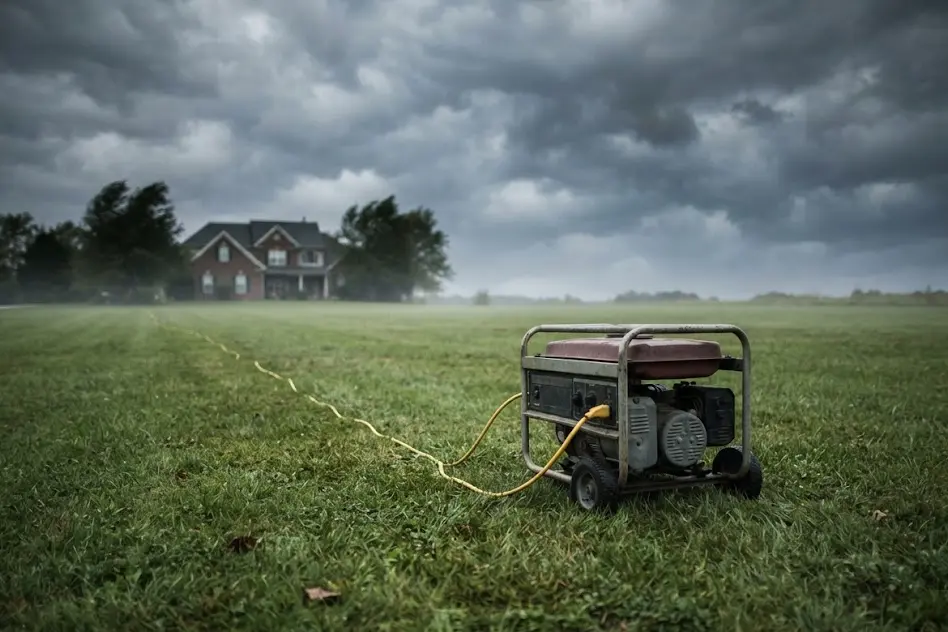
Generators burn fuel and produce carbon monoxide, a colorless, odorless gas. An average of nearly 100 people die in the U.S. each year from carbon monoxide poisoning caused by portable generators, and it can act so fast that people pass out before they notice symptoms (CPSC, March 16, 2026). Federal agencies give the same rules:
- Never run a portable generator inside a home, garage, basement, crawl space or shed. Opening doors or windows does not provide enough ventilation (CPSC).
- Run it outside only, at least 20 feet from the house, not on a porch or in a carport, with the exhaust pointed away from the home (CPSC). The CDC says more than 20 feet from any windows, doors and vents (CDC).
- Install carbon monoxide detectors with battery backup on every level of the home (Ready.gov) and near every sleeping area, and replace them per the manufacturer’s instructions or every 5 years (CDC).
- Keep the generator dry, and let it cool before refueling; fuel spilled on hot engine parts can ignite (Ready.gov).
- When buying a portable unit, look for one with a carbon monoxide shut-off feature (CPSC).
Symptoms of poisoning include headache, dizziness, weakness, upset stomach, vomiting, chest pain and confusion, and people who are asleep can die before they have symptoms (CDC). If a carbon monoxide alarm sounds, get outside immediately and call 911 (CPSC). For standby units, HomeGuide recommends an outdoor spot at least five feet from doors, windows, vents and flammable material (HomeGuide); the manufacturer’s instructions and local code set the exact clearance.
How to keep the bill down
- Size for what you need. Backing up essentials with a 7 to 10 kW unit costs far less than a 22 kW whole-home system.
- If a portable generator is enough, connect it with an interlock or transfer switch rather than buying a standby unit.
- Place a standby generator as close to the gas meter and panel as safe clearances allow; gas line and wiring are priced by the foot.
- Ask about a smart load manager, which lets a smaller generator cover more appliances.
- Get at least three in-person estimates, each with a full cost breakdown.
Questions to ask before you sign
- What load calculation did you use to choose the size?
- Does the price include the transfer switch, pad, gas line, wiring and permits?
- Will your company do the gas piping, or a subcontractor, and is that person certified for gas work?
- Where will the unit sit, and how far is it from windows, doors and vents?
- Are you licensed and insured in this state, and what warranty covers the unit and the work?
- What does yearly maintenance cost, and what is your payment schedule?
Sources
- U.S. Consumer Product Safety Commission, CPSC Issues Winter Weather Safety Tips to Prevent Fires and Carbon Monoxide Poisoning, March 16, 2026.
- Centers for Disease Control and Prevention, Carbon Monoxide Poisoning Basics, January 12, 2026.
- Ready.gov, Power Outages.
- North Carolina Department of Labor, Generator Safe Work Practices.
- U.S. Bureau of Labor Statistics, Occupational Outlook Handbook: Electricians, pay data for May 2025.
- HomeGuide, How Much Does a Whole House Generator Cost?, December 30, 2025.
- ConsumerAffairs, Whole House Generator Installation Cost, updated September 17, 2026.
- The Spruce, How Much Does a Home Generator Cost?, updated May 29, 2025.
- This Old House, Generator Buying Guide: What You Need To Know (2026), updated May 27, 2026.