$8,000 – $36,000That is the typical knob and tube replacement cost in 2026 for a whole house, across three published cost guides. Per square foot, the guides give $4 to $20, and one of them puts a typical 1,500 to 2,000 sq ft home at $12,000 to $18,000. Panel work, permits and wall repair can sit inside or outside those figures, depending on the guide.
The figures come from HomeGuide (February 12, 2026), Block Renovation (July 15, 2026) and ThePricer (September 4, 2026). HomeGuide puts the average job at $12,000 to $35,000, ThePricer at $12,000 to $36,000 or more, and Block Renovation says most projects land at $8,000 to $25,000. Below you will find what drives the spread, how to tell whether your house still has knob and tube, why insurers care about it, and what inspection, panel work, permits and plaster repair add to the bill.
Knob and tube replacement cost at a glance
| Guide | Whole house | Per square foot | What the figure covers |
|---|---|---|---|
| HomeGuide (Feb 2026) | $12,000 – $35,000 | $8 – $17 | New panel, wiring, outlets and switches, labor and permits |
| Block Renovation (Jul 2026) | $8,000 – $25,000 | $4 – $10 | Per-sq-ft figure is the rewire only, before panel work or wall repair |
| ThePricer (Sep 2026) | $12,000 – $36,000+ | $8 – $20 | Electrical rewire, before major plaster restoration or a complicated service upgrade |
| Inch Calculator, older guide (Aug 2023) | $12,000 – $36,000 | $10 – $20 | Removal and rewiring; opening and repairing walls could bring it to $40,000 or more |
The guides disagree more than the headline suggests, mostly because they price different things. Block Renovation’s $4 to $10 per square foot leaves out the panel and the wall repair, which it lists separately; HomeGuide’s $12,000 to $35,000 already includes a new panel and permits in its cost breakdown. ThePricer, which compares other published guides rather than collecting its own quotes, lands closest to the high end. Before you compare a quote with any of these numbers, check what it includes.
Our estimate: the $8,000 to $36,000 headline runs from the lowest low (Block Renovation’s $8,000) to the highest high (ThePricer’s $36,000) of the three 2026 guides, and the $4 to $20 per square foot range is built the same way. The older Inch Calculator guide sits inside both ranges. This is our own combination, not a measured figure.
Estimate your knob and tube replacement cost
Our estimate: the published ranges above multiplied out for your inputs. Not a quote. Ranges from HomeGuide (Feb 2026), Block Renovation (Jul 2026), ThePricer (Sep 2026) and Thumbtack (Jul 2026), as shown in the tables in this article. The HomeGuide range already includes a panel and permits: do not tick those extras with it unless your quote leaves them out. A local quote can differ. State adjustment: BLS construction wages (May 2025), applied to an assumed 70% labor share. How we calculate
Our estimate: the calculator multiplies your square footage by each guide’s per-square-foot range, exactly as published. The partial-replacement line is Block Renovation’s $2,000 to $8,000 for replacing the remaining runs in a house that was already partly rewired. Each extra runs from the lowest to the highest figure the sources in this article give: inspection from HomeGuide’s $100 to the top of Thumbtack’s $217 to $663 range, panel upgrade from HomeGuide’s and ThePricer’s $800 to Block Renovation’s and ThePricer’s $4,000, plaster or drywall repair from Block Renovation, and permits from HomeGuide and Block Renovation. The state adjustment applies to a 70% labor share, the low end of Block Renovation’s statement that labor is 70 to 85% of the total. This is our own combination, not a measured figure.
Cost by home size
| Home size | HomeGuide (Feb 2026) | ThePricer (Sep 2026) | Block Renovation (Jul 2026) |
|---|---|---|---|
| 1,000 sq ft | $8,000 – $17,000 | $8,000 – $20,000 | $6,000 – $12,000 (under 1,200 sq ft) |
| 1,500 sq ft | $12,000 – $25,500 | $12,000 – $30,000 | $10,000 – $18,000 (1,200 – 2,000 sq ft) |
| 2,000 sq ft | $16,000 – $34,000 | $16,000 – $40,000 | $10,000 – $18,000 (1,200 – 2,000 sq ft) |
| 2,500 sq ft | $20,000 – $42,500 | $20,000 – $50,000 | $16,000 – $26,000 (2,000 – 3,000 sq ft) |
| 3,000 sq ft | $24,000 – $51,000 | $24,000 – $60,000 | $16,000 – $26,000 (2,000 – 3,000 sq ft) |
| 3,500 sq ft | $28,000 – $59,500 | — | $24,000 – $40,000+ (over 3,000 sq ft) |
Block Renovation’s ranges are the lowest, and it warns that square footage is only a starting point. In its words, access drives this project so completely that two homes with the same footprint can land twice as far apart on final price: a ranch over an open basement is one of the easiest rewires, while a three-story rowhouse with plaster walls and no attic access over the middle floor is one of the hardest. It also notes that high-cost metro areas can run 30 to 50% above national ranges (Block Renovation).
Most of the money goes to labor. Block Renovation puts labor at 70 to 85% of the total, with electricians charging $50 to $130 an hour over 60 to 120 hours for a full rewire; HomeGuide gives the same $50 to $130 hourly rate and notes that some electricians instead charge $100 to $300 or more per opening, meaning each outlet, switch or fixture (HomeGuide). For comparison, the median electrician earned $30.38 an hour in 2025, according to the Bureau of Labor Statistics, which also notes that most states require electricians to be licensed. A billed rate is higher than the wage because it also covers the business behind the worker.
What knob and tube wiring is and how to spot it
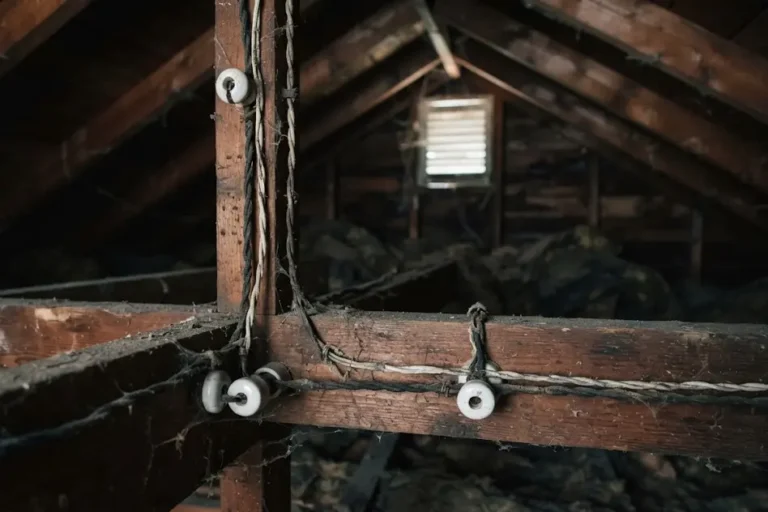
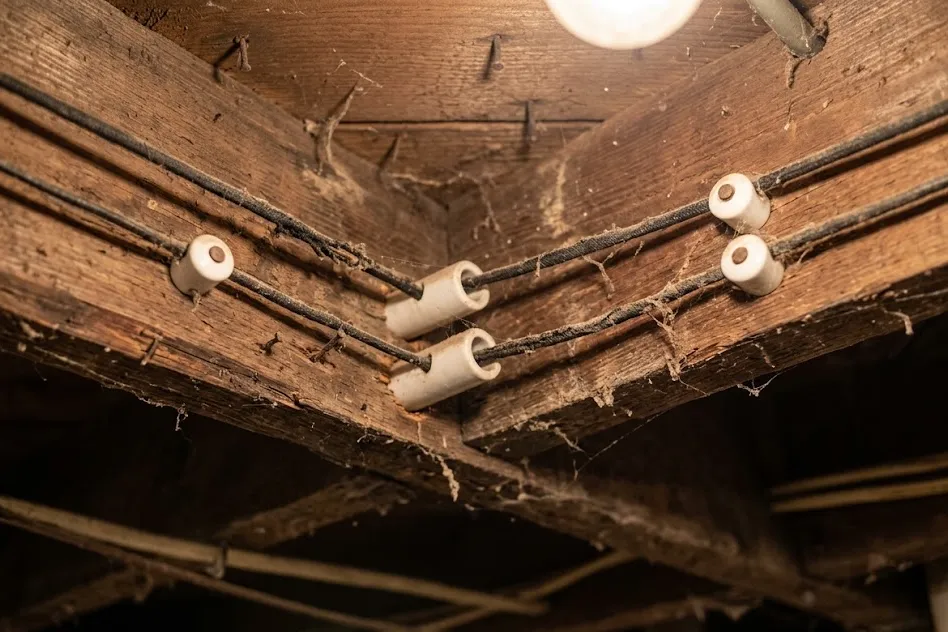
Knob and tube is an ungrounded, two-wire system. Ceramic knobs hold the wires away from the wood framing, ceramic tubes protect them where they pass through joists and studs, and the wires themselves are covered in thin rubber and cloth. HomeGuide says it was the standard in homes before 1930, and some areas installed it until the 1950s (HomeGuide). Signs that a house may still have it:
- White ceramic knobs carrying single wires along basement joists or across the attic (Block Renovation).
- Two-prong outlets, and only two wires, a hot and a neutral, behind a fixture or sconce, with no ground wire (ABC7 San Francisco, March 2025).
- A house built before about 1950, especially one with an old fuse box or a low-amp panel, which HomeGuide says is common in knob and tube homes.
Three-prong outlets do not rule it out: a previous owner may have fitted them to an ungrounded circuit. A visual check also has limits. Block Renovation points out that an inspector’s “no knob and tube visible” covers only what was visible, and that live original circuits can survive for decades behind walls nobody opened. Only an electrician tracing the circuits from the panel can confirm what is still energized.
Why knob and tube is considered a risk
Existing knob and tube is not illegal, but it does not meet current codes because it is ungrounded and lacks the capacity modern homes need (HomeGuide). HomeGuide lists four reasons it can be unsafe: the rubber and cloth sheathing, now 70 to 100 or more years old, degrades and exposes live wire; there is no ground wire, which matters most in kitchens, bathrooms, laundry rooms and outdoors; the wires need open air to shed heat, so insulation packed around them is a serious fire hazard; and circuits added later without replacing the old wiring can be a fire risk if done incorrectly.
Federal research points the same way, although it is old. A study sponsored by the Consumer Product Safety Commission, in which 16 fire departments investigated 149 residential electrical fires in the 1980s, found knob and tube common in the dwellings over 40 years old, and a fire rate in those homes about three times that of homes 11 to 20 years old. Improper alterations contributed to 55 of the fires. The report describes old 25-amp fuses left in service on newer cable spliced into knob and tube, larger fuses fitted after frequent blowouts, splices made by wrapping wires without connectors, and wiring later covered by thermal insulation (NFPA’s Fire Journal, January/February 1990, hosted by the CPSC). In 2003, the CPSC and the Electrical Safety Foundation International urged an electrical inspection for homes 40 years and older, and for homes 10 years and older that have had major renovations or new appliances added or have been resold (CPSC).
Insulation is where the code is most specific. The California Electrical Code bars concealed knob and tube in walls, ceilings and attics where loose, rolled or foamed-in-place insulation envelops the wires, unless a licensed electrical contractor certifies the wiring is in good condition and other conditions are met; Berkeley’s permit form for this, revised March 25, 2026, says attics with knob and tube may not be insulated without that certification letter (City of Berkeley). Washington allows loose or rolled insulation over existing knob and tube only after a licensed electrical contractor certifies the wiring in writing, among other conditions, and never foam insulation (WAC 296-46B-394). If you are planning attic insulation in an older house, find out about the wiring first.
For scale, the U.S. Fire Administration estimates that 24,200 residential building electrical fires were reported in 2021, causing 295 deaths, 900 injuries and over $1.2 billion in property loss; that figure covers all electrical fires, not knob and tube alone. Not every authority sees a specific trend: the San Francisco Fire Department told ABC7 in March 2025 that its investigators had not seen trends in knob and tube residential fires (ABC7 San Francisco). The USFA’s basic advice applies in the meantime: never force a three-prong cord into a two-slot outlet.
Knob and tube and homeowners insurance
For many owners the deadline comes from the insurer, not the electrician. HomeGuide says some insurance companies refuse coverage or charge higher premiums when a home has knob and tube (HomeGuide). Block Renovation describes a range of responses: some insurers add a surcharge, some require replacement within a set window as a condition of coverage, and some decline to write the policy (Block Renovation). ABC7 reported in March 2025 that insurers were canceling and denying Bay Area homeowners’ policies over knob and tube, and that without insurance a lender will not approve the mortgage unless the buyer pays for California’s FAIR Plan (ABC7 San Francisco).
Do not expect the policy to pay for the rewire. Both Block Renovation and ThePricer say replacement is treated as maintenance or a condition of coverage, not a covered loss (ThePricer). If your insurer asks for the work, get its requirement in writing, including the deadline and the documentation it wants afterward, before you book an electrician.
Cost of a knob and tube inspection
| Source | Range | Average | What it covers |
|---|---|---|---|
| HomeGuide (Feb 2026) | $100 – $200 | — | Electrical inspection to confirm the work is up to code |
| homeyou (Sep 2026) | $150 – $313 | $215 | Safety and diagnostic inspection by a licensed electrician, with a written report |
| Thumbtack (Jul 2026) | $217 – $663 | $389 | Inspection of the breaker panel and fuse boxes, from the platform’s own data |
An inspection before you collect quotes tells you how much knob and tube is still live, whether any of it is buried in insulation, and whether the panel can stay. Thumbtack’s figure is the highest and covers the panel and fuse boxes; its low and high outliers run from $89 to $1,786. Many inspectors issue written documentation for insurance or mortgage companies (Thumbtack), and that paperwork is what an insurer will usually ask for.
Panel upgrade, permits and other costs
| Item | HomeGuide (Feb 2026) | Block Renovation (Jul 2026) | ThePricer (Sep 2026) |
|---|---|---|---|
| Panel upgrade | $800 – $2,500 | $1,500 – $4,000 | $800 – $4,000 |
| Permits | $200 – $900 | $200 – $900 | A few hundred dollars |
| Wiring materials, outlets and switches | $8,600 – $10,800 | $1,500 – $4,000 | — |
| Labor | $2,400 – $20,800 | 70 – 85% of the total | — |
| New outlet, installed | $150 – $350 | — | — |
| GFCI outlet replacing an existing one | $90 – $200 | — | — |
The sharpest disagreement is on materials: HomeGuide’s breakdown puts wiring, outlets and switches at $8,600 to $10,800, while Block Renovation says those materials usually total $1,500 to $4,000 for a whole house. HomeGuide adds that materials often carry a 20 to 35% or higher markup. Ask each bidder to separate materials from labor so you can see where the money goes.
Homes with knob and tube often still have a fuse box or a low-amp service, which HomeGuide says requires updating to a higher-capacity breaker panel. Block Renovation says most knob and tube homes need a panel upgrade and that it is almost always cheaper to do the panel and the rewire together. Our guide to electrical panel upgrade cost breaks down that part of the job by amperage. Replacing knob and tube needs one or more permits, and HomeGuide notes that the National Electrical Code now requires an outlet at least every 12 feet, so older rooms with a single outlet will gain several.
Wall and plaster repair
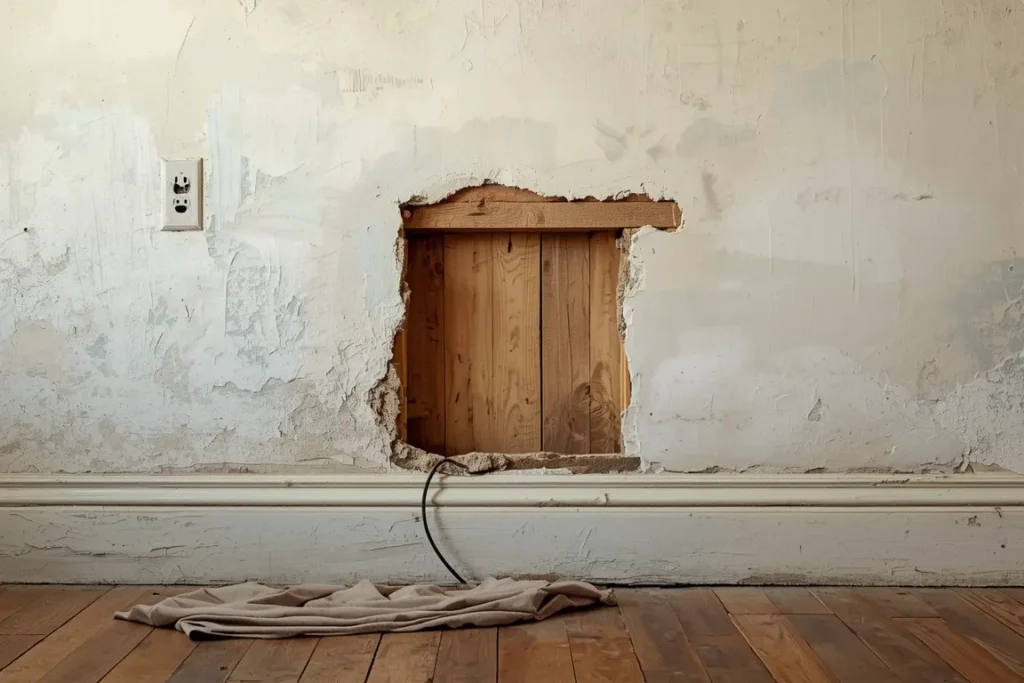
The electrician’s quote often stops where the patching begins. Electricians fish new cable through small openings from the attic, basement or crawl space where they can, and every opening has to be patched, sanded and painted afterward. Block Renovation puts plaster or drywall repair at $1,000 to $5,000 on top of the rewire, depending on how many access holes the crew had to cut, and says two identical floor plans can come in $5,000 apart on access alone (Block Renovation).
| Repair | Cost | Source |
|---|---|---|
| Plaster or drywall repair after a whole-house rewire | $1,000 – $5,000 | Block Renovation (Jul 2026) |
| Drywall patch | $300 – $1,500+ per patch | HomeGuide (Feb 2026) |
| Minor to larger drywall repairs | About $300 to $900+ | ThePricer (Sep 2026) |
| Ceiling repair | $50 – $100 per sq ft (drywall); $50 – $125 per sq ft (lath and plaster) | HomeGuide (Feb 2026) |
| Plastering | $2 – $10 per sq ft (walls); $2.50 – $12 per sq ft (ceilings) | HomeGuide (Feb 2026) |
Patching is usually a separate trade and a separate line item. Block Renovation’s example: a $14,000 quote that includes wall repair can be a better deal than an $11,500 quote that leaves you hiring a plasterer afterward. Get the repair scope in writing so it does not arrive later as a change order.
Partial vs. full replacement
Some houses were partly rewired decades ago, with knob and tube surviving only in ceilings or a back bedroom. Block Renovation says replacing the remaining runs can cost $2,000 to $8,000 and may be enough to satisfy an insurer, but it comes with two cautions: insurers usually want documentation that the old circuits were fully disconnected at the panel, and splicing new cable onto old knob and tube is a code violation in most jurisdictions and a common inspection failure. Staged work also costs more in total than one full rewire, because the crew mobilizes several times (Block Renovation).
HomeGuide agrees that partial replacement is possible but says experts recommend replacing the whole system at once where possible, because connecting incorrectly to knob and tube creates more hazards. As a stopgap, it says replacing outlets with GFCI outlets adds shock protection until a full replacement is possible (HomeGuide).
Abandoned vs. live knob and tube
Replacing knob and tube rarely means pulling every old wire out of the walls. HomeGuide says electricians remove only the visible wiring, in attics and unfinished basements for example, and abandon the disconnected wires concealed in the walls; removing all of it would mean opening the walls (HomeGuide). ThePricer describes the same practice (ThePricer).
What matters is that abandoned wiring is truly dead and documented. Block Renovation warns that a capped run with no paperwork has not been retired, and that partial rewires from past decades sometimes leave both systems running live at once (Block Renovation). Berkeley’s certification form, for example, has the electrician state either that the wiring is in good condition, that it needs repair or rewiring, or that it is disconnected and not live or has been removed (City of Berkeley). Ask for that kind of written statement at the end of the job.
How long it takes
Block Renovation says the electrical work on a typical home takes 3 to 10 working days, and 2 to 3 weeks for larger or harder-to-reach homes, with wall repair and paint after that. Permitted work includes at least a rough-in inspection and a final one. The guides disagree on whether you can stay home: Block Renovation says crews usually work room by room and restore power each evening, so most families stay, while HomeGuide says most electricians recommend staying out of the house during the project (HomeGuide). Ask your electrician, and budget for a few nights away if the answer is no.
Help paying for it
HomeGuide says some states offer grants or interest-free loans for removing knob and tube when it prevents a home from being insulated, and that government programs may help bring older homes up to safety codes, depending on age, income, location and scope. At the federal level, the USDA’s Section 504 Home Repair program, for homes in eligible rural areas, offers 1% loans of up to $40,000 to low and very-low-income homeowners to repair or modernize their homes or remove health and safety hazards, and grants of up to $10,000 to very-low-income homeowners aged 62 or older to remove health and safety hazards (USDA Rural Development). Ask your state energy office or local housing agency what applies where you live.
How to keep the bill down
- Have the wiring inspected before you collect bids, as the CPSC recommends for homes 40 years and older, and share the report with every bidder so they price the same scope.
- Get at least three itemized quotes and compare what each includes for panel work, wall repair and disposal of the old wiring before comparing totals (Block Renovation; HomeGuide).
- Do the panel upgrade and the rewire together, which saves a second mobilization and a second permit (Block Renovation).
- Rewire rooms at the same time as a kitchen or bathroom remodel that already opens the walls, which Block Renovation says costs far less than opening them again later.
- Choose standard outlets, switches and fixtures; HomeGuide notes that designer finishes cost much more and add up across a whole house.
- Keep a contingency of 10 to 20% for what old walls hide, as Block Renovation recommends.
Questions to ask before you sign
- How much of the knob and tube is still live, and how did you check?
- Does the price include the panel, permits, inspections and new outlets the code requires?
- How many wall and ceiling openings do you expect, and who patches and paints them?
- Will the old wiring be removed or abandoned, and will you put in writing that every old circuit is disconnected at the panel?
- Can we stay in the house during the work, and how long will the power be off each day?
- What documentation will you give me for my insurer, and what warranty covers the work?
Sources
- U.S. Consumer Product Safety Commission, CPSC-sponsored study of residential electrical wiring fires, published in NFPA’s Fire Journal, January/February 1990.
- U.S. Consumer Product Safety Commission, CPSC, ESFI Warn Consumers About Electrical Hazards in the Home, June 18, 2003.
- U.S. Fire Administration, Appliance and Electrical Fire Safety, page last reviewed May 4, 2023.
- U.S. Bureau of Labor Statistics, Occupational Outlook Handbook: Electricians, 2025 median pay.
- USDA Rural Development, Single Family Housing Repair Loans & Grants.
- City of Berkeley Building and Safety, Knob-and-Tube Wiring Safety Report, Form #146, revised March 25, 2026, citing the 2025 California Electrical Code.
- Washington State Legislature, WAC 296-46B-394, Concealed knob-and-tube wiring, effective April 1, 2024.
- ABC7 San Francisco, Bay Area homeowners could get coverage denied or canceled for having outdated electrical system, March 13, 2025.
- HomeGuide, Cost to Replace Knob and Tube Wiring, February 12, 2026.
- Block Renovation, Knob and Tube Wiring Replacement Cost: A Homeowner’s Guide, July 15, 2026.
- ThePricer, How Much Does Knob and Tube Wiring Replacement Cost?, updated September 4, 2026.
- homeyou, Electrical Inspection Cost, updated September 24, 2026.
- Thumbtack, How much does an electrical inspection cost?, updated July 8, 2026.
- Inch Calculator (older guide), Cost to Replace Knob and Tube Electrical Wiring, August 14, 2023.