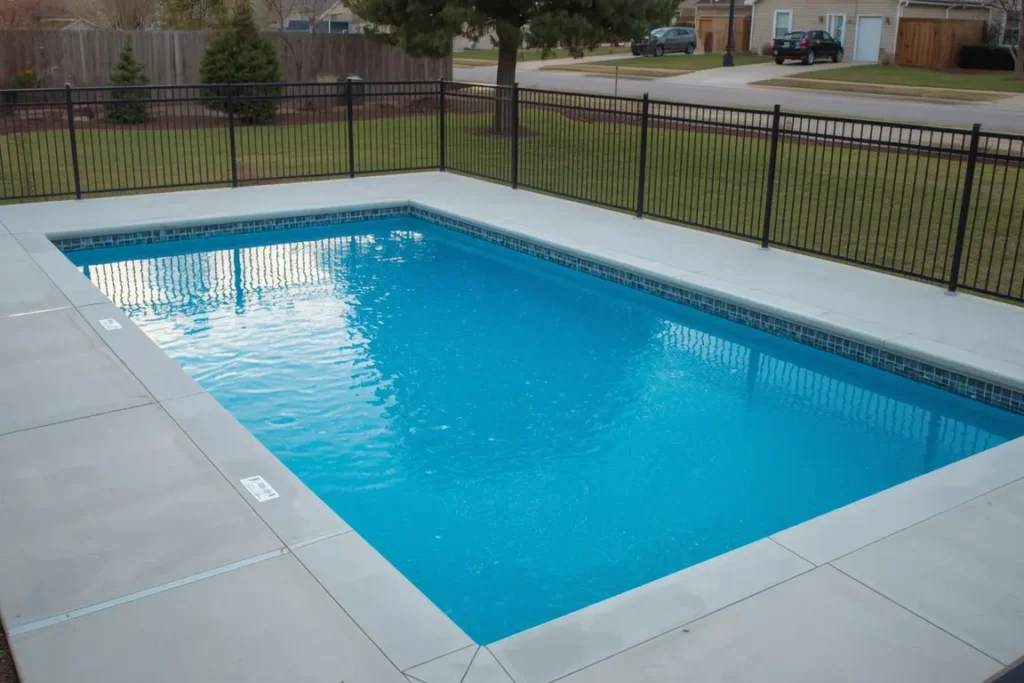
$25,000 – $100,000That is the typical pool installation cost in 2026 for an inground pool, or $80 to $250 per square foot installed, according to HomeGuide; HomeAdvisor and This Old House put most projects inside that span. An above-ground pool costs far less: $1,000 to $7,500 with installation, depending on the guide. Material, size and what goes around the pool (fence, deck, heater) decide where you land in the range.
The price of the pool shell is only part of the bill. Excavation, the pump and filter, a safety barrier, the permit and the yearly running costs all add up. The tables below break down each piece so you can compare quotes line by line.
Inground vs. above-ground pool cost
| Pool type | HomeGuide | HomeAdvisor | This Old House |
|---|---|---|---|
| Above-ground | $1,600 – $7,500 | $1,000 – $6,000 | — |
| Semi-inground | $7,000 – $25,000 | $6,800 – $25,000 | — |
| Plunge / spool pool | $15,000 – $40,000 | $10,000 – $50,000 | $10,000 – $18,000 (spool) |
| Inground (typical range) | $25,000 – $100,000 | $44,499 – $87,349 | $38,000 – $100,000 (12×24 ft) |
| Lap pool | $40,000 – $80,000 | — | $50,000 – $95,000 |
HomeGuide puts the national average for an inground pool at $62,500, with projects reported from $16,000 up to $200,000 (HomeGuide). HomeAdvisor’s figure is close: most homeowners pay around $65,909, with small jobs from $14,000 and large ones to $135,000 (HomeAdvisor). This Old House runs higher per square foot, at $180 to $350, against $80 to $250 at HomeGuide and $90 to $250 at HomeAdvisor (This Old House; HomeAdvisor). The guides agree on the order of magnitude but not on the low end, so treat any single figure as a starting point for quotes.
For above-ground pools, HomeGuide’s older guide (June 2024) gives an average of $4,500: $800 to $4,500 for the pool itself and $800 to $3,000 for labor (HomeGuide). HomeAdvisor’s 2025 guide gives $1,000 to $6,000, or $10 to $15 per square foot (HomeAdvisor). Above-ground pools are cheaper and easier to remove, but they do not last as long as inground pools.
Inground pool cost by material
| Material | HomeGuide | HomeAdvisor | This Old House (12×24 ft) |
|---|---|---|---|
| Vinyl liner | $35,000 – $80,000 | $40,000 – $75,000 | $38,000 – $70,000 |
| Fiberglass | $45,000 – $100,000 | $55,000 – $100,000 | $50,000 – $95,000 |
| Concrete (gunite) | $50,000 – $120,000 | $65,000 – $120,000 | $58,000 – $100,000 |
The three guides line up well on material. One exception: HomeAdvisor’s separate build-a-pool guide lists much lower figures for vinyl ($20,000 to $40,000) and fiberglass ($25,000 to $60,000) (HomeAdvisor), so the same publisher is not consistent. Per square foot, This Old House gives $130 to $240 for vinyl, $175 to $330 for fiberglass and $200 to $350 for concrete, pool only, with no decking or fencing (This Old House).
Concrete or gunite pools can take any shape and last the longest, but they cost the most to build and to keep. They need an acid wash every 3 to 5 years, at $300 to $1,000, and resurfacing every 10 to 15 years, at $8,000 to $10,000 (HomeGuide). This Old House puts 10-year upkeep for a concrete pool at $27,000 to $40,000, against $11,000 to $17,000 for vinyl and $5,000 to $15,000 for fiberglass (This Old House). A concrete pool takes 6 to 8 weeks to build.
Vinyl pools are usually the cheapest inground option and the fastest to install, at 2 to 3 weeks. The trade-off is the liner: it costs $3,000 to $7,500 to replace and needs replacing every 6 to 12 years (HomeGuide). HomeGuide’s own text also quotes a lower vinyl range of $25,000 to $65,000; the table above uses its summary figure.
Fiberglass shells arrive in one piece, so you choose from fixed shapes and sizes. They resist algae better than concrete or vinyl and need no liner, and they last 25 to 30 years, sometimes with a refinish at around 10 years (HomeGuide).
Inground pool cost by size
| Size (feet) | HomeGuide | This Old House | HomeAdvisor |
|---|---|---|---|
| 10 × 20 | $16,000 – $50,000 | $26,000 – $70,000 | $10,000 – $25,000 |
| 12 × 24 | $23,000 – $72,000 | $38,000 – $100,000 | $25,200 |
| 14 × 28 | $31,400 – $98,000 | $51,000 – $137,000 | $34,000 |
| 16 × 32 | $41,000 – $128,000 | $67,000 – $180,000 | $44,800 |
| 18 × 36 | $51,800 – $162,000 | — | $56,700 |
| 20 × 40 | $64,000 – $200,000 | — | $70,000 |
Here the sources disagree a lot. HomeAdvisor’s size figures sit at or below HomeGuide’s low end, while This Old House’s sit well above it. For the same 16 × 32 foot pool the published numbers run from $41,000 to $180,000. A written quote for your yard is the only number that counts.
The average inground pool is about 300 to 400 square feet and 6 to 7 feet deep at the deep end. A diving board usually needs a deep end of 9 feet or more, which means more digging and more water (HomeGuide).
Estimate your pool installation cost
Use the tables above to estimate your cost. The interactive calculator needs JavaScript.
Above-ground pool cost by size
| Pool size | Pool only (no installation) |
|---|---|
| 12′ round | $800 – $1,100 |
| 15′ round | $900 – $1,800 |
| 18′ round | $1,100 – $2,600 |
| 24′ round | $1,700 – $3,200 |
| 12′ × 24′ oval | $1,500 – $2,000 |
| 18′ × 33′ oval | $2,600 – $3,000 |
Steel walls are the cheapest ($800 to $3,000) but can rust; resin ($900 to $3,500) does not rust but can fade and crack; aluminum ($1,000 to $4,500) is lighter and costs the most (HomeGuide, June 2024). HomeAdvisor’s 2025 figures are higher: steel $800 to $5,000, resin $1,500 to $6,000 and aluminum $1,000 to $6,000 (HomeAdvisor).
Excavation, equipment and other line items
| Item | HomeGuide | HomeAdvisor / This Old House |
|---|---|---|
| Excavation | $1,000 – $5,000 | $3,400 average, up to $20,000 on a tight site (HomeAdvisor) |
| Yard leveling | $500 – $1,000 | — |
| Tree removal | $150 – $2,000 | — |
| Pool pump | $300 – $1,600 | — |
| Pool filter | $300 – $1,700 | $500 – $3,000 (HomeAdvisor) |
| Water delivery | $400 – $2,400 | — |
| Building permit | $100 – $300 | $450 – $1,800 (This Old House) |
| Pool heater (inground) | $1,600 – $5,200 | $1,800 – $4,000 (HomeAdvisor) |
| Pool lights (inground) | $700 – $1,800 | About $200 per light (HomeAdvisor) |
HomeAdvisor says labor and excavation make up 25% to 50% of a pool’s total price, and that hauling away soil often accounts for more than half of the excavation bill (HomeAdvisor).
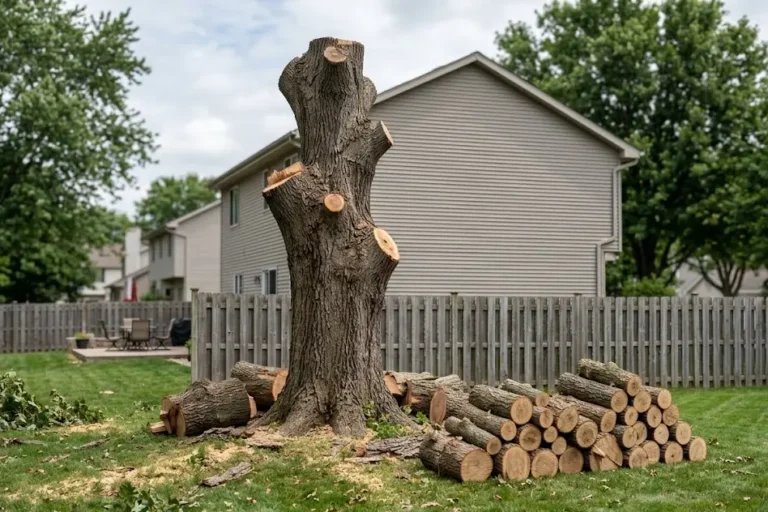
Pools usually cost more in northern states than in warm southern states where they are common, and a steep or hard-to-reach yard raises the price (HomeGuide). This Old House puts the premium at about 15% to 25% in northeastern states and urban areas (This Old House). If trees have to come out first, see our guide to tree removal cost.
Most contractors include the permit fee in their price, and some cities do not require a permit for small above-ground pools (HomeGuide). Permit estimates differ widely between guides (see the table above), so ask your local building department before you buy.
Fencing and safety barriers
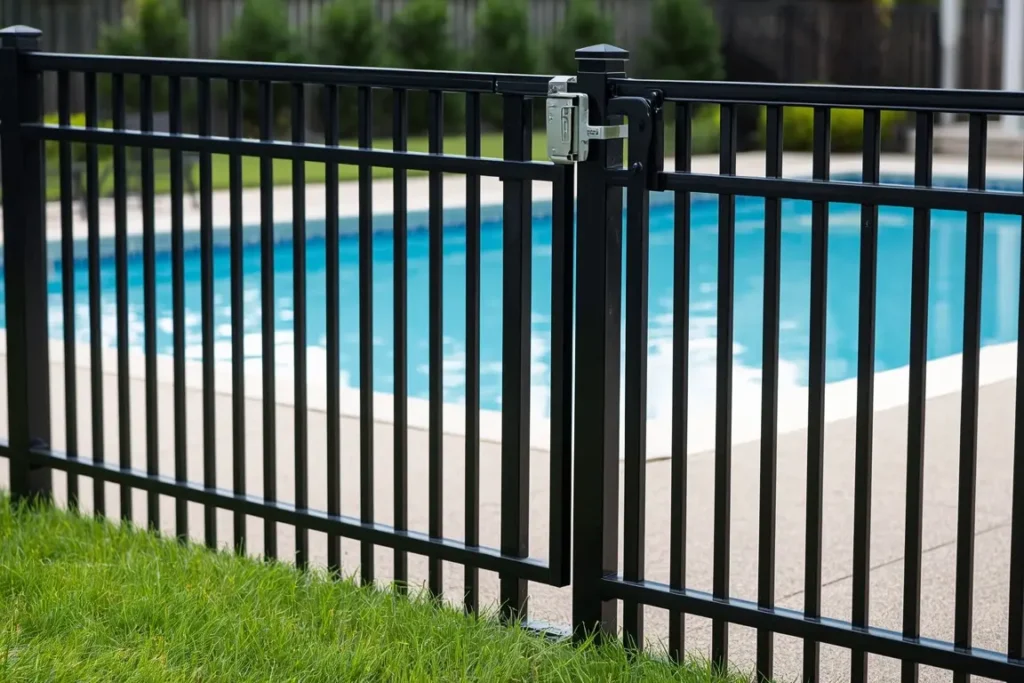
Many communities require a barrier around residential inground and above-ground pools. The U.S. Consumer Product Safety Commission’s barrier guidelines recommend that the top of the barrier be at least 48 inches above grade, measured on the outside, and note that some states, counties or cities require 60 inches. Gaps between vertical members should not exceed 4 inches, and gates should open outward from the pool and be self-closing and self-latching (CPSC, Safety Barrier Guidelines for Residential Pools).
For above-ground pools, CPSC says the pool wall itself can act as the barrier if it is high enough, and that the steps or ladder should be removable, lockable or fenced off. Where the house forms one side of the barrier, it recommends door alarms or self-closing, self-latching doors (CPSC). Your local code is what the inspector will check, so confirm it before the fence is ordered.
| Safety feature | HomeGuide | HomeAdvisor |
|---|---|---|
| Pool fence (total) | $5,000 – $15,000 | $1,500 – $10,000 |
| Aluminum pool fence | $30 – $45 per linear foot | — |
| Pool cover | $1,000 – $3,600 (manual safety cover) | $800 – $2,600 |
| Automatic cover | $8,000 – $20,000 | — |
| Screen enclosure | $4,000 – $14,000 | $1,500 – $10,000 |
Our estimate: a 16 × 32 foot pool with a fence set 4 feet back on every side needs about 128 linear feet of fence (2 × (24 + 40) feet). At HomeGuide’s $30 to $45 per linear foot for aluminum, that is roughly $3,840 to $5,760 before gates. This is our own calculation, not a measured price; your layout and your fence line will differ.
What a pool costs to run
Professional maintenance, including cleaning, chemicals and opening or closing for the season, costs $80 to $150 a month (HomeGuide).
Our estimate: at $80 to $150 a month, a pool maintained by a service all year costs $960 to $1,800 a year (12 × the monthly range). A seasonal pool that is serviced fewer months costs less. This is a calculation from HomeGuide’s monthly figure, not a measured annual cost, and it excludes electricity.
Other guides confirm the range or go higher. HomeAdvisor gives $960 to $1,800 a year for maintenance (HomeAdvisor), but $3,000 to $5,000 a year once repairs, water and electricity are counted (HomeAdvisor). This Old House puts maintenance at $90 to $270 a month (This Old House).
Electricity is the other big line. The U.S. Department of Energy says the pool pump is probably the largest electric motor in a home and can be its second-largest energy user, costing as much as $270 a year. In a Florida study of 120 pools it cites, downsizing the pump and cutting run time together reduced pumping energy by 75%, from 3,000 to 720 kWh a year. DOE suggests starting at 6 hours of filtration a day and adding half-hour steps only if the water is not clean (U.S. Department of Energy).
If you heat the pool, a cover matters more than the heater choice. DOE calls covering the pool when it is not in use the single most effective way to cut heating costs, with savings of 50% to 70% possible, because evaporation is by far the largest source of heat loss (U.S. Department of Energy).
HomeGuide also notes that an inground pool can raise your property taxes and homeowner’s insurance (HomeGuide). It gives no figure for either, so ask your county assessor and your insurer before you build.
How to keep the bill down
- Choose a rectangle or oval. Freeform, L-shaped and kidney shapes cost more (HomeGuide).
- Skip the diving board unless you will use it: it needs a deeper deep end, which raises the cost (HomeGuide).
- Add lights and an attached spa during construction, not afterwards. An attached hot tub costs $6,000 to $15,000 built with the pool against $8,000 to $25,000 added later (HomeGuide).
- Ask about installing an above-ground pool in fall or winter, outside the busy season (HomeGuide).
- Size the pump small and run it less: DOE says a 0.75 horsepower or smaller pump is generally enough for a residential pool (DOE).
- Compare at least three itemized written estimates for the same size and material, and avoid large upfront payments in favor of a payment schedule (HomeGuide).
Questions to ask before you sign
- Does the price include excavation, soil haul-away, the permit, the pump, filter and the first fill of water?
- Is the safety fence or barrier in the quote, and does it meet our local code for height and gates?
- What pump size and run schedule do you recommend, and why?
- Which material do you recommend for our yard and climate, and what will liner replacement or resurfacing cost later?
- How long will the project take, and what is the payment schedule?
- What warranty covers the shell or liner, and what covers your workmanship?
Sources
- U.S. Consumer Product Safety Commission, Safety Barrier Guidelines for Residential Pools (Publication 362).
- U.S. Department of Energy, Energy Saver, Choosing, Installing, and Operating an Efficient Swimming Pool Pump and Swimming Pool Covers. Both pages have been removed from energy.gov; the links are archived copies of March 1, 2026 and January 1, 2026.
- HomeGuide, How Much Does an Inground Pool Cost?, July 16, 2025.
- HomeGuide, How Much Does an Above-ground Pool Cost?, June 10, 2024 (older guide; not updated since).
- HomeAdvisor, How Much Does an In-Ground Pool Cost?, updated Nov 13, 2025, and How Much Does It Cost To Build a Pool?, updated June 23, 2025. The live pages block automated access; the links are archived copies of January 21, 2026 and November 19, 2025.
- This Old House, How Much Does an Inground Pool Cost?, updated June 6, 2025.