$20 – $65 per sq ftThat is the average retaining wall cost in 2026 across three published cost guides, materials and professional labor included, measured on the face of the wall. HomeGuide puts it at $35 to $65, LawnStarter at $20 to $53 and Homewyse at about $38 to $52 for a basic block wall. A typical 50-foot wall that stands 4 feet tall comes to $4,000 to $13,000 depending on the guide, and most contractors will not take a job under $1,500 to $3,000. Walls taller than 4 feet usually need an engineer and a permit, which pushes the price up.
Retaining walls are priced by the square foot of wall face, so height matters as much as length: doubling the height doubles the price before any engineering is added. The tables below show what each wall size, type and material costs, what drainage and permits add, and when repairing an old wall makes more sense than replacing it.
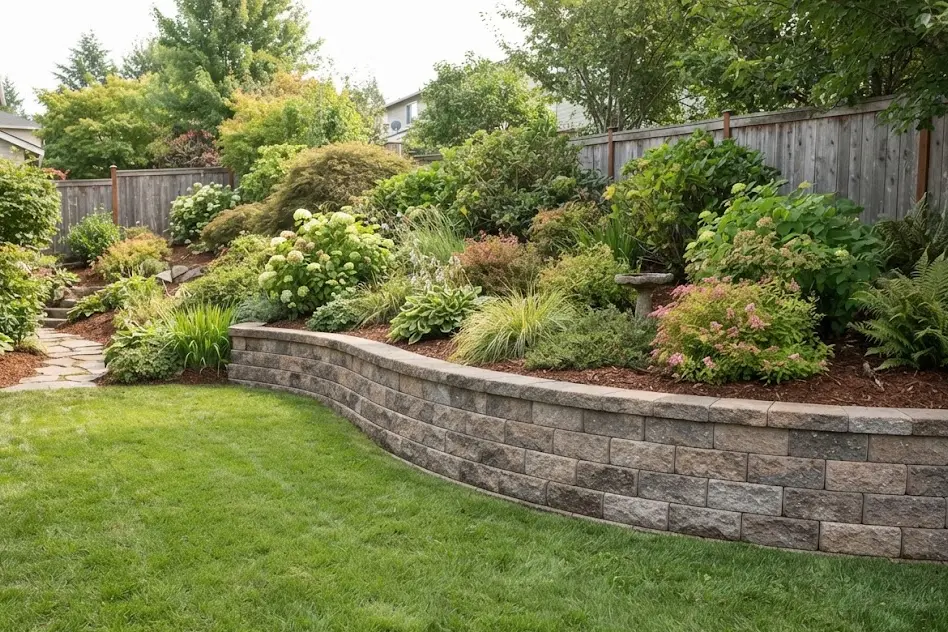
Retaining wall cost by length and height
| Wall length | 2 ft tall | 4 ft tall | 6 ft tall |
|---|---|---|---|
| 10 linear ft | $700 – $1,300 | $1,400 – $2,600 | $2,100 – $3,900 |
| 25 linear ft | $1,750 – $3,250 | $3,500 – $6,500 | $5,250 – $9,750 |
| 50 linear ft | $3,500 – $6,500 | $7,000 – $13,000 | $10,500 – $19,500 |
| 100 linear ft | $7,000 – $13,000 | $14,000 – $26,000 | $21,000 – $39,000 |
| 200 linear ft | $14,000 – $26,000 | $28,000 – $52,000 | $42,000 – $78,000 |
What three cost guides say
| Source | Per sq ft of wall face | What it covers |
|---|---|---|
| HomeGuide (Jan 2026) | $35 – $65 | Typical installed wall, all materials |
| LawnStarter (Dec 2025) | $20 – $53 (average $33) | Typical installed wall; national average job $6,300, most pay $3,500 – $9,400 |
| Homewyse (Sep 2026) | $37.55 – $51.76 | Basic dry-stack interlocking block, non-structural, no higher than 3 ft; excludes permits and a 13% – 22% general contractor markup |
The guides agree on the middle of the range but not on the low end: LawnStarter’s floor of $20 per square foot is well below HomeGuide’s $35. At LawnStarter’s rates a 175-square-foot wall runs $3,500 to $9,275 (LawnStarter), while at HomeGuide’s rates a 50-foot, 4-foot wall costs $7,000 to $13,000. Homewyse’s figure is for the simplest short block wall only, so taller or engineered walls will cost more.
Our estimate: the $20 to $65 headline range is the lowest low and the highest high of the three guides above, not an average. A 50-foot by 4-foot wall is 200 square feet, so $4,000 to $13,000 is 200 times that combined range. This is our arithmetic, not a measured price.
Our estimate: dividing the length-and-height table by wall length gives roughly $70 to $130 per linear foot for a 2-foot wall, $140 to $260 per linear foot for a 4-foot wall and $210 to $390 per linear foot for a 6-foot wall. This is our own arithmetic on HomeGuide’s figures, not a measured price, and it does not include the engineering and deeper footings that walls over 4 feet usually need.
Labor is 40% to 60% of the total, with wall contractors charging $50 to $75 an hour. Rocky or clay-heavy soil can raise labor costs by up to 50%, and sloped yards that need terracing can raise the total by 50% or more (HomeGuide).
Cost per square foot by material
| Material | HomeGuide, per sq ft | LawnStarter, per sq ft | Typical lifespan |
|---|---|---|---|
| Vinyl | $10 – $20 | $10 – $15 | About 50 years |
| Concrete block | $15 – $40 | $15 – $40 (cinder block) | — |
| Wood / timber | $15 – $30 | $13 – $35 | 20 – 30 years (pressure-treated) |
| Poured concrete | $20 – $45 | $20 – $40 | 50 – 100 years |
| Natural stone | $20 – $95 | $20 – $90 | 100 – 200 years |
| Brick | $30 – $60 | $17 – $43 | 100+ years |
| Steel / metal | $40 – $150 | $42 – $137 | 20 – 40 years |
Concrete block is the most common choice for homes: interlocking blocks go together without mortar and are easy to install. Timber is cheap up front but needs regular upkeep and eventual replacement. Poured concrete is the strongest option and needs professional installation. Natural stone has the widest price range because it depends on the type of stone (HomeGuide).
Colorado State University Extension draws the line between a poured-in-place concrete “structural” wall and a much cheaper “dry-laid” wall of stacked, open-joint material. It puts installed dry-laid walls at $20 to $35 per square foot of wall face, and structural walls at two to ten times that (CSU Extension, PlantTalk Colorado).
Estimate your retaining wall cost
Use the tables above to estimate your cost. The interactive calculator needs JavaScript.
Cost by type of wall
| Wall type | HomeGuide, per sq ft | LawnStarter, per sq ft | Where it fits |
|---|---|---|---|
| Segmental (interlocking block) | $15 – $35 | $15 – $35 (interlocking blocks) | Up to 3–4 ft without extra reinforcement |
| Sheet piling | $15 – $50 | $10 – $50 | Tight spaces, soft soil, waterfront |
| Gravity | $20 – $50 | $10 – $30 | Shorter walls held by their own weight |
| Cantilevered (reinforced concrete) | $40 – $80 | $25 – $30 | Walls over 4 ft, professionally designed |
| Anchored | $50 – $150 | $10 – $30 | High walls or heavy loads |
The guides disagree sharply on engineered walls: HomeGuide prices anchored walls at $50 to $150 per square foot and cantilevered walls at $40 to $80, while LawnStarter lists $10 to $30 and $25 to $30. These walls are designed for each site, so treat both sets of figures as rough and get engineered quotes.
Height, permits and engineering
The 2021 International Residential Code, a model code for homes, exempts from a building permit any retaining wall that is not over 4 feet tall, measured from the bottom of the footing to the top of the wall, unless the wall supports a surcharge, meaning extra load such as a driveway, a slope or a structure above it (2021 International Residential Code, Section R105.2). Note that the 4 feet include the buried footing, so a wall that looks 3.5 feet tall above ground may already be over the line. Local codes can differ from the model code, so check the threshold with your building department before you plan.
Where a permit is required, it costs $50 to $450 depending on location and wall size. Walls 4 feet or higher usually need a structural engineer’s design, which costs $500 to $2,000 or more, and concrete footings for taller walls add $18 to $55 per linear foot (HomeGuide). Structural engineers bill $100 to $220 an hour if you only need an inspection of an existing wall (HomeGuide).
Our estimate: on a 50-foot wall, going from 4 to 6 feet tall adds $3,500 to $6,500 in wall face alone (from the length-and-height table), plus $500 to $2,000 or more for engineering and $50 to $450 for a permit, or about $4,050 to $8,950 in total before footings. This is our sum of HomeGuide’s ranges, not a quoted price.
Drainage behind the wall
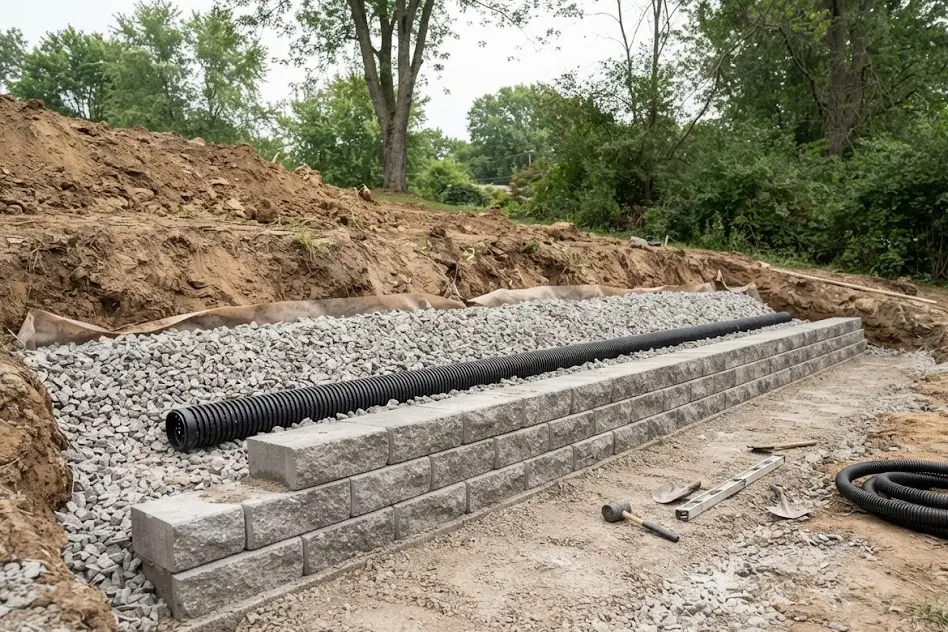
Colorado State University Extension says most retaining walls fail because of pressure from water or soil moisture building up behind them. Every wall should let that water drain down and away, using gravel backfill or manufactured drainage blankets and drain pipes, and structural walls need weep holes (CSU Extension). The same page recommends a compacted base that extends at least one foot beyond the front and back of the wall, a slight backward lean (batter) into the slope, and for timber walls at least one “deadman” anchor per 16 square feet of wall face.
A drain pipe along the base of the wall, similar to a French drain, costs $10 to $85 or more per linear foot, and waterproofing the back of the wall adds $2 to $10 per square foot (HomeGuide; the same range at LawnStarter). If a quote does not list drainage stone, pipe and an outlet for the water, ask why before you sign.
Site prep and extras
| Extra | Typical cost |
|---|---|
| Excavator | $100 – $300 per hour |
| Grading a level base | $0.40 – $2.00 per sq ft |
| Tree removal in the wall’s path | $400 – $1,200 |
| Demolishing an old wall | $15 – $30 per linear ft |
| Rebar reinforcement | $1.50 – $2.50 per sq ft |
| Stone or brick veneer | $5 – $25 per sq ft |
| Cap stones | $5 – $15 each |
Call 811 before anyone digs
A retaining wall needs a trench for its base, so buried lines are a real risk. The national 811 program asks you to call 811 or make an online request a few days before breaking ground. Your state 811 center notifies the utility operators, who mark buried lines with paint or flags, and you should avoid digging within 18 to 24 inches on all sides of those marks (811 Before You Dig). The waiting period varies by state. If a contractor is doing the work, ask who places the request and confirm every utility has responded before the excavator arrives.
Repair or replace?
| Problem or job | Typical cost |
|---|---|
| Leaking or seeping | $100 – $1,000 |
| Cracking or crumbling | $150 – $1,000 |
| Efflorescence (white salt residue) | $150 – $800 |
| Leaning or bowing | $200 – $1,500 |
| Foundation repair | $40 – $75 per linear ft |
| Remove and replace a 50 ft × 4 ft wall | $6,000 – $14,000 |
Most problems cost far less to fix than to rebuild. Adding drainage pipes or weep holes, anchoring a leaning wall, or reinforcing and straightening it each run about $50 to $80 per square foot of affected wall (HomeGuide). Because water pressure is the most common cause of failure (CSU Extension), a repair that does not deal with drainage is likely to be temporary. For a wall that is leaning or bowing, have a structural engineer find the cause before you pay for repairs.
How to keep the bill down
- Keep the wall low where the site allows it. Price rises with every foot of height, and walls over 4 feet measured from the footing usually add a permit and an engineer.
- Choose segmental block or a dry-laid wall for short garden walls; save poured concrete for walls that carry real load.
- Do not cut drainage to save money. It is the part that decides whether the wall lasts.
- Group small walls into one job, since most contractors charge a project minimum of $1,500 to $3,000.
- Fix small cracks and blocked weep holes early, while repair is still in the hundreds of dollars.
- Get at least two itemized written quotes so you can compare excavation, base, drainage and wall material line by line.
Questions to ask before you sign
- How tall will the wall be from the bottom of the footing, and does it need a permit or an engineer’s design here?
- Will anything sit above the wall, such as a driveway, a slope or a shed, that adds load?
- What drainage is included: gravel backfill, drain pipe, fabric, weep holes, and where does the water go?
- Who requests the 811 utility locate, and who pulls the permit?
- Does the price include removing the old wall, hauling away soil and final grading?
- What warranty do you give on the wall and on the installation?
Sources
- International Code Council, 2021 International Residential Code, Chapter 1, Section R105.2 (Work exempt from permit).
- Colorado State University Extension, PlantTalk Colorado, 1118 – Retaining Walls: Design Considerations.
- 811 Before You Dig, 811 Information for Homeowners.
- HomeGuide, Retaining Wall Cost, January 16, 2026.
- LawnStarter, How Much Does a Retaining Wall Cost in 2026?, December 27, 2025.
- Homewyse, Cost to Install a Retaining Wall, September 2026.
- HomeGuide, Retaining Wall Repair Cost, December 23, 2025.