$1,500 – $15,000That is the typical whole house repipe cost in 2026, across four published cost guides, for replacing the water supply lines in a house. PEX tubing keeps a job near the bottom of that range; copper, a large or multistory house and hard-to-reach pipes push it toward the top. Permits, wall patching and any work on the service line from the street are often extra.
The figures come from HomeGuide (August 29, 2025), Angi (updated November 20, 2025), ThePricer (August 25, 2026) and Thumbtack (January 6, 2025). Below you will find what each guide says, how size, bathrooms and pipe material move the price, the signs that a house needs new pipes, what lead, galvanized and polybutylene pipes mean for the job, and what wall repair, permits and a new service line add.
Whole house repipe cost at a glance
| Guide | Whole-house range | Average or typical | Notes |
|---|---|---|---|
| HomeGuide (Aug 2025) | $2,000 – $15,000 | $2,280 – $5,120 (national average $4,080) | Repiping a 2,000 sq ft home: $3,100 – $5,500 on average |
| Angi (Nov 2025) | $1,500 – $15,000 | $7,500 | Labor is about 70% of the total |
| ThePricer (Aug 2026) | $4,500 – $15,000 | — | Planning range for a whole-house repipe of galvanized supply lines; PEX toward the low end |
| Thumbtack (Jan 2025) | $1,743 – $6,490 | $3,364 | “Repiping an entire home“Repiping an entire home”, from estimates given to its usersrdquo;, from data provided by pros on its platform |
| Forbes Home, older guide (Oct 2024) | $3,000 – $16,000 | $6,500 | Replacing the plumbing in a typical 2,000 sq ft home |
The guides agree on the ceiling, about $15,000, but not on the middle. Thumbtack’s typical repipe is $1,743 to $6,490 and HomeGuide’s average range is $2,280 to $5,120, while Angi puts the average at $7,500 and ThePricer starts its planning range at $4,500. ThePricer, the newest of the four, warns that published ranges vary because contractors define the scope differently: its price means the interior hot and cold supply piping, reconnecting fixtures, testing and the access work in the contract, and it does not automatically include the service line from the street, drain or sewer piping, a new water heater, finish painting or every permit charge (ThePricer). Before you compare a quote with any of these numbers, check what it covers.
Our estimate: the $1,500 to $15,000 headline runs from the lowest low (Angi’s $1,500) to the highest high shared by HomeGuide, Angi and ThePricer ($15,000) among the four guides from 2025 and 2026. Thumbtack’s range sits inside it; the older Forbes Home guide reaches $16,000. This is our own combination, not a measured figure.
Estimate your whole house repipe cost
Our estimate: the published ranges above multiplied out for your inputs. Not a quote. Ranges from HomeGuide (March 2025 and August 2025), ThePricer (August 2026), Angi (November 2025) and Thumbtack (January 2025), as shown in the tables in this article. ThePricer ranges are higher than HomeGuide for the same pipe. A local quote can differ. State adjustment: BLS construction wages (May 2025), applied to an assumed 70% labor share. How we calculate
Our estimate: the size options are HomeGuide’s whole-house figures by bedrooms and bathrooms (from its March 2025 polybutylene replacement guide, which prices a full repipe), and the two “any size” options are ThePricer’s 2026 answers for PEX ($4,500 to $12,000) and copper ($8,000 to $20,000 or more). Each extra runs from the lowest to the highest figure in the sources: inspection from HomeGuide’s $100 to $200; permit from Angi’s $50 to $500, which also covers HomeGuide’s $70 to $400; drywall from Thumbtack’s $260 to HomeGuide’s $1,500; water main from Angi’s $600 to $2,500, which covers HomeGuide’s $800 to $2,000; and the water heater from Angi’s $850 to $1,750. The state adjustment applies to a 70% labor share, the figure Angi gives. This is our own combination, not a measured figure.
Cost by home size and number of bathrooms
| Home | PEX | Copper |
|---|---|---|
| 2 bedrooms, 1 bath | $1,500 – $2,500 | $2,500 – $4,000 |
| 3 bedrooms, 2½ baths | $3,000 – $7,000 | $4,500 – $10,000 |
| 4 bedrooms, 3 baths | $6,000 – $8,000+ | $8,000 – $15,000+ |
| 2,000 sq ft home (HomeGuide, Aug 2025) | $2,000 – $4,000 | $8,000 – $16,000 |
Only HomeGuide breaks the price down by bedrooms and bathrooms, so treat this table as one guide’s view. The 2026 figures in ThePricer run higher: it gives $4,500 to $12,000 for many whole-house PEX repipes and $8,000 to $20,000 or more for copper, and says large homes in expensive markets can reach $20,000 to $30,000 (ThePricer). It also cites a San Diego contractor guide from May 2026 quoting $7,000 to $12,000 in PEX and $12,000 to $20,000 in copper for a 1,500 to 2,500 sq ft house with two or three baths, including permits and basic drywall patching.
Bathrooms matter because every fixture needs its own hot and cold lines. Angi puts the cost of repiping a single fixture at about $1,200 on average, and lists these costs per fixture: a sink $350 to $800, a dishwasher $400 to $800, a washing machine $350 to $1,500, a shower $600 to $1,600 and a water heater $700 to $1,800 (Angi). Thumbtack says pipe installation is bid by the fixture, at $450 to $1,000 or more each, and that a second or third story raises the price because pipes have to run vertically through the walls (Thumbtack).
PEX vs copper vs CPVC
| Pipe | Angi (Nov 2025) | HomeGuide (Mar 2025) | Thumbtack (Jan 2025) | Forbes Home, installed, older guide (Oct 2024) |
|---|---|---|---|---|
| PEX | $0.40 – $2 | $0.50 – $2 | $0.40 – $2 | $1.50 – $4 |
| CPVC | $0.50 – $1 | $0.50 – $1 | $0.50 – $1 | $1.50 – $3.25 |
| Copper | $2 – $8 | $2 – $10+ | $2.50 – $10 | $4 – $12 |
The pipe itself is a small part of the bill. Angi puts labor at about 70% of a repipe, which is why a cheaper pipe does not halve the total. ThePricer makes the same point: on a $10,000 job, 70% labor is about $7,000, leaving about $3,000 for pipe, fittings and everything else (ThePricer). Still, the choice of pipe moves the total: for the same 2,000 sq ft house, HomeGuide gives $2,000 to $4,000 in PEX and $8,000 to $16,000 in copper.
- PEX is flexible plastic tubing. It can be snaked behind drywall, which means fewer wall openings, and it does not burst if it freezes. It cannot be installed outside because sunlight breaks it down, and rodents can chew through it (HomeGuide). Angi adds that it does not corrode and resists scale and chlorine buildup.
- Copper is the most expensive option. It resists bacteria, is recyclable and, in earthquake areas, may not break during a quake (HomeGuide). It is not affected by sunlight, but it can burst if it freezes and needs pipe insulation (Angi). HomeGuide’s polybutylene guide notes that it is often preferred in high-end remodels and in areas with aggressive water.
- CPVC is rigid plastic pipe rated for hot and cold drinking water, and the cheapest of the three per foot (HomeGuide). Its joints are cemented to make each angle, and it has a lower temperature limit than the other two (Angi). HomeGuide says it can be more complex to install than PEX: PEX costs more per foot than CPVC but is easier to install, which reduces labor costs.
Local codes can limit which pipes you may use, so ask your plumber what is allowed where you live (Angi).
Signs you need to repipe
Angi lists the warning signs: water pressure that is too high or too low, discolored water or water that tastes or smells strange, visible corrosion or cracked pipes, leaks that keep coming back after repairs, water temperature that swings, and old pipes — galvanized or lead pipes, or pipes over 60 years old (Angi). HomeGuide gives typical lifespans of 20 to 50 years for galvanized steel, 40 to 70 years for brass and 50 years for copper (HomeGuide). Three materials come up most often:
- Galvanized steel. The zinc coating wears away over time and exposes the steel, which rusts; the rust builds up inside the pipe, lowers water pressure and discolors the water (HomeGuide). Thumbtack adds that the corrosion eventually causes pinhole leaks. HomeGuide puts the cost of replacing galvanized pipes at $2,000 to $15,000, depending on the new pipe.
- Polybutylene. A gray, blue or black plastic pipe used in homes from the late 1970s to the mid-1990s. It deteriorates from chlorine and other chemicals in the water and leaks or bursts, and it does not meet current U.S. building codes. It is usually ½ to 1 inch across and may be stamped “PB2110”; look near the water heater, in the basement or where pipes come out of the walls (HomeGuide).
- Lead. Covered in its own section below, because the most likely lead pipe is often outside the house.
Polybutylene also matters for insurance. HomeGuide says most insurers do not pay to replace it because they treat it as a known defect, although some policies cover damage from a sudden pipe failure, and that over the past decade many insurers have told clients that failing to replace it could lead to the policy being terminated (HomeGuide). Check your own policy.
Lead pipes and the service line
The pipe that connects your house to the water main is called the service line. Where it is made of lead, it is typically the most significant source of lead in the water, and lead pipes are more likely in older cities and in homes built before 1986. In homes without a lead service line, the most common problem is brass or chrome-plated brass faucets and plumbing joined with lead solder. EPA’s health goal for lead in drinking water is zero, and you cannot see, taste or smell it: testing is the only sure way to know, and a test from a certified laboratory costs $20 to $100 (EPA). EPA’s Protect Your Tap guide shows how to check the pipe where it enters your home with a coin or key and a magnet.
Under EPA’s Lead and Copper Rule Improvements, finalized in October 2024, water systems must identify and replace lead pipes within 10 years (EPA). The rule covers lead service lines and certain galvanized service lines under the control of the water system, and about 99% of systems must replace them in 10 years or less. Water systems have to keep a public inventory of service line materials and notify you if you are served by a lead line, a galvanized line that may be contaminated by lead, or a line of unknown material. Water systems must begin complying three years after the final rule was published, which EPA puts in late 2027. The federal infrastructure law put $15 billion toward lead service line replacement through state revolving funds (EPA, LCRI questions and answers).
For your budget, this means the service line is usually a separate job from the repipe. ThePricer advises not to compare an interior repipe quote with a service-line replacement quote, because they cover different pipe networks with different permits, ownership rules and pricing (ThePricer). EPA says some states and utilities offer programs that pay for water testing or lead service line replacement, and that if you have a lead service line you should contact your water utility to join its replacement program (EPA). Ask the utility before you pay a plumber to replace it yourself. If you do replace your section of the water main at the same time, Angi puts it at $600 to $2,500 and notes that depending on where you live, the town may be responsible for it (Angi); HomeGuide gives $800 to $2,000.
Drywall repair and other extra costs
| Item | Cost | Source |
|---|---|---|
| Drywall patching after the repipe | $300 – $1,500+ / $300 – $900+ / $260 – $450 | HomeGuide / Angi / Thumbtack (average drywall repair) |
| Drywall, per sq ft | $1.50 – $3.50 (ceilings $2 – $4) | HomeGuide (Mar 2025) |
| Painting, per sq ft | $1 – $3 | HomeGuide (Mar 2025) |
| Removing the old pipes | $1,000 – $5,000, usually included in the repipe price | HomeGuide (Aug 2025) |
| Permit | $50 – $500 / $70 – $400 | Angi / HomeGuide (Mar 2025) |
| Reinspection, if the first one fails | $25 – $150 | Angi |
| Plumbing inspection before quotes | $100 – $200 | HomeGuide (Mar 2025) |
| New tank water heater at the same time | $850 – $1,750 | Angi |
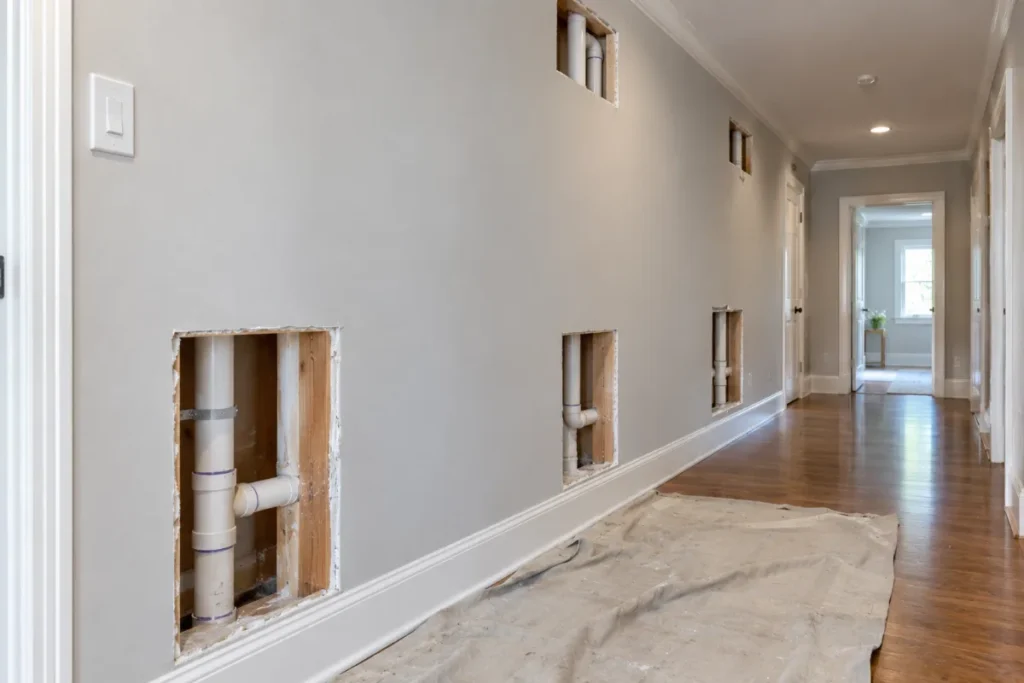
Wall repair is the line most likely to be missing from a plumbing quote. Thumbtack says some plumbing companies patch the walls themselves while others work with drywall companies and include that cost in their bid; Angi suggests asking whether the plumber recommends a drywall installer, since you will likely need to replace a significant amount of drywall. ThePricer warns that a contractor may leave the openings ready for another trade, patch the board but not texture it, or texture it but leave primer and paint out, so a lower repipe quote can finish higher than a more complete one (ThePricer). Pipes under a concrete slab cost significantly more to remove and replace than pipes behind drywall (Angi).
If you are replacing the water heater anyway, doing it during the repipe is common (Angi); our water heater replacement cost guide compares the options, and the tankless water heater installation cost guide covers going tankless.
Permits and timeline
In most cases you need a permit to repipe a house, at $50 to $500 depending on the region, and the first inspection is usually included in the permit fee (Angi). Thumbtack describes the usual order: the plumber pulls the permit, replaces the pipes, the city inspects the work and then the walls are patched. It warns that most insurers will not pay a claim for damage from piping installed without a permit (Thumbtack). Most states require plumbers to be licensed (BLS).
On timing, Thumbtack puts a whole-house repipe at three to five days, with an average 2,200 sq ft home taking four, plus one to two days to patch the walls. HomeGuide says smaller homes take a few days and larger ones may take over a week, before wall and ceiling repairs (HomeGuide). Angi gives the widest range: a few days for a small home to several weeks for a large, multistory home with many fixtures.
Repipe or fix the leak?
| Job | HomeGuide (Oct 2025) | Inch Calculator, older guide (Sep 2023) |
|---|---|---|
| Small leak, easy to reach | $150 – $500+ | $50 – $800 (average $350) |
| Larger or hidden leak, inside a wall | $500 – $5,000+ | $100 – $400 to find it, plus $200 – $400 to repair, plus the wall |
| Major leak | $2,000 – $10,000+ | — |
A single leak in an exposed pipe is a repair, not a repipe: HomeGuide puts a leak in an interior pipe that is easy to reach at $100 to $500. The bill climbs when the leak is behind a wall or ceiling, because of the repairs that follow, and HomeGuide notes that older pipes are more prone to corrosion and leaks, often needing replacement rather than a patch (HomeGuide). Angi’s sign that it is time to repipe is a pattern: you have patched a pipe or replaced a short section and keep finding new leaks. ThePricer draws the same line: a full repipe makes sense when supply lines are failing in several places, several fixtures have weak flow or the walls are already open for a remodel, and it does not make sense when the problem is one repairable valve, fitting or short section and the rest of the system is sound (ThePricer).
If a remodel is coming, plan the two together. Our bathroom remodel cost and kitchen remodel cost guides show what those jobs cost, and open walls are one of the conditions under which ThePricer says a repipe pays.
How to keep the bill down
- Ask your water utility about your service line before you pay to replace it. If it is lead, the utility may have a replacement program (EPA).
- Consider PEX. Every guide here prices it well below copper for the same house, and it needs fewer wall openings.
- Time the repipe with a remodel, when walls are already open.
- Get the wall repair in writing. Compare quotes only after you know which ones include patching, texture and paint.
- Get at least three estimates from licensed, bonded and insured plumbers, and do not pay in full until the work is complete (HomeGuide).
Questions to ask before you sign
- Which pipe do you recommend for my house and water, and is it allowed by my local code?
- Does the quote cover every supply line, including outdoor faucets and the water heater connections?
- Are the permit, inspection, removal of the old pipe and wall patching included? Who does the texture and paint?
- Does the price include the service line from the street, or the drain lines? If not, what would they cost?
- How many days will we be without water, and do we need to move out?
- What warranty do you give on the work, and what does the manufacturer give on the pipe?
Sources
- U.S. Environmental Protection Agency, Basic Information about Lead in Drinking Water.
- U.S. Environmental Protection Agency, Lead and Copper Rule Improvements, final rule October 2024, and LCRI Questions and Answers.
- U.S. Environmental Protection Agency, Protect Your Tap: A Quick Check for Lead.
- U.S. Bureau of Labor Statistics, Occupational Outlook Handbook: Plumbers, Pipefitters, and Steamfitters.
- HomeGuide, How Much Does It Cost to Install or Replace Plumbing?, August 29, 2025.
- HomeGuide, How Much Does It Cost to Replace Polybutylene Pipes?, March 4, 2025.
- HomeGuide, How Much Does a Pipe Leak Repair Cost?, October 29, 2025.
- Angi, How Much Does It Cost to Repipe a House?, updated November 20, 2025. Archived copy of December 12, 2025; the live page blocks automated access.
- ThePricer, How Much Does It Cost To Replace Galvanized Pipes?, updated August 25, 2026.
- Thumbtack, How much does pipe installation cost?, updated January 6, 2025.
- Forbes Home (older guide), How Much Does It Cost To Install Or Replace Plumbing In A House?, October 31, 2024.
- Inch Calculator (older guide), Cost to Repair Plumbing Leaks, September 18, 2023.