$3,500 – $15,000That is the typical well drilling cost in 2026 for a new residential water well, or $25 to $65 per foot drilled (This Old House). Septic & Well Pro gives the same $3,500 to $15,000 for a typical well and $20,000 to $30,000+ for deep or hard-rock wells. The Well Guide prices the whole system and puts a standard 100 to 200 foot well at $5,500 to $12,000, though its own depth table runs higher: $11,000 to $16,000 at 200 feet.
“Well drilling cost” means different things in different guides. Some price only the borehole. Others add casing, pump, pressure tank, electrical hookup, permit and water test. The Well Guide says drilling-only quotes run 40% to 60% of its complete-system figures, so always ask which one a number describes. This guide separates the two. If you already have a well and only need a new pump, read our guide to well pump installation cost instead.
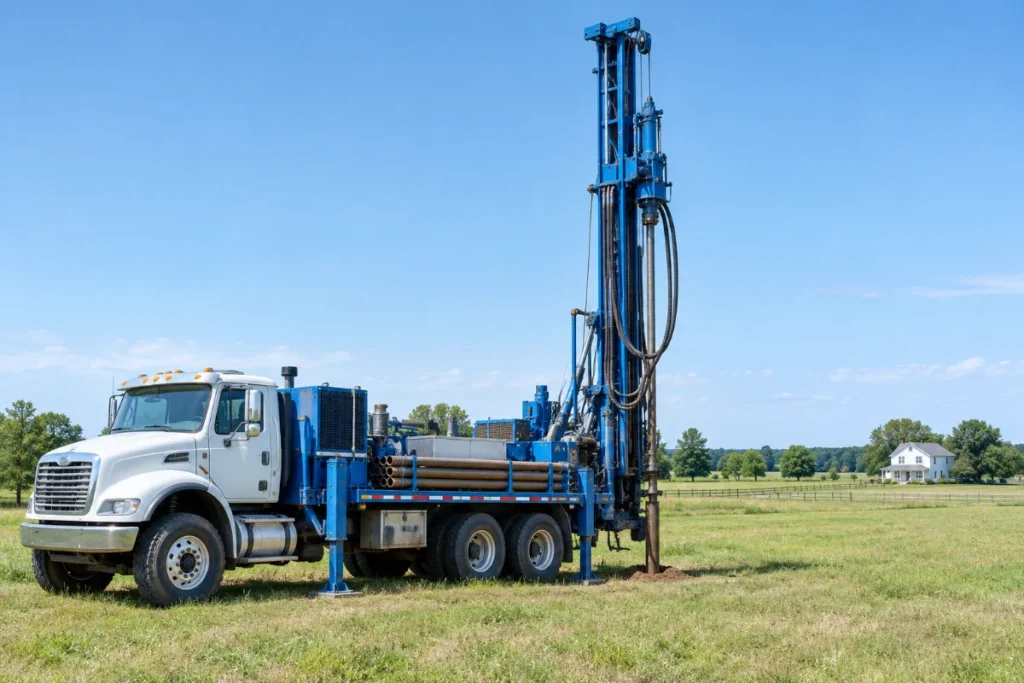
Well drilling cost per foot
| Basis | This Old House | The Well Guide | Septic & Well Pro |
|---|---|---|---|
| Residential well, per foot | $25 – $65 | $25 – $65 (complete installation) | — |
| Borehole only, per foot | — | $15 – $30 | $15 – $30 (sedimentary zones) |
| Hard rock, per foot | — | $45 – $65 (fractured granite, gneiss, schist) | $40 – $60+ |
| Typical total, residential well | $3,500 – $15,000 | $5,500 – $12,000 (100 – 200 ft) | $3,500 – $15,000 |
The guides agree on $25 to $65 per foot for a finished well and $15 to $30 for the borehole alone. They differ on rock. The older Bob Vila guide (March 30, 2023) quotes only $15 to $30 per foot for a residential well, which shows how much the price has moved, or how differently guides define it.
Well drilling cost by depth
| Depth | This Old House (drilling) | The Well Guide (complete system) |
|---|---|---|
| 50 ft | $1,775 – $3,060 | $5,500 – $7,500 |
| 100 ft | $3,550 – $6,120 | $7,000 – $10,000 |
| 150 ft | $5,325 – $9,180 | $9,000 – $13,000 |
| 200 ft | $7,100 – $12,240 | $11,000 – $16,000 |
| 300 ft | $10,650 – $18,360 | $16,000 – $22,000 |
| 400 ft | $14,200 – $24,480 | $21,000 – $30,000 |
Two cautions. First, This Old House’s depth table is almost identical to the older Bob Vila one (150 ft: $5,325 – $9,180 against $5,300 – $9,200; 400 ft: $14,200 – $24,480 against $14,200 – $24,500), so treat them as one data set, not two. Second, The Well Guide contradicts itself: its quick answer gives $3,750 to $15,600 for a complete 150-foot system, while its depth table gives $9,000 to $13,000.
You do not choose the depth; the ground does. Septic & Well Pro says typical depths run 50 to 100 feet on the coast, 200 to 400 feet in Piedmont and mountain areas, and 400 to 600 feet in parts of Texas and Georgia (Septic & Well Pro). The U.S. Geological Survey notes that modern drilled wells can reach from several hundred to over a thousand feet and can penetrate bedrock (USGS, page dated March 1, 2019, older).
How geology changes the price
| Ground | The Well Guide (per foot, drilling) | Septic & Well Pro (per foot, drilling) |
|---|---|---|
| Soft soil, sand, gravel | $15 – $35 | $15 – $30 (sedimentary zones) |
| Clay and unconsolidated sediment | $25 – $45 | — |
| Sedimentary rock (sandstone, limestone) | $35 – $55 | — |
| Fractured granite, gneiss, schist | $45 – $65 | $40 – $60+ (hard rock) |
| Dense basalt or quartzite | $55 – $85 | — |
This Old House says difficult soil or bedrock can raise the total by up to 150% of the base price. Septic & Well Pro estimates drilling alone at $14,000 to $21,000 for a 350-foot well through Piedmont granite, against $1,500 to $3,000 for 100 feet in sandy soil. The older Bob Vila guide (March 2023) puts partially rocky soil at 92% more and dense rock at more than 150% more.
Estimate your well drilling cost
Our estimate: the published ranges above multiplied out for your inputs. Not a quote. Drilling price per foot by ground, pump, tank and hookup from The Well Guide (March 2026); casing, permit and water test from This Old House (March 30, 2026). The Well Guide is internally inconsistent, so treat the result as a rough range. Lines from the well to the house and water treatment are not included. State adjustment: BLS construction wages (May 2025), applied to an assumed 50% labor share. How we calculate
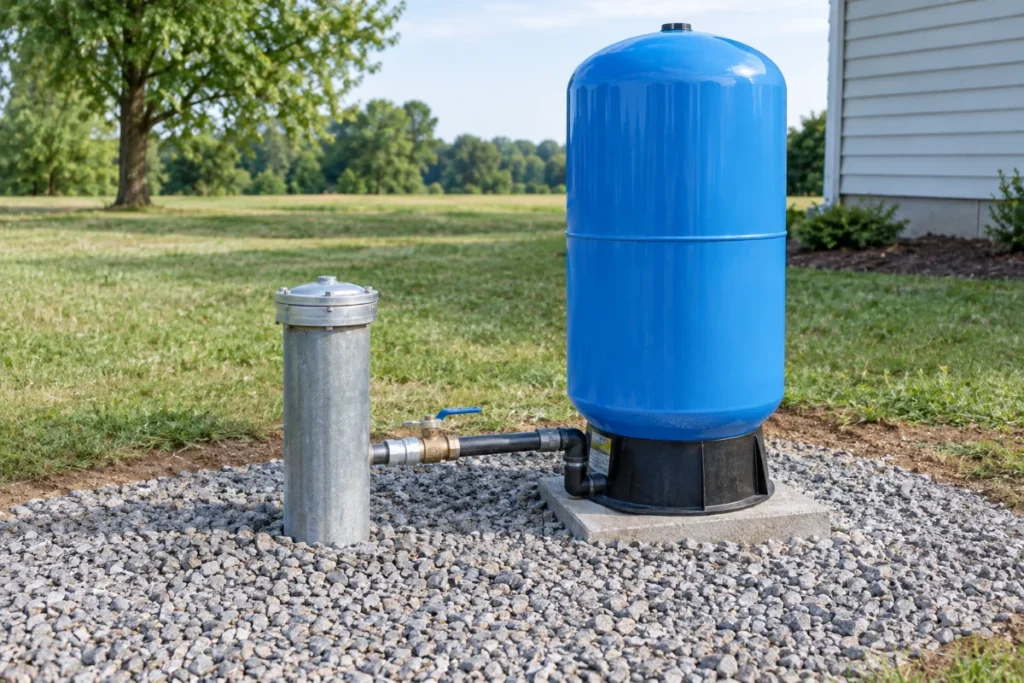
Casing, pump, pressure tank and hookup
| Item | This Old House | The Well Guide |
|---|---|---|
| PVC casing | $6 – $10 per foot ($630 – $2,400 total) | $6 – $11 per foot |
| Steel casing | $30 – $130 per foot | $30 – $130 per foot (bedrock only) |
| Well pump | $300 – $2,000 (electronic pumps) | $800 – $1,800 (submersible, ½ – 1 HP) |
| Pressure tank | $1,400 – $2,400 (large tank; a 2-gallon tank from $100) | $600 – $1,500 (20 – 44 gallons) |
| Electrical | $150 – $500 for an electrician (pump and electrical components from $50 – $150) | $1,000 – $3,000 (230V hookup) |
| Pipe and wiring to the house | $50 – $150 per linear foot | — |
| Water treatment | $500 – $3,000, plus $200 – $400 to install | $500 – $5,000 (not in standard quotes) |
The distance from the well to the house can matter more than the pump. At $50 to $150 per linear foot for piping and wiring, a well 300 feet from the house adds a large line item (This Old House). For what the pump itself costs and when it fails, see well pump installation cost. The Well Guide expects a pump and pressure tank to need replacing roughly 10 to 15 years in, at $1,000 to $2,500 and $600 to $1,500. If your water is hard, our water softener installation cost guide covers one treatment option.
Permits, licensed drillers and water testing
Permit costs are small next to drilling, but the rules are local. This Old House gives $5 to $500 for permits, The Well Guide $100 to $500, and Septic & Well Pro $200 to $1,000 for permits, plus $100 to $500 for initial water testing. Three state and county examples show how much it varies:
| Where | Fee | What it requires |
|---|---|---|
| Minnesota | $325 notification fee for a water-supply well | Wells installed by Minnesota Department of Health licensed contractors; notification and fee before drilling; sample tested for bacteria, nitrate and arsenic |
| Virginia | Application fee (amount not stated on the page) | Construction permit from the local health department after a sanitary survey; licensed provider; bacteria test before use |
| Wake County, North Carolina | $800 new well permit | Includes contamination source review, inspections, and sampling and lab analysis by the county |
Testing is on you. USGS says more than 43 million people, about 15% of the U.S. population, rely on private wells, and that this water is not regulated by the federal Safe Drinking Water Act or, in most cases, by state laws (USGS, March 2019, older). The EPA says to hire a certified well driller for new construction and to test the well every year for total coliform bacteria, nitrates, total dissolved solids and pH (EPA, February 26, 2026). A professional test costs $100 to $500, or $50 to $150 for a do-it-yourself kit (This Old House).
Well and septic together, and running costs
Rural lots often need both. This Old House puts a septic system at $2,000 to $7,000 and a well and septic pair at $5,000 to $22,000. The older Bob Vila guide gives $5,000 to $22,500 for the pair (March 2023). Our septic tank replacement cost guide has the septic side. Once the well is in, This Old House estimates pump electricity at about $3 to $4 a month and maintenance at $100 to $250 a year, against a municipal water bill of $20 to $40 a month. Hot water is a separate line in a new-build plumbing budget; see water heater replacement cost.
Our estimate: for a 200-foot residential well in ordinary ground, plan on about $11,000 to $16,000 complete (The Well Guide), with $7,100 to $12,240 for the borehole alone (This Old House). The $3,500 to $15,000 headline range fits shallower or simpler wells. This is a range we combined from published figures, not a measured price.
How to keep the bill down
- Get quotes that state the price per foot, what is included, and what happens if the driller has to go deeper than the estimate.
- Look up nearby wells. The Well Guide points to state well completion and log databases for depth and yield in your area.
- Where health setbacks allow, site the well close to the house, since piping and wiring run $50 to $150 per linear foot.
- If you have an old well, ask about deepening it. The Well Guide gives $3,000 to $10,000 for deepening against $8,000 to $20,000 for a new well.
- Do not skip the water test. Treatment you discover you need later is a separate bill.
Questions to ask before you sign
- Is the driller licensed in this state, bonded and insured? The EPA advises making sure drillers and pump installers are bonded and insured (EPA).
- Does the price include casing, pump, pressure tank, wiring, permit and water test?
- What is the casing type and diameter, and how much of the hole is cased?
- What if the well comes in dry or low-yield: do you charge per foot to keep drilling?
For more on vetting a driller, read how to find a contractor.
Sources
- This Old House, How Much Does Well Installation Cost?, updated March 30, 2026.
- The Well Guide, Well Drilling Cost: What Homeowners Actually Pay in 2026, updated March 2026.
- Septic & Well Pro, How Much Does Well Drilling Cost? (2026 National Guide), June 10, 2026.
- Bob Vila, Well Drilling Cost: What to Know, and How Much to Expect You’ll Pay, March 30, 2023 (older).
- U.S. Environmental Protection Agency, Protect Your Home’s Water, February 26, 2026; About Private Water Wells, September 14, 2026.
- U.S. Geological Survey, Domestic (Private) Supply Wells, March 1, 2019 (older).
- Minnesota Department of Health, Well fee schedule, July 1, 2025, and Constructing a New Water-Supply Well, October 18, 2024 (older).
- Virginia Department of Health, Private Well Program, July 28, 2026.
- Wake County, North Carolina, Well Permits, Fees and Approvals, date not shown.