$1,000 – $3,000That is the typical whole house water filter cost in 2026 for a system on city water, installed. Published cost guides disagree widely: HomeBuddy puts the average installed range at $1,500 to $5,500, while RateYourPlumber says $300 to $2,500. Well water, iron or bacteria problems and whole-house reverse osmosis push the price to $3,000 – $10,000 or more, and replacement filters add $100 to $300 a year.
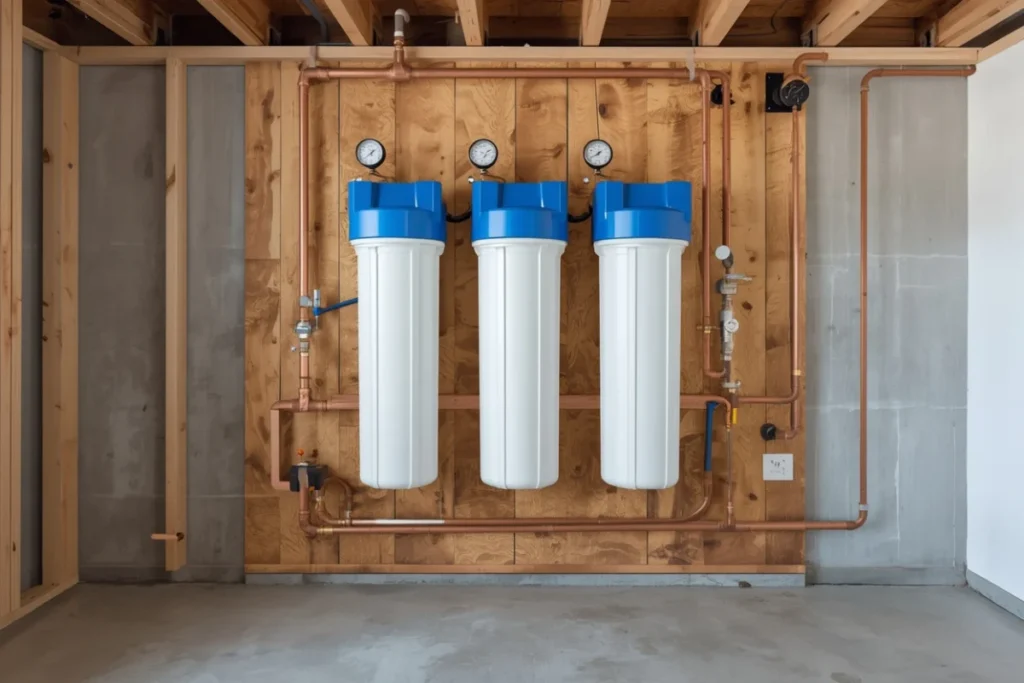
A whole-house filter, which the CDC calls a point-of-entry system, treats most or all of the water entering the house, while a point-of-use system treats the water at a single tap (CDC). That changes the job and the price. Before you compare quotes, know what you are paying to remove: the CDC advises testing your tap water first, and says that if it has no harmful germs or chemicals you may not need a treatment system at all.
Installed cost by source
| Source | Installed cost | What the range covers |
|---|---|---|
| HomeBuddy (September 2026) | $1,500 – $5,500 | Average installed range; the guide adds that well-water or multi-stage systems can pass $10,000 |
| RateYourPlumber (May 2026) | $300 – $2,500 | Its typical range; its table by type runs from $130 to $3,600 |
| Homewyse (May 2026) | $990 – $1,245 | One popular three-stage whole-home unit, basic installation in easy conditions |
| Bob Vila (August 2022, older guide) | $1,000 – $4,000 | Typical range; average $2,078 |
The guides do not measure the same jobs, so read this table as a spread rather than a quote. HomeBuddy’s average range and RateYourPlumber’s typical range overlap only between $1,500 and $2,500. Homewyse prices a single basic unit and leaves out plumbing modifications, code upgrades and permit fees (Homewyse). Bob Vila is the only guide here older than 2025, and we use it only as a cross-check. RateYourPlumber’s own page gives two figures for a multi-stage system, $1,500 to $4,000 in its introduction and $900 to $2,400 in its table; we use the table figures below.
Our estimate: The headline range of $1,000 to $3,000 is our reading of the city-water cases in the guides above, not a measured figure. Its low end is Homewyse’s $990 for a basic three-stage unit, which matches the floor of $1,000 in Bob Vila. Its high end is the $3,000 that HomeBuddy gives as the top installed price of a basic system on city water. RateYourPlumber’s multi-stage price tops out at $2,400, inside that band. HomeBuddy’s overall average range and its well-water and reverse osmosis figures all reach above it.
Cost by type of whole-house system
| System type | HomeBuddy | RateYourPlumber | This Old House |
|---|---|---|---|
| Sediment filter only | — | $130 – $400 | — |
| Carbon filtration | $1,500 – $3,000 | $250 – $700 | — |
| Iron and manganese filter | — | $600 – $1,700 | — |
| Ultraviolet (UV) disinfection | $1,500 – $3,500 | $350 – $950 | — |
| Multi-stage or combination system | $3,000 – $7,000+ | $900 – $2,400 (sediment, carbon and UV) | — |
| Water softener system | $1,500 – $4,500 | — | — |
| Whole-house reverse osmosis | $3,000 – $10,000+ | $1,300 – $3,600 | $1,000 – $4,800 |
| Well-water filtration system | $3,000 – $10,000+ | — | — |
The gap is widest for basic filters: RateYourPlumber’s highest price for a carbon system, $700, is below HomeBuddy’s lowest, $1,500. HomeBuddy also lists the equipment alone, before installation: $500 to $1,500 for carbon, $800 to $2,000 for UV and $2,000 to $5,000 or more for whole-house reverse osmosis (HomeBuddy). This Old House says some whole-house reverse osmosis jobs reach $10,000 when bundled with a water softener (This Old House).
Estimate your whole house water filter cost
The calculator below uses the lowest low and the highest high of the guides in the table above for each system type, so its ranges are wide where the guides disagree. The basic three-stage option is Homewyse’s range for easy conditions.
Our estimate: Each calculator range runs from the lowest low to the highest high of the guides that price that type. Where HomeBuddy gives an open-ended figure such as $7,000+ or $10,000+, we use the number shown. The ranges for the well-water option come from one guide only. The results are our combination of published ranges, not quotes.
Our estimate: the published ranges above multiplied out for your inputs. Not a quote. Installed ranges from HomeBuddy (September 2026), RateYourPlumber (May 2026), Homewyse (May 2026) and This Old House (March 2026): lowest low to highest high per type. Permit from Bob Vila (August 2022, older guide); filters and servicing from HomeBuddy. The guides disagree widely. State adjustment: BLS construction wages (May 2025), applied to an assumed 50% labor share. How we calculate
What the installation adds
Labor depends on how easy the plumbing is to reach and how many stages the system has. HomeBuddy puts labor at about $300 to $800 for simple, accessible plumbing and $1,500 to $2,000 or more for complex jobs such as multi-stage systems or tight spaces, and notes that UV units need an electrical connection (HomeBuddy). This Old House gives $300 to $700 for a typical installation and up to $1,500 for complex plumbing, with plumbers charging $45 to $200 an hour (This Old House). Bob Vila’s older guide says $300 to $500 (Bob Vila, August 2022).
RateYourPlumber’s labor line runs from $100 to $250 for a single-stage sediment filter to $300 to $600 for reverse osmosis or a multi-stage system, and it estimates 1 to 2 hours for a single-stage filter and 3 to 5 hours for a multi-stage system with an iron filter (RateYourPlumber). For context, the median plumber in the United States earned $30.67 an hour, according to the Bureau of Labor Statistics; what a company bills is higher because it also covers the vehicle, tools, licensing and insurance.
Some basic systems can be installed by the homeowner, but HomeBuddy says most whole-house setups are more complicated and usually need a professional, and that you may need a permit depending on local rules (HomeBuddy). Bob Vila’s older guide puts permits at $100 to $600. If a general contractor supervises the job, Homewyse says to add 13% to 22% to its totals (Homewyse). If you are pricing other plumbing at the same time, see our guides to water heater replacement cost and whole house repipe cost.
Yearly running costs
| System type | Replacement | Yearly maintenance |
|---|---|---|
| Sediment filter | Cartridge every 3 – 6 months | $20 – $60 |
| Carbon filter | Cartridge every 6 – 12 months | $50 – $150 |
| Iron and manganese filter | Media lasts 5 – 10 years, weekly backwash | $50 – $200 (media) |
| UV disinfection | Bulb every year | $60 – $120 (bulb) |
| Whole-house reverse osmosis | — | $150 – $400 |
| Multi-stage (sediment, carbon, UV) | — | $100 – $300 |
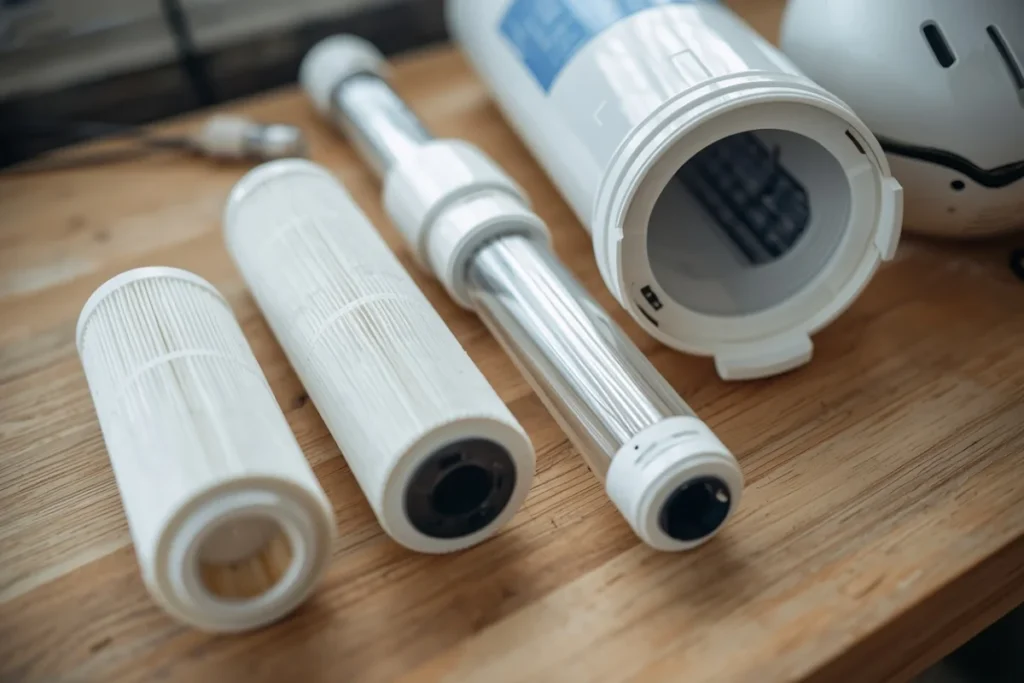
HomeBuddy is in the same range: most homeowners spend $100 to $300 a year on replacement filters, filters need replacing every 3 to 12 months depending on the system, and servicing an advanced system adds $100 to $200 a year (HomeBuddy). Bob Vila’s older guide gives $50 to $300 a year (Bob Vila, August 2022). This Old House puts the yearly operating cost of a reverse osmosis system, water and replacement filters together, at about $400, plus $50 to $100 for the membrane every 3 to 5 years (This Old House).
Do not skip the changes. The CDC says to replace filters regularly, following the manufacturer’s recommendations, to wear gloves when you do it and wash your hands afterward, and that people with weakened immune systems should not change filters themselves (CDC).
Our estimate: Adding ten years of replacement filters at HomeBuddy’s $100 to $300 a year ($1,000 to $3,000) to our $1,000 to $3,000 headline range gives a ten-year cost of about $2,000 to $6,000, before servicing, water and electricity. This is our arithmetic on published ranges, not a measured figure, and it assumes you spend the same on filters every year.
Test your water before you buy
The CDC advises choosing a filter that removes the germs or chemicals your test found, because filters that remove germs often do not remove chemicals, and the reverse (CDC). On a public supply, your utility’s water quality report, called a Consumer Confidence Report, is the place to start (EPA). If what bothers you is rusty color, a metallic taste or a musty smell, note that EPA’s secondary standards for contaminants such as iron (0.3 mg/L) and manganese (0.05 mg/L) are non-enforceable guidelines for taste, color and odor, and EPA says these contaminants are not considered to present a risk to human health at those levels (EPA).
Private wells. The quality of well water is not regulated by the federal government under the Safe Drinking Water Act or by most state governments, so the owner is responsible. About 15 percent of the U.S. population, over 43 million people, rely on private wells, and a U.S. Geological Survey study of 2,100 private wells found that about one in five contained one or more contaminants above a human-health benchmark (EPA, updated August 25, 2026). EPA recommends testing a private well every year for total coliform bacteria, nitrates, total dissolved solids and pH, using a laboratory certified for drinking water testing, and notes that your local health department may provide private well testing for free (EPA). The CDC adds that you should test again after any treatment to confirm it worked (CDC).
| Problem | Treatment Penn State Extension lists |
|---|---|
| Hardness (scale, reduced suds) | Ion-exchange water softener |
| Iron (orange or brown staining, metallic taste) | Water softener for low to moderate levels; oxidizing filter for higher levels |
| Manganese (black specks or stains) | Water softener for low levels; oxidizing filter for higher levels |
| Hydrogen sulfide (rotten-egg odor in hot and cold water) | Oxidizing filter, shock chlorination in some cases, continuous chlorination with filtration, or activated carbon for milder cases |
| Cloudy or dirty water (sediment) | Cartridge filter for milder cases; multi-level media filtration for severe cases |
| Coliform, fecal and E. coli bacteria | Shock chlorination of the well; ultraviolet light, chlorination or ozonation for recurring contamination |
For UV, the CDC says systems that filter the water before disinfecting it with UV light work better than those without pre-filtering (CDC). RateYourPlumber’s multi-stage example in the cost table combines sediment, carbon and UV stages.
City water, well water and the price
HomeBuddy says most homes on city water need only a basic system, about $1,500 to $3,000 installed, and puts the cost for chlorine or sediment problems in the same band. For well water with bacteria, iron or heavy metals it cites roughly $3,000 to $5,500 or more, and well-water systems usually need several stages to handle iron, sulfur, bacteria and sediment (HomeBuddy). If you are on a well and the pump is also near the end of its life, see our guide to well pump installation cost.
Whole-house filter or water softener?
They solve different problems. HomeBuddy says a basic whole-house system usually takes care of things like chlorine and sediment (HomeBuddy). A water softener removes minerals such as calcium and magnesium, and the CDC notes that softeners do not remove parasites, bacteria or viruses (CDC). We cover prices, salt, water use and hardness testing in our guide to water softener installation cost, so we do not repeat them here.
What a whole-house filter does not do
Check the label for the specific substances a filter removes, and look for an NSF certification on it (CDC). Penn State Extension names two NSF/ANSI standards used to certify home treatment units: Standard 53 for drinking water treatment units (health effects) and Standard 58 for reverse osmosis systems (Penn State Extension, June 2024). The CDC also warns that whole-home filters that remove chlorine may allow more germs to grow in plumbing, which is a reason to talk through disinfection with your installer if you are on city water. Filtering all the water is not always necessary either: a point-of-use system treats a single tap (CDC).
How to keep the bill down
- Test first. On a well, use a certified laboratory; on city water, read your utility’s water quality report. Pay only to remove what the test found.
- Match the system to the problem, as in the table above: hardness calls for a softener, bacteria for disinfection.
- On city water, ask whether a basic system is enough. HomeBuddy says most homes on city water need only one.
- Budget the filters. At HomeBuddy’s $100 to $300 a year, ten years of replacements comes to $1,000 to $3,000 (our arithmetic).
- Get at least three written quotes that itemize equipment, labor, the permit and any plumbing changes, and compare them like for like.
Questions to ask before you sign
- Which contaminants is this system certified to reduce, and by whom? Can I see the certification on the label?
- What did my water test show, and how does each stage of the system address it?
- Does the price include the permit, any plumbing or electrical changes, and removal of old equipment?
- What will replacement filters, bulbs or media cost each year, and how often do they need changing?
- Will you retest the water after installation to confirm it works?
Sources
- Centers for Disease Control and Prevention, About Home Water Treatment Systems and About Choosing Home Water Filters, both dated April 10, 2024; Guidelines for Treating Well Water, July 2, 2024.
- U.S. Environmental Protection Agency, Private Drinking Water Wells, updated August 25, 2026; Protect Your Home’s Water, updated February 26, 2026; Secondary Drinking Water Standards: Guidance for Nuisance Chemicals, updated May 26, 2026; Consumer Confidence Reports, updated September 9, 2026.
- Penn State Extension, Common Drinking Water Problems and Solutions, updated May 29, 2025; Home Water Treatment for PFAS, updated June 7, 2024.
- U.S. Bureau of Labor Statistics, Occupational Outlook Handbook: Plumbers, Pipefitters, and Steamfitters, pay data for May 2025.
- HomeBuddy, Whole House Water Filtration System Cost Guide 2026, updated September 23, 2026.
- RateYourPlumber, Whole House Water Filter Cost: Installation Prices for 2026, updated May 4, 2026.
- Homewyse, Cost to Install Water Filter System, May 2026.
- This Old House, How Much Does a Reverse Osmosis System Cost?, updated March 30, 2026.
- Bob Vila, How Much Does a Home Water Filtration System Cost?, last updated August 16, 2022 (older guide).