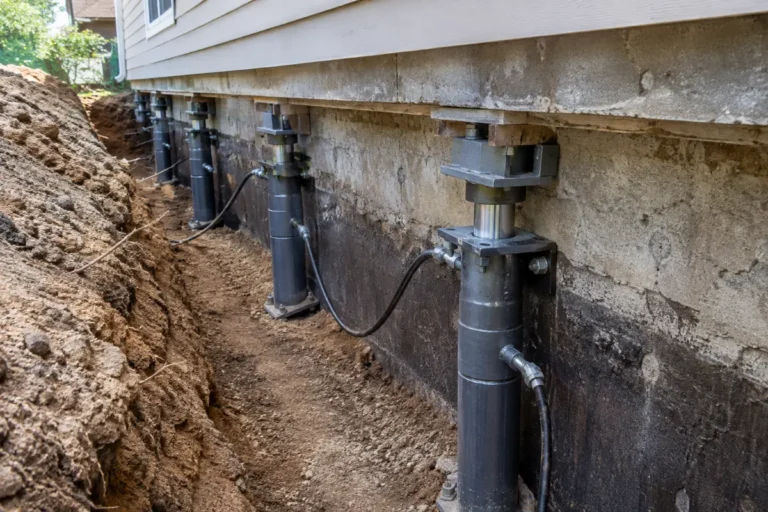
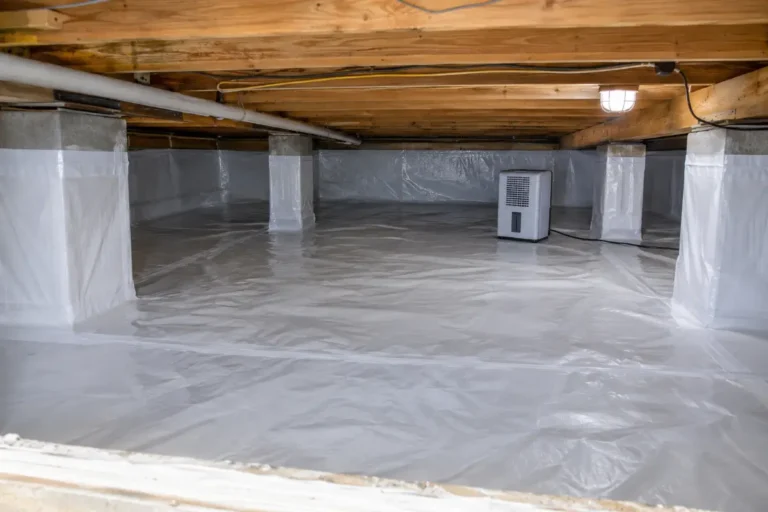
$500 – $8,800That is the typical french drain cost in 2026 for an exterior drain in the yard, or $10 to $35 per linear foot installed. An interior french drain dug into a basement floor costs far more: $4,000 to $17,000, or $40 to $85 per foot (HomeGuide). Other guides land in the same territory: Fixr puts the typical job at $2,800 to $6,500 (average $5,000, with jobs from $500 to $18,000), and Forbes Home gives $1,600 to $13,000 for a foundation drain.
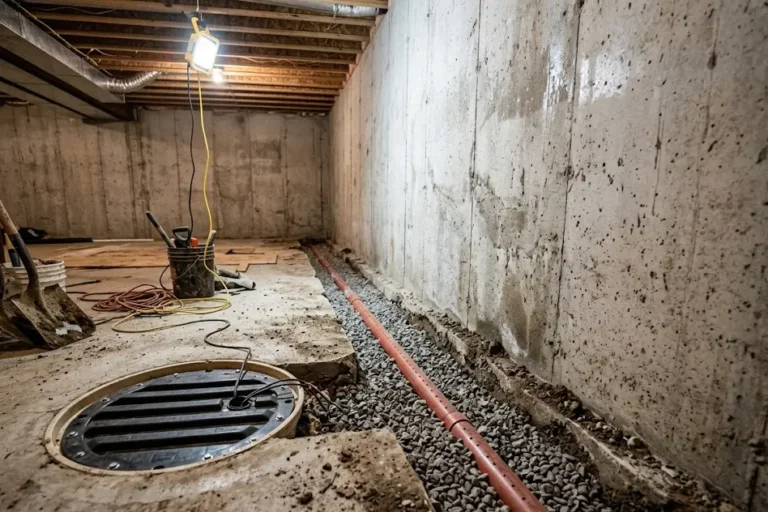
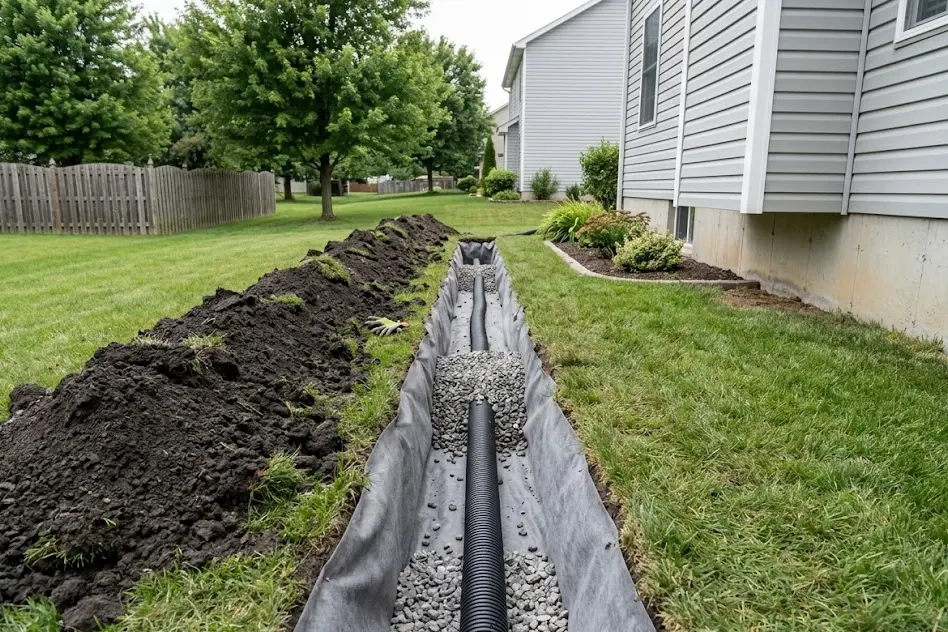
A french drain is a sloped trench with a perforated pipe bedded in gravel. Water soaks into the gravel, enters the pipe through its holes and runs by gravity to somewhere it can do no harm. The price depends mostly on three things: how long the trench is, how deep it goes, and whether it runs through open lawn or under a concrete floor. The tables below break those down, followed by the extras that tend to show up on the bill.
French drain cost by type
| Type | HomeGuide, per ft | Fixr, per ft | Forbes Home, per ft | Typical total (HomeGuide) |
|---|---|---|---|---|
| Surface-level drain in the yard | $10 – $30 | $10 – $50 (shallow) | $10 – $100 (all exterior) | $500 – $5,300 |
| Curtain drain (shallow, soil-covered) | $10 – $35 | – | – | $1,500 – $8,800 |
| Exterior drain at the footings, per side of house | $30 – $90 | $80 – $100 | $20 – $60 (foundation) | $1,200 – $4,500 |
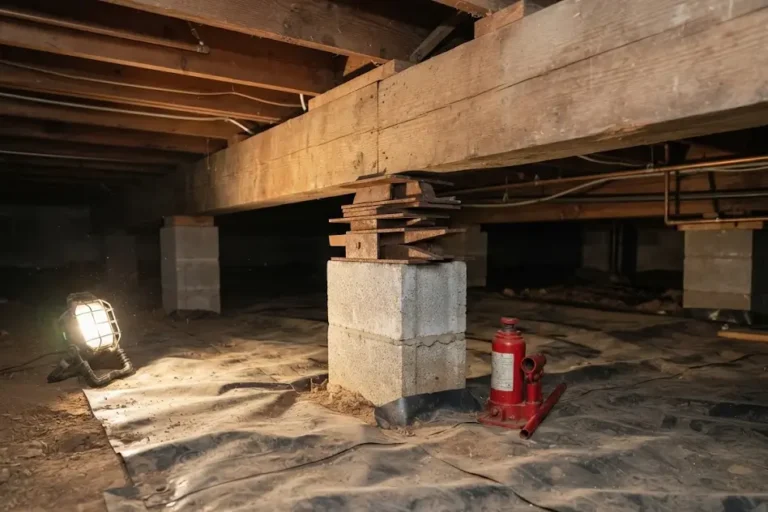
| Interior drain, crawl space | $20 – $40 | $25 – $35 | – | $2,000 – $8,000 |
| Interior perimeter drain, basement | $40 – $85 | $40 – $100 | $40 – $100 | $4,000 – $17,000 |
A surface-level drain sits under 2 feet deep and mainly moves surface water; its gravel is usually left visible. A curtain drain goes 2 feet or deeper, is covered with soil or sod, and mainly intercepts groundwater. A deep perimeter drain, also called weeping tile or drain tile, is dug down to the foundation footings to carry water away before it reaches the basement wall (HomeGuide).
The three guides broadly agree on interior basement drains ($40 to about $100 per foot) and crawl spaces, but not on deep exterior drains at the footings: Fixr puts them at $80 to $100 per foot, while Forbes Home calls $20 to $60 per foot realistic for foundation work and notes the trench may need to go 8 to 10 feet deep.
Estimate your french drain cost
Use the tables above to estimate your cost. The interactive calculator needs JavaScript.
Cost per linear foot, yard vs basement
| Length | Exterior (HomeGuide) | Exterior (Fixr) | Interior (HomeGuide) | Interior (Fixr) |
|---|---|---|---|---|
| 25 ft | $250 – $900 | – | $1,000 – $2,100 | – |
| 50 ft | $500 – $1,800 | $1,250 – $2,000 | $2,000 – $4,300 | $2,500 – $3,000 |
| 100 ft | $1,000 – $3,500 | $3,500 – $4,000 | $4,000 – $8,500 | $5,000 – $6,000 |
| 150 ft | $1,500 – $5,300 | $4,250 – $5,000 | $6,000 – $12,800 | $7,500 – $9,000 |
| 200 ft | $2,000 – $7,000 | – | $8,000 – $17,000 | – |
| 250 ft | $2,500 – $8,800 | – | $10,000 – $21,300 | – |
Fixr’s exterior figures sit at or above the top of HomeGuide’s range, so the two guides disagree most on cheap yard drains: for 100 feet, HomeGuide starts at $1,000 and Fixr at $3,500.
Our estimate: taking the lowest and highest figure either guide gives for a 100-foot exterior drain, the combined span is $1,000 to $4,000. This is simply the envelope of the two published ranges, not a measured figure.
Exterior drains in the yard are the cheap end: a shallow run through an accessible lawn that needs no regrading can go in within a day. A deep exterior drain around an existing house can take several days because of the excavation (HomeGuide).
Interior drains cost more because the installer has to break out the perimeter of the concrete floor down to the footings, lay the pipe and gravel, and connect it to one or more sump pumps. A 100-foot basement perimeter with one pump runs $4,000 to $8,500, while a 200-foot perimeter with two pumps runs $8,000 to $17,000. In a crawl space the dirt floor is easier to dig, which is why the price per foot is roughly half (HomeGuide). If the interior drain is part of a larger job to seal and dry out the basement walls, that is a waterproofing project, priced separately.
What the price includes: pipe, gravel and fabric
| Item | Cost for 100 – 200 ft |
|---|---|
| Perforated pipe | $100 – $1,000+ |
| Drainage gravel | $100 – $600 |
| Filter (landscape) fabric | $40 – $360 |
| Trenching | $500 – $2,400 |
| Installation labor | $700 – $8,000 |
| Sump pump, installed | $500 – $1,800 |
| Dry well, installed | $50 – $3,000+ |
Labor is the largest part of the bill. Materials are comparatively cheap: perforated pipe costs $1 to $5 or more per foot, filter fabric $0.40 to $1.80 per foot, and washed gravel about $1 to $3 per foot. Corrugated pipe is the cheapest and bends around curves; PVC costs $1.20 to $5 per foot but is more durable and stands up better to a plumber’s snake, which makes it the better fit for deep footing drains (HomeGuide). Fixr gives a labor breakdown: about $35 to $40 of the average $50 per foot for an interior basement drain, and $20 to $25 of about $35 per foot for an exterior drain, with hourly rates of $35 to $75.
The fabric matters more than its price suggests. Louisiana State University’s AgCenter explains that geotextile fabric laid along the bottom and sides of the trench keeps soil from washing into the gravel and clogging the spaces water needs to flow through (LSU AgCenter). A quote that skips it may be cheaper today and drain more slowly later.
Our estimate: for a 100-foot yard drain, the per-foot material prices above add up to roughly $240 to $980 (pipe $1–$5, fabric $0.40–$1.80, gravel $1–$3 per foot, multiplied by 100). Set against the $1,000 to $3,500 installed range, that suggests most of the price is labor and excavation. This is our own arithmetic from HomeGuide’s figures, not a measured figure.
How deep and wide the trench goes
For landscape drains, LSU AgCenter describes a trench 12 to 18 inches wide and 18 to 24 inches deep, with a perforated pipe, typically 4 inches in diameter, laid at the bottom and covered with washed gravel of about 1 inch (LSU AgCenter). HomeGuide gives a similar picture: 12 to 24 inches deep, at least 12 inches wide, 2 to 5 feet from the foundation, and sloped at least 1%, or 1 foot of drop per 100 feet of drain (HomeGuide).
Depth drives cost. Every extra foot of trench means more soil to dig and move and more gravel to buy, which is why a drain at the footings costs two to three times as much per foot as a shallow yard drain. If your yard does not slope away from the house, regrading adds $500 to $5,000 (HomeGuide).
Where the water goes
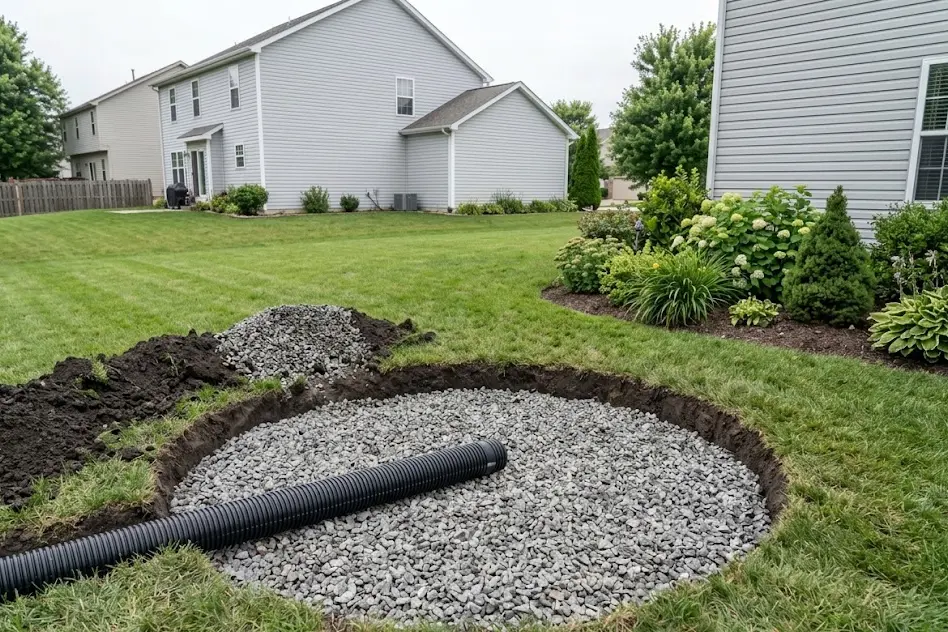
A drain is only as good as its outlet. LSU AgCenter advises deciding where the water will be delivered before digging: on large lots it can go to ponds, ditches or low areas; on small urban lots you should check local regulations and ordinances, and avoid making your excess water your neighbor’s problem (LSU AgCenter). The usual options:
- Daylight. The pipe exits at a lower point of the property, away from the house. It is the simplest outlet when the ground falls away enough.
- Pop-up emitter. Water pressure pushes open a cap downstream and spreads the water over lawn, a bed or a rain garden, then the lid closes again (LSU AgCenter).
- Dry well. A covered pit that lets water soak into the ground, useful when there is no natural outlet. Gravel pits run $50 to $250, plastic tanks $200 to $700 and concrete tanks $500 to $3,000 or more. A percolation test to check the soil costs $600 to $2,000 (HomeGuide).
- Sump pump. Needed for interior drains and for exterior drains where gravity cannot do the job. Adding one to a french drain costs $600 to $2,500 (HomeGuide).
- Storm drain. Connecting to a public storm drain often means extra permit fees (HomeGuide). Ask your local building or public works office before planning on it.
Permits, 811 and other extra costs
Contact 811 first. Anyone digging, including homeowners installing drain tile on their own property, must contact 811 a few days in advance to have buried utilities marked. Some lines lie only inches below the surface, so even a shallow trench counts (811 Before You Dig).
- Permit: $100 to $375, more if you tie into a public storm drain. Some areas also require an inspection before the trench is covered (HomeGuide). Forbes Home puts typical permit fees at $100 to $200.
- Obstacles: digging around driveways, patios, trees or planted beds takes longer and may mean replacing what was removed, and repairing the lawn afterwards is extra (HomeGuide).
- Disposal: hauling off dirt or broken concrete adds to the price; reusing the soil elsewhere in the yard reduces it (HomeGuide).
- Location: labor rates are higher in large cities than in small towns (HomeGuide).
Maintenance and lifespan
A correctly installed french drain lasts 30 to 40 years or more, and cleaning a clogged one costs $80 to $500 or more depending on the blockage (HomeGuide). LSU AgCenter recommends regular checks of inlet grates and outlets, flushing the pipe with a hose when it slows, and an electric snake for severe blockages. It also suggests designing the system so it is easy to reach for maintenance; a grate at the surface in a low spot lets water in fast and gives you an access point (LSU AgCenter).
How to keep the bill down
- Check the grading first. If the yard slopes toward the house, regrading may be part of the answer.
- Choose the shallowest drain that solves the problem. A surface drain costs a fraction of one dug to the footings.
- Plan the outlet before you get quotes. A pump or dry well adds hundreds to thousands of dollars.
- Keep the excavated soil on site if you can use it, to avoid disposal fees.
- Get written estimates that list pipe type, gravel, fabric, length and depth, so the totals are comparable.
Questions to ask before you sign
- Which type of drain do you recommend for my problem, and why that depth?
- Where will the water discharge, and does that outlet need a permit or local approval?
- What pipe, gravel size and filter fabric are in the price?
- Does the quote include the permit, soil disposal and restoring the lawn or hardscape?
- Is there a cleanout or grate for future maintenance, and what does your warranty cover?
Sources
- Fixr, French Drain Installation Cost, updated January 31, 2025.
- Forbes Home, How Much Does A French Drain Cost?, February 7, 2025.
- HomeGuide, How Much Does a French Drain Cost?, February 5, 2026.
- Louisiana State University AgCenter, Landscape Ornamental Series: Installing and Maintaining a French Drain, Publication 3879, May 24, 2023.
- 811 Before You Dig.