$175 – $900That is the typical tree trimming cost per tree in 2026 across three published cost guides, with national averages between $450 and $650. HomeGuide puts the typical range at $400 to $900 (average $650), Fixr at $175 to $750 (average $450) and LawnStarter at $430 to $640. A small ornamental tree can cost as little as $75 to $80, while a very tall or long-neglected tree can pass $1,800 to $2,500. Most tree services also charge a minimum job fee of $100 to $300 or more (HomeGuide).
Height is the biggest driver of the price, followed by how easy the tree is to reach, how many trees are on the job and what shape the tree is in. The sections below break down each of those, explain when trimming is best done, who pays when branches reach power lines, and what to check before you hire.
Average tree trimming cost
| Measure | HomeGuide | Fixr | LawnStarter |
|---|---|---|---|
| National average | $650 | $450 | — |
| Typical range | $400 – $900 | $175 – $750 | $430 – $640 |
| Low end (small tree) | $80 | $75 | $78 |
| High end (very large or neglected tree) | $2,500+ | $1,800 | $1,835 |
| Minimum job fee | $100 – $300+ | — | — |
The three guides do not fully agree. Fixr’s range starts much lower because its average describes a smaller job, a 20-foot tree (Fixr), while HomeGuide’s top end is higher because it counts very large and long-neglected trees (HomeGuide). LawnStarter’s narrower range sits in the middle (LawnStarter).
Our estimate: the $175 – $900 headline range runs from the lowest typical-range floor (Fixr) to the highest typical-range ceiling (HomeGuide) of the three guides. It is a span of published ranges, not a measured average.
Labor is most of what you pay for. Tree trimmers and pruners earned a median of $24.50 an hour in May 2025, and the Bureau of Labor Statistics notes that the occupation has one of the highest rates of injuries and illnesses of all occupations (U.S. Bureau of Labor Statistics).
Our estimate: the $650 national average equals about 26.5 hours of a tree trimmer’s median wage ($650 ÷ $24.50). The price therefore covers much more than one worker’s wages: a crew, equipment, insurance, disposal and overhead. This is our calculation, not a measured figure.
Tree trimming cost by height
| Tree height | HomeGuide | LawnStarter | Typical trees |
|---|---|---|---|
| Up to 30 feet | $250 – $700 | $85 – $415 | Crabapple, crepe myrtle, dogwood, Japanese maple |
| 30 – 60 feet | $600 – $1,200 | $215 – $790 | Fruiting cherry and pear, Bradford pear, most palms |
| More than 60 feet | $1,000 – $2,500+ | $475 – $1,835 | Oak, ash, pine, elm, sugar and silver maple, pecan |
Fixr uses different height bands: $75 to $300 for a small tree of 10 to 20 feet, $150 to $450 for 20 to 30 feet, $150 to $800 for 30 to 50 feet and $300 to $1,800 for 50 to 100 feet (Fixr). HomeGuide’s figures are clearly the highest of the three at every height, so treat them as the upper end of what to expect.
Tree trimming cost calculator
Use the tables above to estimate your cost. The interactive calculator needs JavaScript.
Our estimate: each height option in the calculator runs from the lower of the HomeGuide and LawnStarter floors to the higher of their ceilings (for example $85 – $700 for trees up to 30 feet). Hauling and bird nest removal use HomeGuide’s add-on ranges. The result is a combination of published ranges, not a quote.
Taller trees take more time and more equipment. The tallest often need a bucket truck or crane, which raises labor costs considerably (HomeGuide). Working at height is also where the risk sits: federal workplace-safety guidance lists overhead power lines and falling branches among the potentially fatal hazards in tree care (OSHA).
Cost by tree type
| Tree type | HomeGuide | Fixr | LawnStarter |
|---|---|---|---|
| Crepe myrtle | $80 – $400 | $75 – $400 | $78 – $350 |
| Palm | $100 – $900 | $100 – $1,500 | $100 – $1,330 |
| Cypress | $150 – $1,200 | $150 – $1,200 | $150 – $1,200 |
| Maple | $400 – $1,000 | — | — |
| Oak | $450 – $1,500 | $175 – $1,500 | $230 – $1,480 |
| Pine | $250 – $1,600 | $200 – $1,800 | $210 – $1,630 |
Palms tend to sit at the lower end because the work is simpler, while oaks and other hardwoods cost more because of their dense wood and wide branch systems (HomeGuide).
What else changes the price
Access. Trees close to power lines, buildings or other structures need extra care, and trees in tight spots may have to be worked with smaller equipment or by hand. Trees standing in open ground cost less to service (HomeGuide).
Number of trees. Because of minimum job fees, the cost per tree usually drops as you add trees to the same visit, and many companies offer volume discounts (HomeGuide). A single small tree can end up priced at the minimum fee even if the work is quick.
Tree health. Diseased or damaged trees take longer to trim safely, weak branches raise the risk for the crew, and pest problems may need treatment on top (HomeGuide).
Season and urgency. Demand peaks from late spring through early fall, winter work can come in cheaper, and emergency trimming after a storm almost always costs more than planned maintenance (HomeGuide).
Location. Labor rates are higher in urban, coastal and metropolitan areas than in rural ones (HomeGuide).
Extra charges to expect
| Add-on | Typical cost |
|---|---|
| Hauling away branches and wood | $75 – $250 |
| Pest treatment | $100 – $500+ |
| Bird nest removal | $100 – $300+ |
| Shrub and bush trimming | $5 – $35 per bush |
| Hedge trimming | $25 – $60 per 10 feet |
Our estimate: if debris hauling is quoted separately, a typical trim plus haul-away comes to roughly $475 to $1,150 per tree ($400 – $900 for the trim plus $75 – $250 for hauling). This is our sum of two published ranges, not a measured figure.
If the tree turns out to be beyond saving, trimming is no longer the right job. Our tree removal cost guide covers what taking a tree down costs.
Trimming or pruning: what you are paying for
The two words are often used interchangeably. In the cost guides, trimming means keeping a tree’s size and shape in check and clearing limbs away from structures, while pruning means removing dead, diseased or damaged branches and correcting the tree’s structure (HomeGuide).
University of Minnesota Extension groups the reasons to prune into three: plant health (removing dead or dying wood, branches that rub together and stubs), the plant’s purpose in the landscape (flowering, fruiting, a dense hedge), and safety (removing weak branches that overhang homes, parking areas and sidewalks). It also advises against topping trees, because cutting back large limbs leaves stubs that cause health problems and encourages weak branch structure (University of Minnesota Extension). If a quote says “topping”, ask why.
When to trim trees
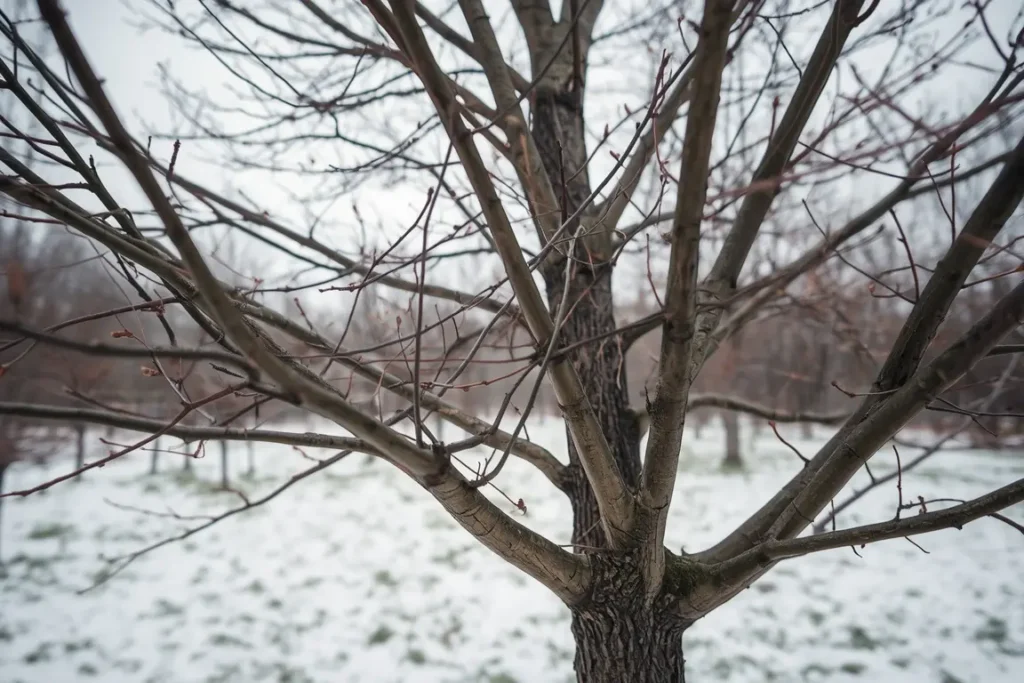
For most trees, the late dormant season, from late winter to early spring, is the best time to prune. Wounds made just before spring growth are exposed only briefly before the tree starts sealing them, and the branch structure is easier to see without leaves (University of Minnesota Extension). That window also falls outside the peak season for tree services, which can help the price.
Some species have their own rules, according to the same Extension guide:
- Oaks: do not prune from April to October, to avoid spreading oak wilt disease.
- Apples, crabapples, mountain ash and hawthorns: prune in late winter; spring or summer cuts raise the risk of fireblight.
- Maples, birches and walnuts: these “bleed” sap after late-winter pruning. It does little harm, but pruning after the leaves are fully out avoids it.
- Bleeding species pruned in leaf: never remove more than a quarter of the live foliage.
Dead or hazardous branches are the exception: they should come off right away, whatever the season (HomeGuide).
Trees near power lines: who pays?
Do not trim near power lines yourself. University of Minnesota Extension says not to attempt pruning near electrical and utility wires and to contact the utility or city maintenance workers instead (University of Minnesota Extension).
Who is responsible depends on the kind of line. According to the Federal Energy Regulatory Commission, federal reliability standards require utilities to keep trees clear of large transmission lines, generally those above 200 kV, usually on high towers. The lines on wooden or metal poles in front of most houses are usually distribution lines, and those fall under each state’s utility regulatory commission, which can set vegetation standards for them (FERC).
How a utility trims near its lines is decided mainly by the utility, within state and local rules, safety codes and the terms of any right-of-way agreement, which is usually attached to the property deed (FERC). Before paying a private crew for branches near a line, call your utility and ask whether it will handle the work, and check with your state regulatory commission if the answer is unclear.
Certified arborist and insurance
Hiring a certified arborist is not a legal requirement, but it is recommended for trees over 15 feet tall, and certified arborists usually charge more than general tree trimmers (HomeGuide). The premium buys knowledge of when and how to cut, which matters given the species-specific timing rules above.
Ask any crew for proof of liability insurance and workers’ compensation coverage, and be wary of bids far below the others, which can signal missing insurance or unsafe practices (HomeGuide).
Your own homeowners policy is not a substitute for trimming. Standard policies cover damage when a tree falls on your house from causes such as wind, lightning or hail, but poor maintenance is not covered. If a tree hits an insured structure, removal is generally covered only up to about $500 to $1,000 (Insurance Information Institute). Keeping branches off the roof is the cheaper side of that trade-off.
How to keep the bill down
- Group several trees into one visit so you pay the minimum job fee once and may get a volume discount.
- Book in the dormant season, which is both the best time for most trees and outside the busiest months for tree services.
- Deal with dead or hanging branches before a storm; emergency work costs more.
- Ask your utility first about any branches near power lines.
- Get at least three written quotes that list labor, equipment and disposal separately.
Questions to ask before you sign
- Are you insured for both liability and workers’ compensation, and can I see the certificates?
- Is a certified arborist doing or supervising the work?
- Exactly which branches will you cut, and how much of the canopy will you remove?
- Is hauling away the branches and wood included in the price?
- Is this the right time of year to prune this species?
- How will you protect my lawn, roof and landscaping during the work?
Sources
- U.S. Bureau of Labor Statistics, Occupational Outlook Handbook: Grounds Maintenance Workers, pay data for May 2025.
- Federal Energy Regulatory Commission, Tree Trimming and Vegetation Management Landowners FAQ.
- University of Minnesota Extension, Pruning trees and shrubs, reviewed 2026.
- Occupational Safety and Health Administration, Tree Care Industry: Hazards and Solutions.
- Insurance Information Institute, If a tree falls on your house, are you covered?
- HomeGuide, Tree Trimming Cost, January 13, 2026.
- Fixr, Tree Trimming Cost, updated January 31, 2025.
- LawnStarter, How Much Does Tree Trimming Cost in 2026?, updated September 24, 2026.