$1,000 – $3,000That is the typical EV charger installation cost in 2026 for a Level 2 home charger, hardware and installation included: HomeGuide puts it at $1,200 to $3,000 and Fixr at $1,000 to $2,500, with most people paying around $1,200. EnergySage, using 2026 installer data, quotes $800 to $3,000 for the installation alone, before the charger itself. Charging on a Level 1 cord from an existing outlet can cost nothing, while a home that needs a new electrical panel can spend well above the top of that range.
The charger itself is usually the smaller part of the bill. What decides the final price is the electrical work behind it: how far the charger sits from your panel, whether the panel has room for a new 240-volt circuit, and what your city charges for the permit. The sections below break down each piece, then cover the federal tax credit, rebates and what charging adds to your electric bill.
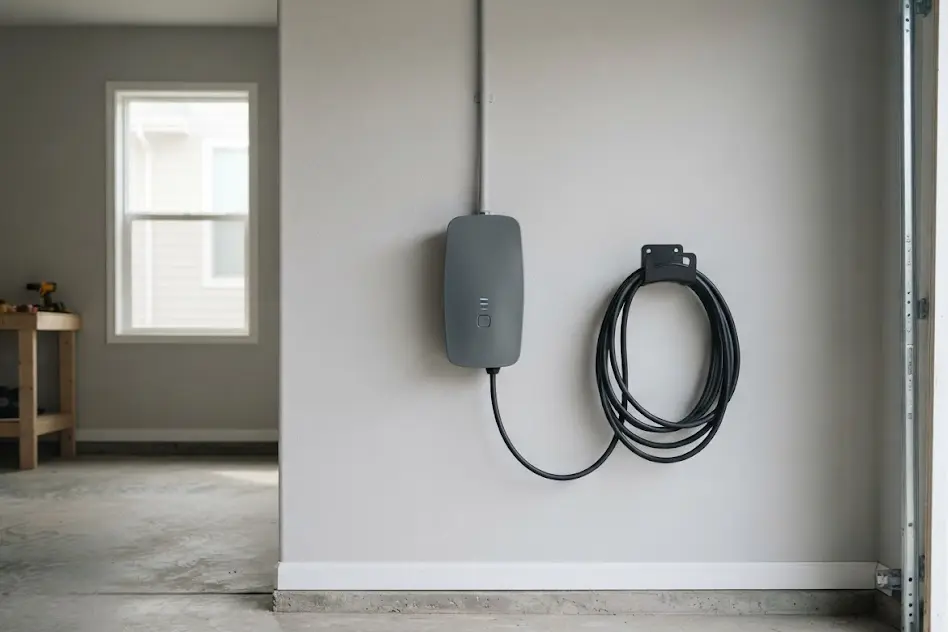
EV charger installation cost by level
| Charger level | Power supply | HomeGuide | Fixr |
|---|---|---|---|
| Level 1 | 120 V outlet | $0 – $900 | $300 – $600 (replacement cordset) |
| Level 2 | 240 V dedicated circuit | $1,200 – $3,000 | $1,000 – $2,500 |
| Level 3 (DC fast) | Industrial-grade supply | $20,000 – $50,000 | $12,000 – $35,000 (charger only) |
HomeGuide and Fixr broadly agree on a Level 2 install. EnergySage splits it differently: $800 to $3,000 for the installation (a US average of $2,442 in 2026, from installer network data) plus $100 to $800 for the charger, typically $300 to $600. Added together, its top end runs higher than HomeGuide’s or Fixr’s.
Level 1 charging uses the portable cordset that comes with most EVs and plugs into a standard 120-volt household outlet, so no extra charging equipment is required. The Department of Energy rates it at about 5 miles of range per hour of charging, or about 40 miles from 8 hours overnight for a mid-size EV (DOE Alternative Fuels Data Center). The DOE notes that many drivers meet their daily needs this way at no additional cost, provided there is an outlet on a dedicated branch circuit near where they park (DOE AFDC). If there is no outlet in reach, adding one costs $150 to $350, and a dedicated circuit $250 to $900 (HomeGuide).
Level 2 runs on 240 volts and adds about 25 miles of range per hour of charging, enough to charge a typical EV battery overnight (DOE AFDC). The DOE suggests it for drivers with irregular schedules, long commutes or large batteries that a night on Level 1 cannot refill (DOE AFDC). This is the option most homeowners install, and the one the rest of this guide focuses on.
Level 3, or DC fast charging, needs industrial-grade power, extensive upgrades and special permits, which puts it outside the budget of nearly every household (HomeGuide).
Charger hardware vs. installation
| Cost line | HomeGuide | Fixr | EnergySage |
|---|---|---|---|
| Level 2 charger (hardware) | $450 – $1,000 (with supplies) | $600 – $1,200 | $100 – $800 |
| Installation / labor | $750 – $2,000 | $420 – $800 (outlet and wall mount) | $800 – $3,000 |
| Electrician hourly rate | $50 – $130 | $40 – $120 | – |
| Hardwired, installed | – | $850 – $1,800 | – |
| Plug-in (240 V outlet), installed | – | $1,000 – $2,200 | – |
In HomeGuide’s breakdown labor is the larger share, while Fixr says most people pay around $600 of a $1,200 job for the installation. Electricians typically charge $50 to $130 an hour according to HomeGuide, and $40 to $120 according to Fixr. EnergySage says the price gap between a hardwired unit and a plug-in 240-volt outlet is usually $100 to $200, and that hardwiring supports faster charging and often satisfies utility rebate rules (EnergySage). For reference, the Bureau of Labor Statistics puts the 2025 median pay of electricians at $30.38 an hour, or $63,190 a year (BLS). That is what the electrician earns, not what the company bills you: the hourly rate you pay also covers insurance, vehicles, licensing and overhead.
On the hardware side, basic Level 2 units have standard safety features and status lights, while “smart” models add charging timers, data collection, displays and communications (DOE AFDC). Smart features, longer cables and cable organizers push the materials line up (HomeGuide). The DOE recommends buying safety-certified equipment, such as ENERGY STAR certified chargers, which are tested by a nationally recognized testing laboratory, and using a certified electrical contractor (DOE AFDC).
EV charger cost calculator
Our estimate: the published ranges above multiplied out for your inputs. Not a quote. Ranges from HomeGuide (Oct 2025), Fixr (Jan 2025) and EnergySage (Jun 2026). Panel and permit ranges span the figures quoted by all of them. State adjustment: BLS construction wages (May 2025), applied to an assumed 50% labor share. How we calculate
The 240-volt circuit and your panel’s capacity
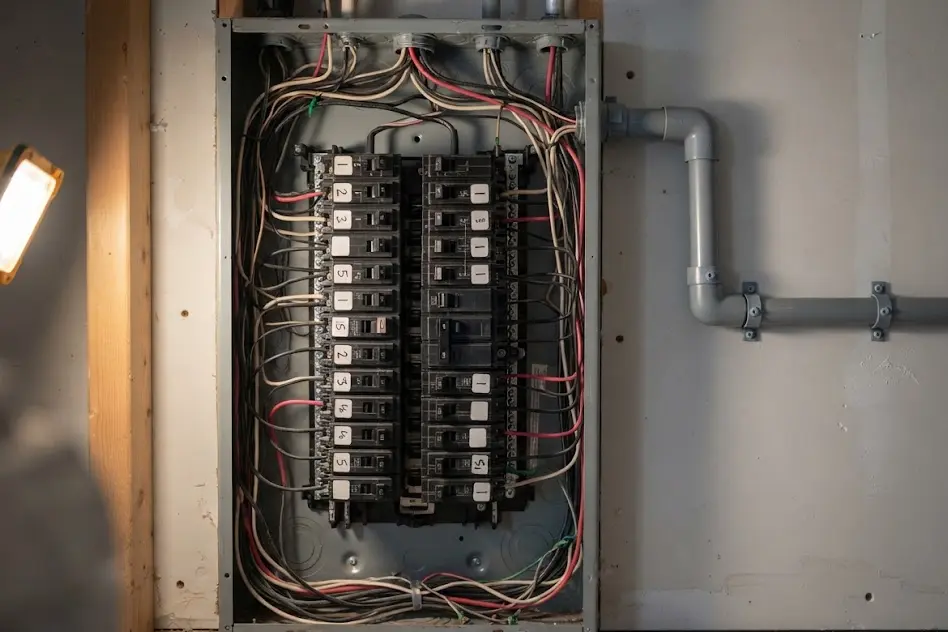
Most residential Level 2 chargers draw up to 30 amps and deliver 7.2 kW. Under Article 625 of the National Electrical Code they need a dedicated 40-amp circuit, and the code treats EV charging as a continuous load (DOE AFDC; DOE AFDC). Level 2 equipment in general can range from 2.9 to 19.2 kW, so a more powerful unit needs a bigger circuit.
Whether your panel can take that circuit is the single biggest swing factor in the price. The DOE notes that some homes have insufficient capacity for Level 2 equipment, and an electrician can tell you whether yours is one of them (DOE AFDC). If the panel has to be replaced, a 200-amp panel costs $1,800 to $2,500 on its own according to HomeGuide; EnergySage puts a full main service upgrade at $1,500 to $4,000 or more, a subpanel at $500 to $1,500 and simply adding a circuit at $60 to $150. For the whole job, see our guide to electrical panel upgrade cost.
| Extra work | HomeGuide | EnergySage |
|---|---|---|
| New 120 V outlet (Level 1) | $150 – $350 | – |
| Dedicated / new circuit | $250 – $900 | $60 – $150 |
| Subpanel | – | $500 – $1,500 |
| Panel replacement or service upgrade | $1,800 – $2,500 (200-amp) | $1,500 – $4,000+ |
| Running power to a garage or shed | $10 – $25 per linear foot | – |
| Permit | $50 – $200 | $50 – $800 (2026 average $297) |
| Electrical inspection | $100 – $200 | – |
Location matters too. Longer wire runs between the panel and the charger add labor and materials (HomeGuide). EnergySage calls distance the single biggest cost driver: most quotes assume 40 to 60 feet of wire, and a 60 to 80 foot run can add $1,000 to $1,500 (EnergySage). Outdoor installations need weatherproofing and often extra labor (HomeGuide). Outdoor charging is safe, even in the rain, but the equipment must be outdoor-rated (DOE AFDC). A detached garage or shed without power is the costly case: running electricity to it costs $1,200 to $7,100 including interior wiring (HomeGuide).
Our estimate: a Level 2 install that also needs a new 200-amp panel lands around $3,000 to $5,500, adding HomeGuide’s $1,200 – $3,000 installed range to its $1,800 – $2,500 panel range. Our headline $1,000 – $3,000 takes the lowest Level 2 figure (Fixr) and the highest (HomeGuide); adding EnergySage’s $100 – $800 equipment range to its $800 – $3,000 installation range gives $900 – $3,800. This is a sum of two published ranges, not a measured figure, and it may double-count some labor if both jobs are done in one visit.
Permits and inspection
Charging equipment has to comply with local and state codes, and permits may be required from your local building authority. In many areas a site installation plan must be submitted and approved before the work starts (DOE AFDC). A permit for a home EV charger costs $50 to $200 and an electrical inspection $100 to $200, depending on local rules (HomeGuide). EnergySage reports a wider permit range, $45 to $720 depending on the state, with a 2026 average of $297, and notes that permit fees may or may not be in the quote. A licensed electrician normally pulls the permit as part of the job, so check that it is on the quote rather than assuming.
The federal tax credit has ended
The Alternative Fuel Vehicle Refueling Property Credit (section 30C) covered home chargers, but only for a limited window. According to the IRS, for property bought and placed in service at your main home from January 1, 2023, to June 30, 2026, the credit equals 30% of the cost up to $1,000 per charging port, and it only applies if the home is in an eligible low-income or non-urban census tract (IRS). The IRS page gives no amount for property placed in service after June 30, 2026, so a charger installed now does not qualify.
If your charger went in before July 1, 2026, and your home is in a qualifying tract, you claim the credit by attaching Form 8911 to your tax return. The IRS lists qualifying tracts by 11-digit census tract ID on the same page (IRS).
Utility and state rebates
With the federal credit gone, local programs are where the savings are. The DOE notes that state and utility incentives may help offset the cost of charging equipment, and that some utilities offer time-of-use rates or other rate incentives for owners of home chargers (DOE AFDC). According to HomeGuide, many utilities offer rebates of up to 50% on the purchase and installation of Level 2 home chargers, often favoring Wi-Fi enabled models, and some installers will handle the rebate paperwork (HomeGuide). Rebates usually have their own equipment lists and deadlines, so check with your utility before you buy the charger, not after.
What charging at home costs to run
The DOE’s rule of thumb: multiply your electricity price per kWh by how much energy the car uses per 100 miles. Its worked example uses a vehicle that consumes 27 kWh per 100 miles (DOE AFDC). The average U.S. residential electricity price was 18.31 cents per kWh in July 2026, ranging from about 13 cents in some Plains states to over 30 cents in parts of New England (U.S. Energy Information Administration).
Our estimate: at 27 kWh per 100 miles and 18.31 cents per kWh, charging costs about 4.9 cents per mile. Driving 1,000 miles a month would use about 270 kWh, or roughly $49 a month. The 1,000 miles is our assumption, not a measured average; your total scales with your mileage, your car’s efficiency and your local rate, and ignores charging losses.
Actual costs depend on the time of day you charge and the rate plan you are on (DOE AFDC). Setting a smart charger’s timer to off-peak hours on a time-of-use plan is the easiest way to cut the running cost.
How to keep the bill down
- Try Level 1 first. If an outlet on a dedicated circuit is near where you park and your daily driving is short, it may be all you need.
- Mount the charger as close to the panel as practical. Shorter wire runs mean less labor and materials.
- Have an electrician check your panel capacity before you buy a high-power charger that would force a panel upgrade.
- Check your utility’s rebate rules before buying hardware, since approved models may be required.
- Get at least three itemized quotes that separate the charger, labor, permit and inspection.
Questions to ask before you sign
- Can my current panel support a 40-amp circuit, or will it need an upgrade?
- How far is the charger location from the panel, and how does that length affect the price?
- Does the quote include the permit, the inspection and any conduit, trenching or grounding work?
- Is the charger safety-certified, and is it outdoor-rated if it will be outside?
- Are you licensed and insured, and do you offer a workmanship warranty?
- Will you handle the paperwork for any utility rebate?
Sources
- Internal Revenue Service, Alternative Fuel Vehicle Refueling Property Credit.
- U.S. Department of Energy, Alternative Fuels Data Center, Charging Electric Vehicles at Home and Electric Vehicle Charging Stations.
- U.S. Energy Information Administration, Electric Power Monthly, Table 5.6.A, July 2026 data.
- U.S. Bureau of Labor Statistics, Occupational Outlook Handbook: Electricians, 2025 median pay.
- EnergySage, How much does an EV charger installation cost?, updated June 22, 2026.
- Fixr, Cost to Install EV Charger at Home, updated January 31, 2025.
- HomeGuide, How Much Does It Cost to Install an EV Charger at Home?, October 19, 2025.