$1,100 – $3,800That is the typical water softener installation cost in 2026 for a whole-house salt-based system, equipment and labor included, across four published cost guides. A dual-tank softener runs $1,500 to $5,000 and a salt-free system $1,500 to $4,500. After that, expect $50 to $150 a year in salt and $100 to $300 a year in maintenance.
A softener is one of the few home systems where the running costs matter almost as much as the price tag. The sections below cover what each type costs installed, what the plumber actually does, what you pay every year afterwards, and how to find out whether your water is hard enough to need one at all.
Installed cost by source
| Source | Typical installed cost | Average | What the range covers |
|---|---|---|---|
| HomeGuide (July 2025) | $1,200 – $3,800 | $2,500 | Salt-based whole-house system |
| Fixr (January 2025) | $1,100 – $3,000 | $2,500 | All common systems; the average is a dual-tank unit in a 3–4 bedroom home |
| HomeBuddy (September 2026) | $1,200 – $3,800 | — | Single-tank ion exchange system |
| Homewyse (September 2026) | $1,167 – $1,447 | — | Basic install of a 20,000-grain softener in easy conditions |
The four guides agree closely on a typical salt-based job. At the extremes they differ: HomeGuide reports jobs from $800 to $8,000 (HomeGuide), Fixr from $600 for a small descaler to $7,000 for a multi-tank softening and filtration system (Fixr), and HomeBuddy says whole-house reverse osmosis can pass $10,000 (HomeBuddy). Homewyse’s figure is a basic installation only; it excludes any work beyond mounting and connecting the unit (Homewyse). Penn State Extension gives about $500 to $1,500 for the softener hardware alone, before installation (Penn State Extension).
Our estimate: The headline range of $1,100 to $3,800 runs from the lowest low (Fixr) to the highest high (HomeGuide and HomeBuddy) of the typical ranges in the table above. It is our combination of published ranges, not a measured figure. Fixr is an older guide (January 2025); it is never the only source for a figure here.
Cost by water softener type
| Type | HomeGuide | Fixr |
|---|---|---|
| Single-tank salt-based (ion exchange) | $1,200 – $3,800 | $650 – $1,500 |
| Dual-tank ion exchange | $1,700 – $5,000 | $1,500 – $3,000 |
| Salt-free (template-assisted crystallization) | $1,500 – $4,500 | — |
| Magnetic | $2,000 – $6,000 | $200 – $400 (unit only) |
| Whole-house reverse osmosis | $4,800 – $10,000 | — |
The sources disagree a lot on the cheapest systems. Fixr puts a single-tank softener at $650 to $1,500 installed, well below HomeGuide’s salt-based range, and prices a magnetic unit at $200 to $400 before installation, against HomeGuide’s $2,000 to $6,000 installed (Fixr; HomeGuide). HomeBuddy lists $200 to $600 for a magnetic or electronic descaler unit and says the evidence that they work is limited and mixed (HomeBuddy). Get quotes that name the system type and capacity, so you compare like with like.
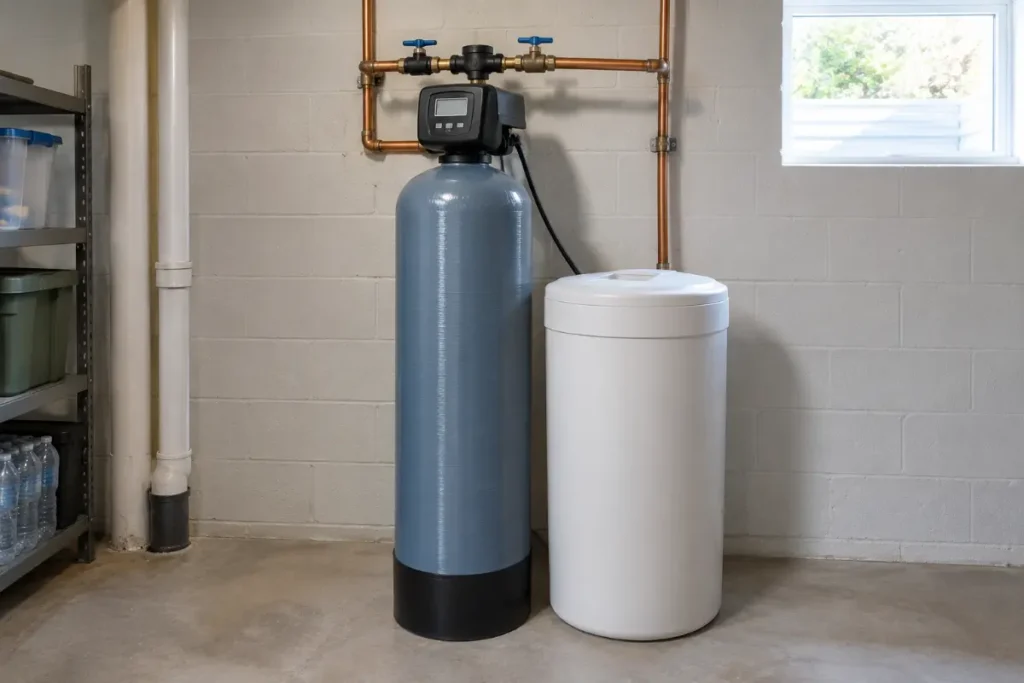
Salt-based softeners swap the calcium and magnesium in the water for sodium as it passes through a resin bed. When the resin is used up, the unit flushes it with brine and sends the removed minerals down the drain; this is called regeneration (Penn State Extension). This is the only type in the table that actually removes hardness.
Dual-tank systems work the same way with two resin tanks that take turns, so you still have soft water while one of them regenerates. They suit large households with heavy water use (HomeGuide).
Salt-free systems, often sold as conditioners, change the form of the minerals to limit scale but leave them in the water. Even the cost guide that lists them says they do not technically soften water and are less effective than salt-based systems on very hard water (HomeGuide). We found no independent government or university source confirming that they reduce hardness, so treat any claim that they “soften” water with caution. The same goes for magnetic devices, whose results HomeGuide itself describes as variable.
Whole-house versus point-of-use. You do not always need to treat every tap. Penn State Extension notes that toilets, outdoor spigots and basement sinks can usually be bypassed, and that some households soften only the hot water (Penn State Extension). We found no published installed-cost range for small point-of-use softeners that met our sourcing standard, so we do not quote one here.
Estimate your water softener installation cost
| Add-on | Typical cost |
|---|---|
| Dedicated electrical circuit | $250 – $900 |
| Professional water test | $130 – $200 |
| Installation labor only | $150 – $1,000 |
HomeBuddy puts professional installation labor at 20% to 30% of the total project cost (HomeBuddy). The calculator below uses the combined low and high of HomeGuide and Fixr for each system type from the table above.
Our estimate: The calculator uses a 25% labor share, the midpoint of HomeBuddy’s 20% to 30%, and each type’s range runs from the lower of the two guides’ lows to the higher of their highs. Its results are our arithmetic on published ranges, not quotes.
Use the tables above to estimate your cost. The interactive calculator needs JavaScript.
What the installation involves
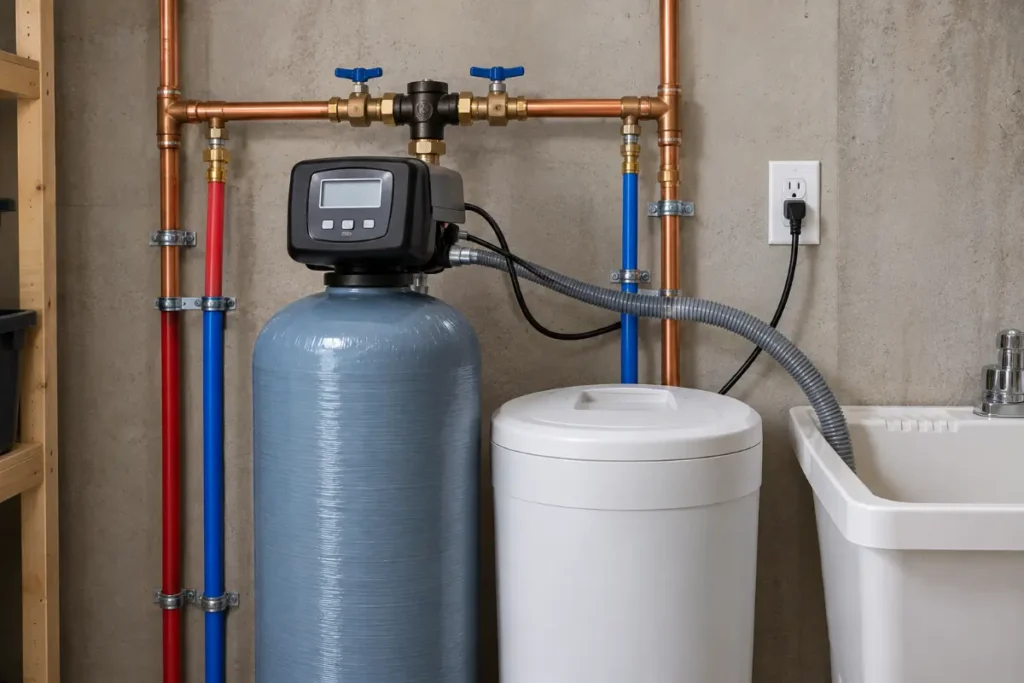
Labor depends less on the softener than on your plumbing. HomeGuide lists the factors that move the price (HomeGuide):
- A softener loop. Homes built with a pre-plumbed loop for a softener need much less work. Without one, the plumber has to cut into the main line and reroute it.
- A drain. A salt-based unit has to discharge brine when it regenerates, so it needs a drain line nearby. Running a new one adds to the bill.
- Power. Some systems need a dedicated electrical circuit, which costs $250 to $900 for labor and materials.
- Access and permits. An easy-to-reach main line saves labor time, and local codes may require a permit and inspection.
Fixr puts the installation labor alone at $150 to $1,000, and $600 to $2,000 to add a softener loop together with the unit where none exists (Fixr). For context on labor rates, the median plumber in the United States earned $30.67 an hour in May 2025, according to the Bureau of Labor Statistics. What a company bills per hour is higher, because it also covers the vehicle, tools, licensing, insurance and overhead.
Yearly running costs
| Item | Typical cost |
|---|---|
| Salt or potassium | $50 – $150 per year |
| Maintenance | $100 – $300+ per year |
| Filters (salt-free and other non-salt systems) | $30 – $100+ each |
| Reverse osmosis filters | $30 – $150, every 6 – 12 months |
| Reverse osmosis membrane | $40 – $250, every 2 – 3 years |
Other guides give similar or higher upkeep figures. HomeBuddy puts operating costs at $100 to $300 a year for salt, filter changes and occasional servicing (HomeBuddy). Fixr gives $150 to $600 for maintenance, with inspections every 2 to 3 years for ion exchange systems, and $10 to $15 for a bag of salt (Fixr).
Water. Each regeneration uses about 50 gallons of water (Penn State Extension). Timer-controlled softeners regenerate on a schedule whether the resin needs it or not, so they waste more water and salt than demand-controlled models, which regenerate after a set volume of water has been treated.
Our estimate: Penn State’s worked example, a family of four using 75 gallons a person a day at 10 grains per gallon with a 20,000-grain softener, regenerates about every 6 to 7 days. That is roughly 52 to 61 regenerations a year (365 ÷ 7 and 365 ÷ 6), or about 2,600 to 3,000 gallons of water a year at 50 gallons each. This is our calculation from the extension’s example, not a measured figure; your water bill impact depends on local rates and your actual regeneration frequency.
Electricity. We found no independent source giving a yearly electricity cost for a home softener, so we do not quote one. The control valve on most salt-based units needs only a standard outlet; ask the installer what the model draws.
Our estimate: Adding HomeGuide’s installed price for a salt-based system ($1,200 to $3,800) to ten years of salt ($50 to $150 a year) and maintenance ($100 to $300 a year) gives a ten-year cost of about $2,700 to $8,300, before water and electricity. This is our arithmetic on published ranges, not a measured figure.
A well-maintained softener lasts 15 to 20 years, according to HomeGuide. Resin can foul with iron, sediment or bacteria; Penn State Extension recommends filtering or disinfecting the incoming water first where that is a problem (Penn State Extension).
Test your water hardness first
| Classification | Milligrams per liter (as calcium carbonate) |
|---|---|
| Soft | 0 – 60 |
| Moderately hard | 61 – 120 |
| Hard | 121 – 180 |
| Very hard | More than 180 |
Test reports may give hardness in grains per gallon instead; one grain per gallon equals about 17 mg/L. Penn State Extension says water below 7 grains per gallon (about 120 mg/L) will probably not cause major scaling or soap film, and that you should have it tested by an independent lab rather than rely only on a free test from a softener seller (Penn State Extension). HomeGuide lists $130 to $200 for a basic professional water test (HomeGuide). If you are on a public supply, your water utility can also tell you your hardness, as the USGS notes.
Hardness is not a health concern, but heated hard water leaves calcium carbonate scale that can shorten equipment life, raise water-heating costs and lower the efficiency of electric water heaters (USGS). If you are also budgeting for a new heater, see our guide to water heater replacement cost.
Sodium, septic systems and local rules
Softening adds sodium: 7.5 milligrams per quart for each grain per gallon of hardness removed. People on low-sodium diets should take this into account, and homes on septic systems should consider the extra water load from regeneration on the drain field (Penn State Extension).
Our estimate: Water at the USGS “very hard” threshold of 180 mg/L is about 10.5 grains per gallon (180 ÷ 17). Softening it fully would add roughly 79 mg of sodium per quart (10.5 × 7.5). This is our calculation from the published conversion factors, not a measured figure.
In parts of California, salt-based units that discharge brine to the sewer can be restricted. Water Code section 13148 lets local sewer agencies in the Central Coast, South Coast, San Joaquin River and Tulare Lake regions, and in several Sacramento Valley counties, require permits or high-efficiency models, or prohibit new installations outright, once a regional water board has made the required finding. Portable exchange-tank service is not limited by the law (California Water Code §13148). Check with your local sewer agency before you buy.
How to keep the bill down
- Test the water before you shop. Below about 7 grains per gallon, you may not need a softener at all.
- Size the unit to your hardness and water use. Penn State’s method: people × gallons per person per day × hardness in grains gives grains removed per day.
- Choose demand-controlled regeneration over a timer to save salt and water.
- Bypass toilets and outdoor faucets so you are not paying to soften water that does not need it.
- Get at least three written quotes and compare what each includes: drain line, electrical work and permit.
Questions to ask before you sign
- What capacity do you recommend, and how did you calculate it from my hardness and household size?
- Does the quote include a new drain line, an outlet or circuit, and the permit if one is required?
- Does the unit regenerate on demand or on a timer, and how much salt and water will it use per cycle?
- Are local rules on brine discharge to the sewer or my septic system a concern here?
- What is the warranty on the tank, the resin and the valve, and on your installation?
Sources
- U.S. Geological Survey, Water Science School, Hardness of Water.
- Penn State Extension, Water Softening, updated September 8, 2025.
- U.S. Bureau of Labor Statistics, Occupational Outlook Handbook: Plumbers, Pipefitters, and Steamfitters, pay data for May 2025.
- California Legislative Information, Water Code section 13148.
- HomeGuide, How Much Does a Water Softener Cost?, July 25, 2025.
- HomeBuddy, How Much Does a Water Softener System Cost?, updated September 21, 2026.
- Homewyse, Cost to Install a Water Softener, September 2026.
- Fixr, Water Softener Installation Cost, updated January 31, 2025 (older guide).