$800 – $4,000That is the typical electrical panel upgrade cost in 2026, installed, across three published cost guides. Going from 100 to 200 amps usually costs $1,300 to $3,000, and a 400-amp upgrade runs $2,000 to $4,000. Installing a service where no panel existed can reach $6,000.
The figures come from This Old House (updated March 2026), Homewyse (September 2026) and HomeGuide, an older guide (December 2024) that compiles contractor estimates. The guides agree closely on the overall range: This Old House gives $800 to $4,000, with an average of $2,150 for a 100-to-200-amp upgrade, and HomeGuide gives $851 to $4,000. Below you will find what each amperage costs, when the utility and the meter get involved, what permits add, and which signs mean your panel should be looked at by a licensed electrician.
Cost by amperage
| Panel replaced or upgraded to | This Old House (Mar 2026) | Homewyse (Sep 2026) | HomeGuide (Dec 2024) |
|---|---|---|---|
| 100 amps | $800 – $1,500 | $1,344 – $1,630 | $850 – $1,100 |
| 200 amps | $1,300 – $3,000 | — | $1,300 – $1,600 |
| 400 amps | $2,000 – $4,000 | — | $2,000 – $4,000 |
When a new service panel is needed, or there is no existing panel, the price rises. Both HomeGuide and This Old House put a new 100-amp service at $1,200 to $1,600 and a new 200-amp service at $1,800 to $2,500. For 400 amps they part ways: HomeGuide lists $2,000 to $4,000, while This Old House lists $4,000 to $6,000 for a new installation (HomeGuide; This Old House).
The Homewyse figure is a narrower, bottom-up estimate for basic work in favorable conditions: 9.7 hours of labor at $1,191 to $1,443, plus a $128 to $157 panel, supplies and debris disposal. It excludes permits and any code corrections (Homewyse). HomeGuide’s 200-amp range is the narrowest because it only covers a panel swap; This Old House’s wider range reflects its note that most homeowners pay $1,300 to $3,000 to go from 100 to 200 amps. HomeGuide notes that a 100-amp panel may be enough for a household that uses little electricity, but that most modern homes need 200 amps (HomeGuide).
Estimate your electrical panel upgrade cost
Use the tables above to estimate your cost. The interactive calculator needs JavaScript.
Our estimate: each calculator range runs from the lowest to the highest figure the guides in this article give for that item. The 100-amp line spans This Old House’s $800 low to Homewyse’s $1,630 high; the 200 and 400-amp lines use This Old House’s wider ranges, which contain HomeGuide’s. The meter box line uses HomeGuide’s simple-replacement figure, and the subpanel, move and permit lines come from the “Other costs” table and the permits section below. This is our own combination, not a measured figure.
Panel replacement vs. upgrade
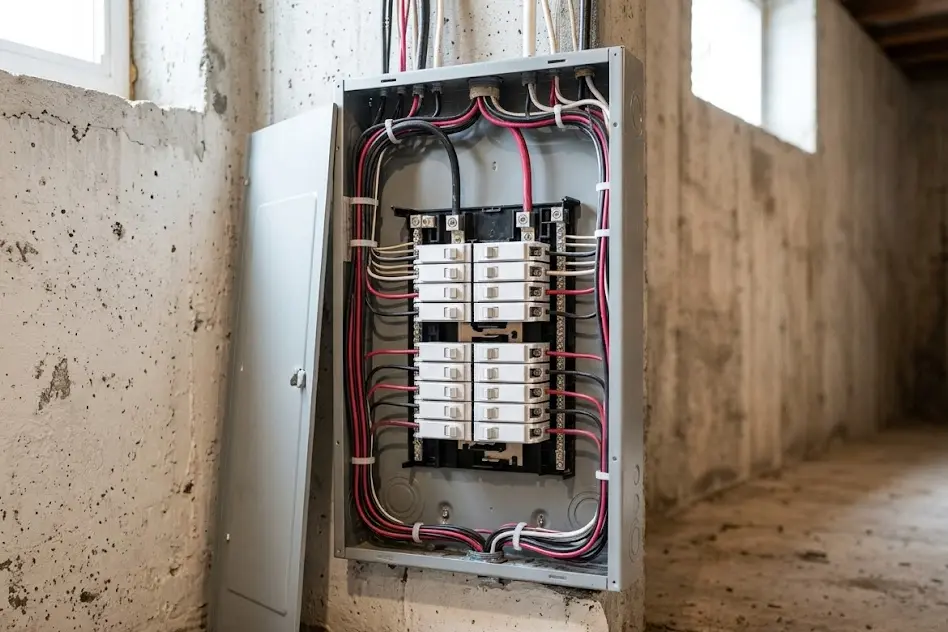
A replacement swaps a worn, damaged or unsafe panel for a new one of the same capacity. An upgrade raises the capacity, for example from 100 to 200 amps, so the house can carry more load. Both jobs look similar on the wall, but an upgrade can reach past the panel: the meter box has to match the new amperage, and in some cases the power company has to install a new meter or supply.
A panel replacement typically takes 8 to 10 hours. HomeGuide puts electricians’ rates at $40 to $100 an hour, with the first hour at $75 to $120, for $400 to $800 in labor on a typical job (HomeGuide, December 2024). Homewyse’s newer estimate budgets 9.7 hours of basic labor at $1,191 to $1,443 (Homewyse). The guides agree that the panel itself is the smaller part of the bill: This Old House says most of the cost comes from installation rather than the panel (This Old House).
| Panel size | This Old House (Mar 2026) | HomeGuide (Dec 2024) |
|---|---|---|
| 100 amps | $100 – $200 | $25 – $199 |
| 125 amps | — | $25 – $233 |
| 150 amps | — | $85 – $360 |
| 200 amps | $250 – $350 | $75 – $870 |
| 300 amps | $350 – $500 | — |
| 400 amps | $500 and up | $480 – $765 |
For comparison, the median electrician in the United States earned $30.38 an hour, or $63,190 a year, in May 2025, according to the Bureau of Labor Statistics. The BLS also notes that most states require electricians to be licensed. A billed hourly rate is higher than the wage because it also has to cover the business behind the worker.
Our estimate: 8 to 10 hours at the BLS median wage of $30.38 comes to roughly $243 to $304 in wages for a panel replacement. This is our own calculation, not a measured figure. Set against HomeGuide’s $400 to $800 labor line, it shows that the electrician’s pay is only part of what the labor charge covers.
Other costs that can appear on the quote
| Item | This Old House (Mar 2026) | HomeGuide (Dec 2024) |
|---|---|---|
| Subpanel (garage, basement, addition) | $400 – $1,750 | $500 – $1,000 |
| Move the panel | $800 – $3,000 | $1,000 – $4,000 |
| Electric meter box replacement | $50 – $250 unit; $1,800 – $3,500 installed | $200 – $500 |
| New meter from the power company, when required | — | $200 – $500 |
| Main breaker replacement | $200 – $300 | — |
| Replace a fuse box with a breaker panel | — | $1,100 – $4,000 |
| Replace a single circuit breaker | — | $150 – $200 |
| AFCI or GFCI breaker | $35 – $60 extra per breaker | $130 – $180 per circuit, installed |
The two guides disagree most on the meter box: HomeGuide lists $200 to $500, while This Old House lists $1,800 to $3,500 installed and notes that the job may require coordination with the local utility. If the main breaker is damaged along with internal parts such as the bus bar, This Old House says the repair can rise to $500 to $2,000 and a full panel replacement may be needed (This Old House).
Opening an old panel can also reveal wiring that has to be brought up to code, worn parts, or drywall that must be opened. As HomeGuide puts it, the actual cost is not known until the old installation is laid bare (HomeGuide). Ask how those surprises will be priced before work starts.
Subpanels
A subpanel is a smaller box fed from the main panel. It usually serves a garage, an outbuilding, a finished basement or an addition. Installed, it costs $400 to $1,750 according to This Old House, depending on size and complexity (This Old House), and $500 to $1,000 on average according to HomeGuide, which lists a 40-amp subpanel at $452 and a 50-amp subpanel at $482 installed (HomeGuide). A subpanel adds circuit space, not service capacity: if the main service is already near its limit, a subpanel will not fix that.
Service and meter upgrades
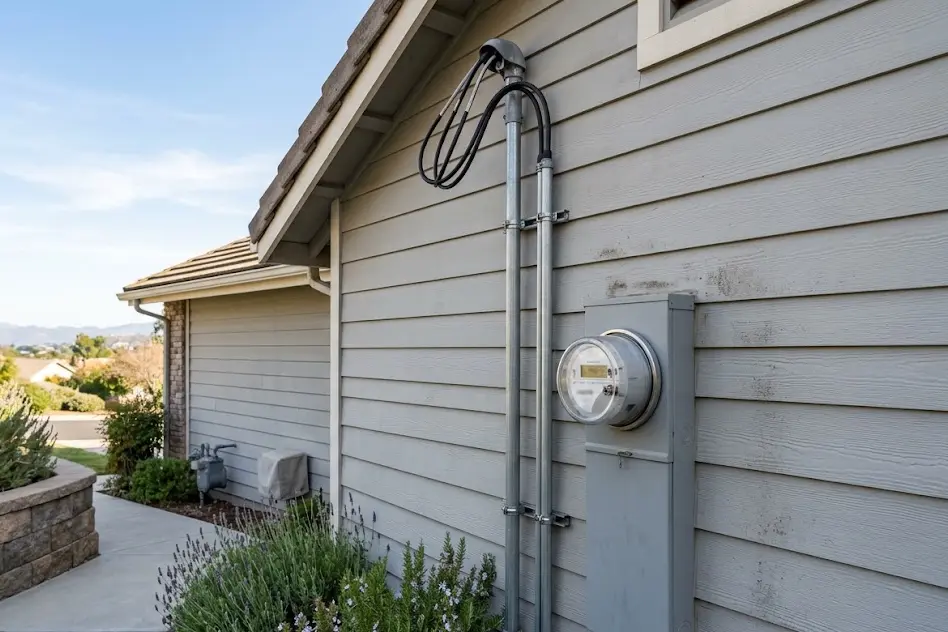
Raising capacity is not only a panel job. The meter box has to be rated for the new service: HomeGuide lists 100-amp meter boxes at $55 to $250, 200-amp at $85 to $680 and 400-amp at $480 to $765 for the part alone. In some cases the power company has to install a new meter, at $200 to $500, or a new power supply (HomeGuide).
Because the meter and the incoming line belong to the utility, a service upgrade depends on its schedule and its fees. Call your utility before booking the job, ask what it charges, and make sure your electrician’s quote says whether coordinating with the utility is included.
Permits and inspection
Do not upgrade a panel without a permit: you can be fined, and the inspection is what confirms the work was done correctly (HomeGuide). In some places, building codes require panel work to be done by a licensed electrician. This Old House puts most permit fees at $50 to $300, depending on location, and notes that the electrician usually handles the permit (This Old House). The exact fee is set locally, so ask your building department or have the electrician list it on the quote. A passed inspection is also the record you will want when you sell the house.
When an upgrade is needed
The usual trigger is new load. Level 2 electric vehicle chargers run on 240 volts, and the Department of Energy notes that some homes do not have enough electrical capacity for Level 2 equipment; an electrician can tell you whether yours does. Charger installations must comply with local and state codes, and permits may be required (U.S. Department of Energy, Alternative Fuels Data Center). Heat pumps, electric ranges and other large electric appliances raise the same question: does the existing service have room for them? Only a load calculation by an electrician answers that.
HomeGuide lists these signs that a panel should be checked (HomeGuide):
- The panel feels warm or gives off a smell.
- Breakers trip when you plug in or run an appliance.
- Lights flicker or dim regularly.
- Outlets buzz or crackle, or show black marks around the holes.
- The house still runs on a fuse box.
- You rely on many power strips.
A warm, smelling or buzzing panel is a safety problem before it is a budget one. Call a licensed electrician promptly and do not open the panel yourself.
Electrical fires and recalled panels
In 2021, an estimated 24,200 residential building electrical fires were reported to U.S. fire departments. They caused an estimated 295 deaths, 900 injuries and over $1.2 billion in property loss, according to the U.S. Fire Administration.
Panels themselves are sometimes recalled. On June 16, 2022, the Consumer Product Safety Commission announced the recall of about 1.4 million electrical panels sold in the United States because of thermal burn and fire hazards. For panels installed indoors, the notice says a qualified electrician may be needed to find the date codes that identify affected units (CPSC). The CPSC keeps a list of panelboard and circuit breaker recalls. If you are unsure about yours, ask the electrician to check it during the estimate visit.
How to keep the bill down
- Size the upgrade for the load you expect in the next few years, such as an EV charger or heat pump, so you pay for one service upgrade instead of two.
- If you only need more circuits in one area, ask whether a subpanel ($400 to $1,750) solves it.
- Keep the panel where it is if the location works; moving it costs $800 to $4,000, depending on the guide.
- Ask your utility about its fees and scheduling before the job is booked.
- Get at least three detailed written quotes from licensed, insured electricians and compare what each one includes.
Questions to ask before you sign
- What amperage do you recommend for my house, and how did you calculate it?
- Does the price include the permit, the inspection and coordination with the utility?
- Will the meter box need to be replaced, and is that in the quote?
- How will code corrections or drywall repairs found during the job be priced?
- How long will the power be off, and what warranty do you give on the work?
- Is my current panel on a CPSC recall list?
Sources
- U.S. Bureau of Labor Statistics, Occupational Outlook Handbook: Electricians, pay data for May 2025.
- U.S. Fire Administration, Appliance and Electrical Fire Safety, page last reviewed May 4, 2023.
- U.S. Consumer Product Safety Commission, electrical panel recall, June 16, 2022, and the panelboards and circuit breakers recall list.
- U.S. Department of Energy, Alternative Fuels Data Center, Charging Electric Vehicles at Home.
- This Old House, What Is the Cost to Upgrade an Electrical Panel?, updated March 31, 2026.
- Homewyse, Cost to Upgrade an Electrical Service Panel, September 2026 estimate.
- HomeGuide (older guide), Cost to Replace Electrical Panel, December 30, 2024.