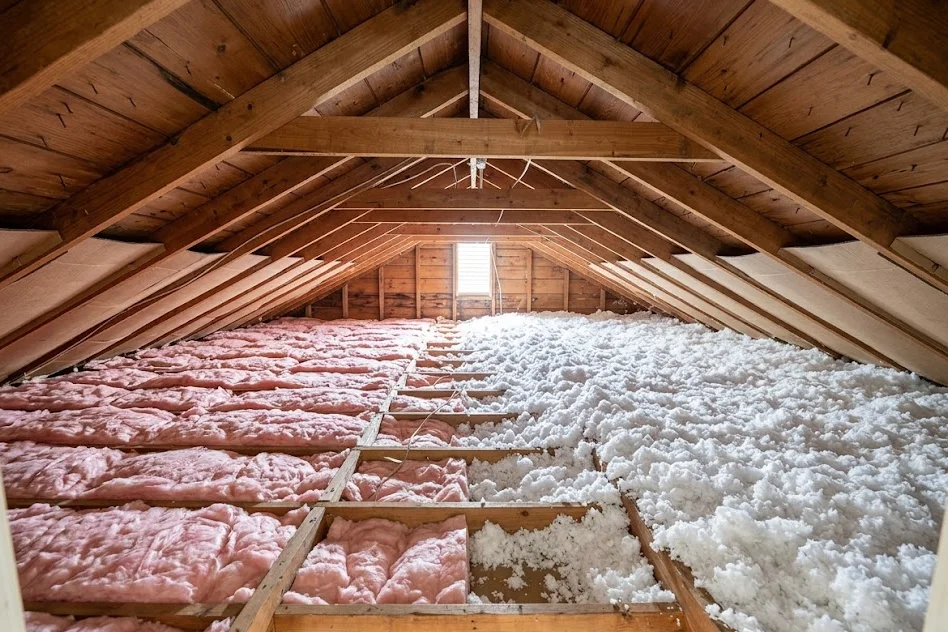
$1.00 – $5.13 per sq ftThat is the spread three cost guides give for blown-in insulation installed in 2026, fiberglass or cellulose. On the other side of the blown in vs batt insulation comparison, fiberglass batts run $0.65 to $5.41 per square foot installed. The high ends of both ranges come from one estimator; HomeGuide alone puts blown-in at $1.00 to $2.80 and batts at $0.80 to $2.60. In an open attic, blown-in usually costs less; in open walls and floors, batts are the simpler fit.
Both options use the same kinds of fiber. Blown-in (also called loose-fill) is fiberglass, cellulose or mineral wool blown through a hose by a machine. Batts are pre-cut blankets of fiberglass or mineral wool sized to fit between studs and joists. This guide compares what each costs per square foot, how well each insulates, where each belongs and how hard each is to install yourself. For the full price of an attic job, including removal and extras, see our guide to attic insulation cost.
Blown-in vs batt insulation cost per square foot
| Type | HomeGuide | Fixr | Homewyse |
|---|---|---|---|
| Blown-in fiberglass | $1.00 – $2.80 | $1.65 – $2.60 | $1.53 – $2.77 |
| Blown-in cellulose | $1.20 – $2.80 | $1.75 – $3.80 | $2.54 – $5.13 |
| Fiberglass batts | $0.80 – $2.60 (batts and rolls) | $0.65 – $2.00 | $2.35 – $5.41 |
| Mineral wool batts | not priced installed; 40% – 50% more than fiberglass batts | $1.40 – $2.10 (labor not stated) | $3.58 – $5.43 (R-11) |
The guides disagree on which is cheaper. HomeGuide and Fixr both put batts below blown-in: Fixr lists batts at $0.65 to $2.00 against $1.65 to $3.80 for blown-in across all locations (Fixr). Homewyse, which prices installation in an existing house, comes out the other way for fiberglass: $1,532 to $2,766 to blow 1,000 sq ft against $2,354 to $5,409 for batts, partly because its batt job takes 11 labor hours and the blown job 7.5 (Homewyse). Its cellulose figure runs much higher than the other two guides because of the material price in its example.
Mineral wool costs more than fiberglass in every guide. HomeGuide says mineral wool batts cost 40% to 50% more than fiberglass ones and prices the material alone at $1.00 to $2.50 per square foot (HomeGuide, HomeGuide insulation cost, December 19, 2025).
Estimate your blown-in vs batt insulation cost
Our estimate: the published ranges above multiplied out for your inputs. Not a quote. Installed ranges from HomeGuide (November 2025), Fixr (August 2025) and Homewyse (September 2026): the lowest low and highest high of the three guides. The mineral wool low end is our estimate from HomeGuide material and labor prices. Extras from HomeGuide (November 2025) and Fixr (January 2026). State adjustment: BLS construction wages (May 2025), applied to an assumed 50% labor share. How we calculate
Our estimate: the calculator multiplies your area by the per-square-foot range of the type you pick, using the lowest low and the highest high of the three guides in the table above (blown-in cellulose, for example, runs from $1.20 at HomeGuide to $5.13 at Homewyse). No guide prices mineral wool batts installed at the low end, so we added HomeGuide’s mineral wool material price ($1.00 – $2.50) to its batt labor rate ($0.50 – $1.30) to get a low of $1.50; the high is Homewyse’s $5.43. Removal runs $1 to $2 per sq ft at HomeGuide’s blown-in guide and $1 to $3 at its batt guide and at Fixr. None of this is a measured figure or a quote.
Which one costs less in a typical attic?
For an attic floor, the Department of Energy is direct: loose-fill insulation is usually less expensive to install than batts, and gives better coverage when installed properly (U.S. Department of Energy). HomeGuide’s prices for the same R-value agree:
| Attic R-value | Blown-in, per 1,000 sq ft | Batts, per 1,000 sq ft |
|---|---|---|
| R-30 | $660 – $1,200 | $1,000 – $3,000 |
| R-38 | $840 – $1,500 | $1,100 – $3,300 |
| Whole attic floor, typical job | $900 – $3,600 | $1,100 – $3,900 |
Going to the top of the scale shows the same gap. Blowing in R-60 costs $1,400 to $2,400 per 1,000 sq ft, while installing batts to R-60, or completely replacing the insulation, runs $1.50 to $4.70 per square foot (HomeGuide).
Our estimate: at HomeGuide’s prices, R-60 over a 1,000 sq ft attic comes to $1,400 – $2,400 blown in and $1,500 – $4,700 with batts ($1.50 – $4.70 × 1,000). The low ends are close; the batt job can cost about twice as much at the top. This multiplies published per-foot prices; it is not a measured figure.
One caution: some insulation companies set a minimum of $1,500 to $2,000 per project (HomeGuide), so on a small attic the minimum, not the per-foot price, may set the bill.
R-value per inch
R-value measures how well insulation resists heat flow; the higher the number, the better. It depends on the type of insulation, its thickness and its density, and for most materials also on temperature, aging and moisture (U.S. Department of Energy). The Energy Saver pages do not publish a single per-inch figure for each material, so the table below uses the cost guides:
| Material | HomeGuide | Fixr |
|---|---|---|
| Fiberglass, blown-in | 2.2 – 2.9 | 2.5 – 3.5 |
| Fiberglass, any form (batts included) | 2.2 – 2.9 | 2.2 – 3.8 |
| Cellulose | 3.1 – 3.8 | 3.2 – 3.7 |
| Mineral wool (rockwool) | 3.2 – 4.1 | 3.0 – 3.7 blown; 3.7 – 4.3 all forms |
Batts are sold by total R-value rather than by the inch. A 2×4 wall holds an R-11 low-density fiberglass batt, an R-13 medium-density one or an R-15 high-density one; a 2×6 wall takes up to R-21 in a high-density batt (U.S. Department of Energy). Loose-fill works differently: as it gets deeper it compresses under its own weight, so its R-value does not rise in step with thickness. Federal rules require each manufacturer to print a coverage chart with the minimum settled thickness, minimum weight per square foot and bags needed for each R-value (U.S. Department of Energy). That chart, not a ruler, is how you check a blown-in job.
How much R-value your climate needs
ENERGY STAR publishes the levels that are cost-effective when adding insulation to an existing home, by climate zone. The Department of Energy’s version of the same table, based on the 2021 International Energy Conservation Code, gives a range for the warmest zones:
| Climate zone | Attic, uninsulated (ENERGY STAR) | Attic, uninsulated (DOE) | Floor over crawl space or unheated basement |
|---|---|---|---|
| 1 | R-30 | R-30 – R-49 | R-13 |
| 2 | R-49 | R-49 – R-60 | R-13 |
| 3 | R-49 | R-49 – R-60 | R-19 |
| 4A and 4B | R-60 | R-60 | R-19 |
| 4C, 5 and 6 | R-60 | R-60 | R-30 |
| 7 and 8 | R-60 | R-60 | R-38 |
Here is roughly how thick each option has to be to reach those numbers:
| R-value | Blown-in thickness | Fiberglass batt thickness |
|---|---|---|
| R-13 | 3.5 in (walls) | 3.6 in |
| R-19 | — | 6 – 6.25 in |
| R-21 | 5.5 in (walls) | 5.5 in |
| R-30 | 10.25 in minimum | 9.5 – 10 in |
| R-38 | 13 in minimum | 12 in |
| R-49 | 16.5 in minimum | — |
| R-60 | 20 in minimum | — |
Air seal before you insulate
Whichever you choose, EPA recommends air sealing the attic before adding insulation (ENERGY STAR). The Department of Energy also says to make sure a home is properly air sealed before you insulate (U.S. Department of Energy). It also notes that batts are not capable of providing an air seal the way two-part spray foam does (U.S. Department of Energy).
Air sealing the attic costs $350 to $3,000 with a contractor, depending on ductwork, fans and ceiling fixtures, and some contractors include it in the insulation price (HomeGuide). ENERGY STAR rates it as a difficult do-it-yourself project but cheap in materials, under $100 if you do it yourself (ENERGY STAR). Sealing and insulating attics, floors over crawl spaces and basements together saves an average of 15% on heating and cooling costs, according to EPA (ENERGY STAR). A tighter, better-insulated house also asks less of its heating and cooling equipment, which is worth knowing if you are also pricing a new system in our guide to hvac replacement cost.
Where each one works best
- Open attic floors: blown-in. Loose-fill conforms to any space without disturbing structures, which suits retrofits and irregular areas (U.S. Department of Energy), and HomeGuide calls it the preferred attic option because it fills gaps, joints and hard-to-reach corners.
- Attics with irregular joists or many obstructions: blown-in. Batts are suited to standard stud and joist spacing that is relatively free from obstructions (U.S. Department of Energy).
- Existing, closed walls: dense-pack blown-in. For an existing home the Department of Energy suggests blow-in insulation installed with the dense-pack technique, which can go into exterior walls without much disturbance to finished rooms (U.S. Department of Energy). Dense-pack cellulose costs $1.60 to $4.20 per square foot installed, and the material should reach about 3.5 pounds per cubic foot (HomeGuide). Insulating closed walls means drilling holes and patching them afterwards.
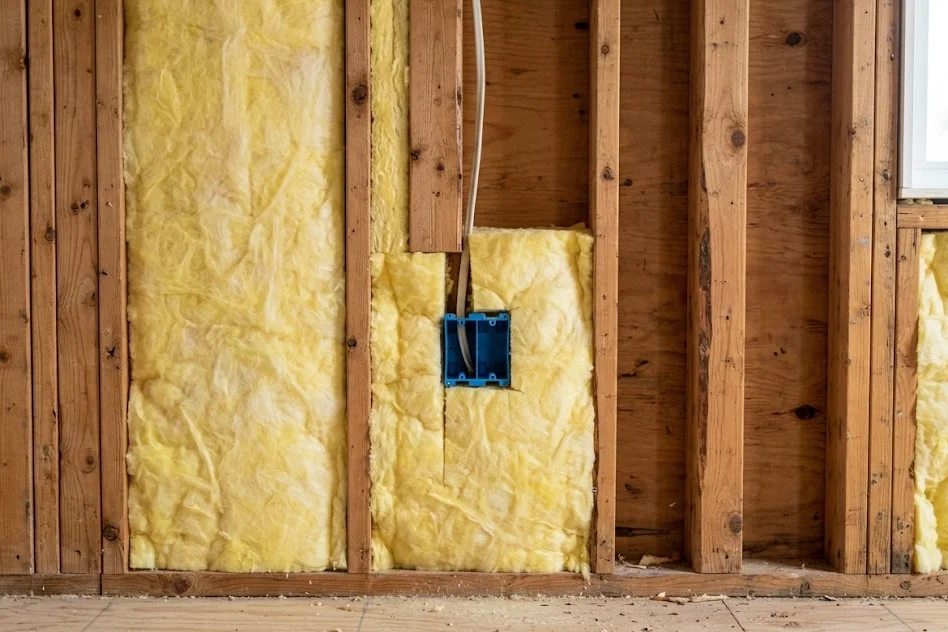
- Open walls in new construction or a gut remodel: batts. Batt insulation is common in new-construction wall cavities (HomeGuide). HomeGuide prices batts for all exterior walls of a house at $1,100 to $5,300, against $1,900 to $7,800 for blown-in wall insulation.
- Floors over vented crawl spaces and unheated garages: batts fitted between the floor joists, one of the uses the Department of Energy lists for blanket insulation. Insulate floors above unconditioned spaces; if the crawl space is unvented, the better approach is to seal and insulate the foundation walls instead of the floor (U.S. Department of Energy). That second route is covered in our guide to crawl space encapsulation cost.
- Cathedral ceilings: batts, often foil-faced or high-density, with a vent baffle between the insulation and the roof deck (U.S. Department of Energy). Loose-fill cannot hold to a sloped roof deck (Fixr).
You do not have to match what is already there. ENERGY STAR says you can add loose fill on top of batts and vice versa; if you lay batts over loose fill or over old batts, use unfaced ones, with no paper or foil backing (ENERGY STAR).
Settling, moisture and fire
Settling. Blown cellulose settles about 10% after installation, while blown fiberglass shows little or no settling (HomeGuide). In enclosed cavities such as walls, cellulose installed at the proper density cannot settle (U.S. Department of Energy). How the machine is set matters: airflow set too high leaves the insulation overly fluffy, so it looks deep enough but may fall short of the R-value once it settles (HomeGuide). Batts lose performance when installed badly: compressed insulation does not give its full rated R-value (U.S. Department of Energy), and gaps between batts or around electrical boxes are what to look for when checking the work (U.S. Department of Energy).
Moisture. Cellulose absorbs water and becomes heavy if there is a leak; fiberglass is not affected by moisture in the same way (Fixr). Any wet insulation loses R-value and can lead to mold, which is a reason to replace it (HomeGuide). Wet or damp attic insulation usually points to a roof leak that a professional should fix before new insulation goes in (ENERGY STAR).
Fire. Cellulose is made mostly from recycled newsprint and treated with borate to resist fire and insects; mineral wool needs no added chemicals to be fire resistant (U.S. Department of Energy). HomeGuide notes that some experts advise against cellulose in fire-prone regions. Foil-faced batts are combustible and belong only where they will be covered (HomeGuide); batts with a special flame-resistant facing exist for places like basement walls where insulation stays exposed (U.S. Department of Energy). With any type, keep insulation at least 3 inches from recessed lights not rated IC (insulation contact), and get knob and tube wiring checked first, as it can be a fire hazard in contact with insulation (ENERGY STAR).
Lifespan. Blown-in insulation lasts 20 to 30 years or more (HomeGuide). Fiberglass can last 80 to 100 years, while cellulose lasts 20 to 30 years and starts to degrade after about 15 (HomeGuide; Fixr gives the same fiberglass figure).
How long installation takes
A two-person crew can install about 1,000 sq ft of batts in 4 to 5 hours (HomeGuide). Blowing 1,000 sq ft of attic takes 6 to 7 labor hours for R-30 and 12 to 13.5 hours for R-60, although HomeGuide also gives 2 to 4 days with a two-person crew for a blown-in attic job, without explaining the gap between the two figures (HomeGuide). Homewyse’s 1,000 sq ft examples assume 7.5 labor hours for blown fiberglass and 11 for batts in an existing house (Homewyse). ENERGY STAR puts a contractor-installed attic insulation project at 1 to 2 days (ENERGY STAR).
Can you do it yourself?
| DIY item | Cost | Source |
|---|---|---|
| Blown-in insulation, materials | $0.35 – $1.50 per sq ft ($500 – $1,200 typical) | HomeGuide |
| Bag of blow-in insulation (30 lb) | $30 – $40 | HomeGuide |
| Blowing machine rental | $100 – $200 per day; free at some stores with 10 to 20+ bags | HomeGuide |
| Blowing machine rental | about $125 per day | Fixr |
| Batts, materials | $0.10 – $2.00 per sq ft, plus $25 – $50 per 1,000 sq ft for fasteners and sealant | HomeGuide |
| Roll of insulation (covers 40 – 75 sq ft) | $20 – $90 | HomeGuide |
Batts are the easier DIY job. ENERGY STAR rates batts and rolls as needing basic skill and loose-fill as intermediate (ENERGY STAR), and says laying fiberglass rolls is easiest for a do-it-yourselfer, while loose fill needs a blowing machine and it may be wise to hire a professional (ENERGY STAR). Blowing insulation is a two-person job, one feeding the machine and one directing the hose; wet-spray cellulose needs special equipment and is best left to professionals (HomeGuide). Fixr estimates that doing a standard insulation project yourself saves $560 to $950 (Fixr).
Wear eye protection, gloves and a dust mask with either material. If your attic has vermiculite, a lightweight, pea-size, flaky gray mineral, do not disturb it until a lab has tested it for asbestos (ENERGY STAR).
No federal tax credit for insulation installed in 2026
The Energy Efficient Home Improvement Credit covered 30% of the cost of insulation and air sealing materials that met the energy code, within a $1,200 annual limit; labor did not count. As of the IRS page last reviewed on April 28, 2026, the credit applies to improvements made through December 31, 2025, so insulation installed in 2026 does not qualify (IRS). Utilities may still offer rebates for insulation and air sealing, and your state’s Weatherization Assistance Program may help eligible households (ENERGY STAR).
How to keep the bill down
- For an open attic floor, price blown-in first; it is the cheaper route in most of the comparisons above.
- Top up instead of tearing out when the old insulation is dry and clean. You can add a different type on top.
- Get written estimates from several contractors for the same R-value. The Department of Energy warns that quotes for the same R-value can vary by more than a factor of two (U.S. Department of Energy).
- If you do it yourself, buy in bulk: bulk insulation prices run 15% to 30% below retail (HomeGuide), and some stores lend the blowing machine with a large enough order.
- Insulate walls when they are already open for a remodel, so you only pay to open and finish them once (Fixr).
- Ask your utility about rebates before you book the work.
Questions to ask before you sign
- What R-value will I end up with, and what settled thickness and number of bags does the manufacturer’s coverage chart call for?
- Is air sealing included, and which gaps, fixtures and fans will you deal with?
- Will you keep insulation clear of non-IC recessed lights and keep the soffit vents open?
- For walls: what density will the dense-pack reach, and how will you patch the holes?
- Does the price include removing old or damaged insulation?
- Are you licensed and insured, and what warranty covers the work?
Sources
- U.S. Department of Energy, Energy Saver: Insulation, Types of Insulation, Insulation Materials, Where to Insulate in a Home and Adding Insulation to an Existing Home. These pages have been removed from energy.gov; the links are archived copies of January 2 and January 11, 2025.
- ENERGY STAR (EPA): Recommended Home Insulation R-Values, Choosing the Appropriate Insulation Type, Attic Insulation Project, Attic Air Sealing Project and Why Seal and Insulate?
- Internal Revenue Service, Energy Efficient Home Improvement Credit, page last reviewed April 28, 2026.
- HomeGuide, Blown-In Insulation Cost and Batt & Roll Insulation Cost, November 5, 2025; Insulation Cost, December 19, 2025.
- Fixr, Cost to Install Blown-In Insulation, updated August 29, 2025; How Much Does It Cost to Insulate a Home?, updated January 29, 2026.
- Homewyse, September 2026 estimates: Blown Fiberglass Insulation, Cellulose Blown In Insulation, Insulation Batts and Mineral Wool Insulation.