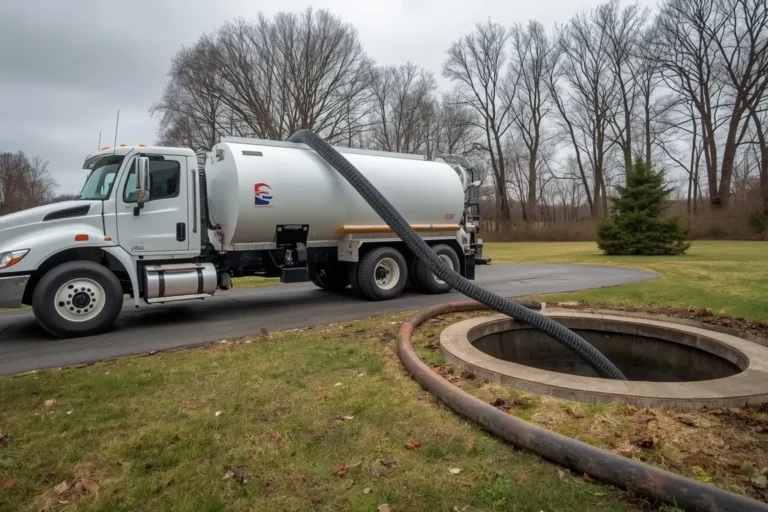
$2,000 – $10,000That is the typical sewer line replacement cost in 2026 for a 40-foot residential line, or $50 to $250 per linear foot. A repair that fixes only part of the pipe costs $150 to $3,800, depending on the method. Lines under a driveway, a basement slab or mature trees sit at the top of the range.
The sewer line, often called the lateral, is the pipe that carries everything from your drains to the public sewer main. When it cracks, sags or fills with roots, the first sign is usually slow drains or a backup in the lowest fixture of the house. The figures below show what the job costs by length and by method, and which extra lines tend to appear on the quote. Prices come from three published cost guides: HomeGuide (updated December 22, 2025), This Old House (updated March 30, 2026) and Forbes Home, an older guide (October 2024) used only next to a newer source. Each figure names its source.
Sewer line replacement cost by length
| Length | HomeGuide (2025) | Forbes Home (2024) |
|---|---|---|
| 10 feet | $500 – $2,500 | $550 – $2,500 |
| 20 feet | $1,000 – $5,000 | $1,100 – $5,000 |
| 40 feet | $2,000 – $10,000 | — |
| 60 feet | $3,000 – $15,000 | — |
| 80 feet | $4,000 – $20,000 | — |
HomeGuide puts the national average at $6,000, with jobs running from $500 at the low end to $20,000 at the top. Most full replacements cover about 40 feet, while partial replacements and repairs may involve only 1 to 15 feet of pipe (HomeGuide).
The per-foot price is where the guides agree most: HomeGuide and This Old House both give $50 to $250 per linear foot, and Forbes Home (October 2024) gives $55 to $250. The typical totals differ more. This Old House says most homeowners pay $1,390 to $5,320, with an average of $3,320, while HomeGuide’s average is $6,000 and Forbes Home’s is about $4,000. Expect quotes anywhere in that spread; length, depth and what sits on top of the pipe decide where yours lands.
Our estimate: the headline range of $2,000 to $10,000 is HomeGuide’s figure for 40 feet. Multiplying the $50 to $250 per foot that This Old House also reports by 40 feet gives the same $2,000 to $10,000. This is our own multiplication, not a measured figure.
Cost by method: open trench, pipe bursting or lining
| Method (per linear foot) | HomeGuide (2025) | This Old House (2026) |
|---|---|---|
| Traditional excavation, full job | — | $50 – $200 |
| Trenchless, any method | — | $60 – $250 |
| Trenchless pipe bursting | $60 – $200 | — |
| Pipe lining (CIPP) | $90 – $250 | — |
| Spin-casting (sprayed resin lining) | $80 – $250 | — |
| Trench digging only (traditional) | $5 – $12 | — |
| Trenchless boring only | $10 – $30 | — |
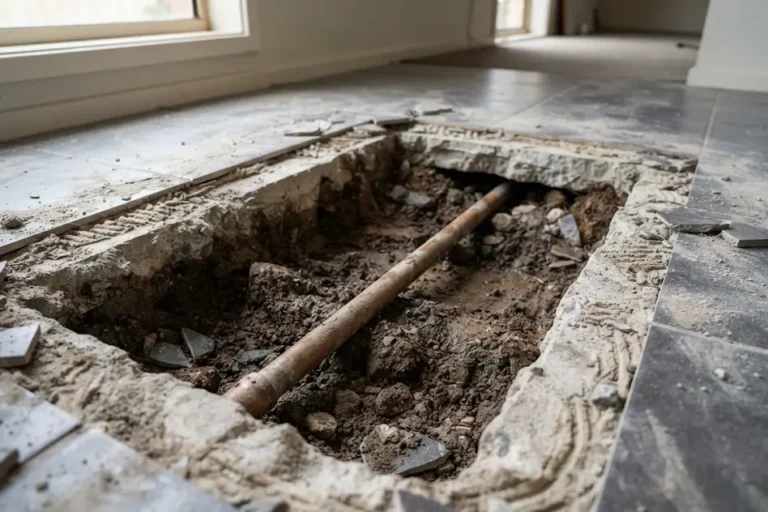
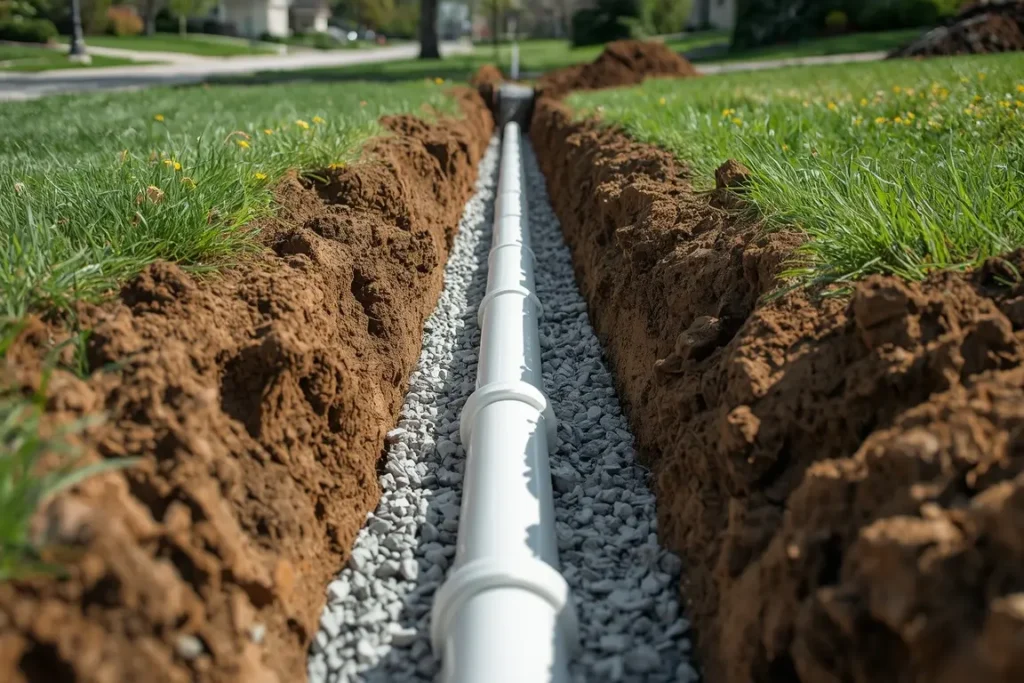
Traditional excavation opens a trench along the whole line. This Old House puts the whole job at $50 to $200 per linear foot, against $60 to $250 for trenchless methods. The digging itself costs $5 to $12 per linear foot depending on depth and obstacles (HomeGuide), but whatever is on top of the pipe (lawn, plantings, a driveway) has to be torn out and put back afterwards (HomeGuide). Forbes Home’s older guide (October 2024) gives $55 to $250 per linear foot for a trenched repair of a collapsed line (Forbes Home).
Pipe bursting pulls a new pipe through the old one from an access pit at each end; the machine breaks the old pipe outward as the new one follows. Cured-in-place pipe (CIPP) lining inserts a resin-coated liner into the existing pipe and inflates it so it hardens into a new pipe inside the old one, without digging up the line. Spin-casting sprays resin onto the inside of the existing pipe instead of using a liner (HomeGuide).
Our estimate: applying HomeGuide’s per-foot rates to a typical 40-foot line gives roughly $2,400 to $8,000 for pipe bursting (40 × $60 to 40 × $200) and $3,600 to $10,000 for CIPP lining (40 × $90 to 40 × $250). This is our own multiplication, not a measured figure, and it leaves out the camera inspection, permit and any restoration.
Cost calculator
Use the tables above to estimate your cost. The interactive calculator needs JavaScript.
Spot repair vs full replacement
| Problem and fix | HomeGuide (2025) | Forbes Home (2024) |
|---|---|---|
| Minor clog: snaking | $200 – $500 | $300 – $600 |
| Heavy clog or roots: hydro jetting | $600 – $1,400 | $300 – $1,100 |
| Repair range | $150 – $3,800 | $300 – $4,000 |
| Full replacement, 40 feet | $2,000 – $10,000 | — |
Small roots or a clog usually need only a basic repair or cleaning. A broken line or large cracks call for a partial or full replacement, or a lining (HomeGuide). If the camera shows one bad joint in an otherwise sound pipe, a spot repair makes sense; if it shows cracks, sags or roots along much of the run, paying to fix one section at a time tends to cost more in the end than replacing the line once.
Camera inspection cost
A sewer camera inspection costs $125 to $500 according to HomeGuide, or $100 to $500 according to This Old House. It gives the contractor what they need for an accurate diagnosis, plan and estimate (HomeGuide). Ask for a copy of the video. It lets a second contractor quote the same job and shows you whether the problem is local or runs the full length of the pipe.
Pipe materials: clay, cast iron, Orangeburg and plastic
| Pipe material | Per linear foot, 4-inch (HomeGuide 2025) | 40 feet of pipe (This Old House 2026) |
|---|---|---|
| Cast iron | $20 – $75 | $800 – $3,000 |
| Copper | $30 – $80 | $1,200 – $3,200 |
| PVC | $3 – $8 | $120 – $320 |
| ABS | $3 – $11 | $120 – $440 |
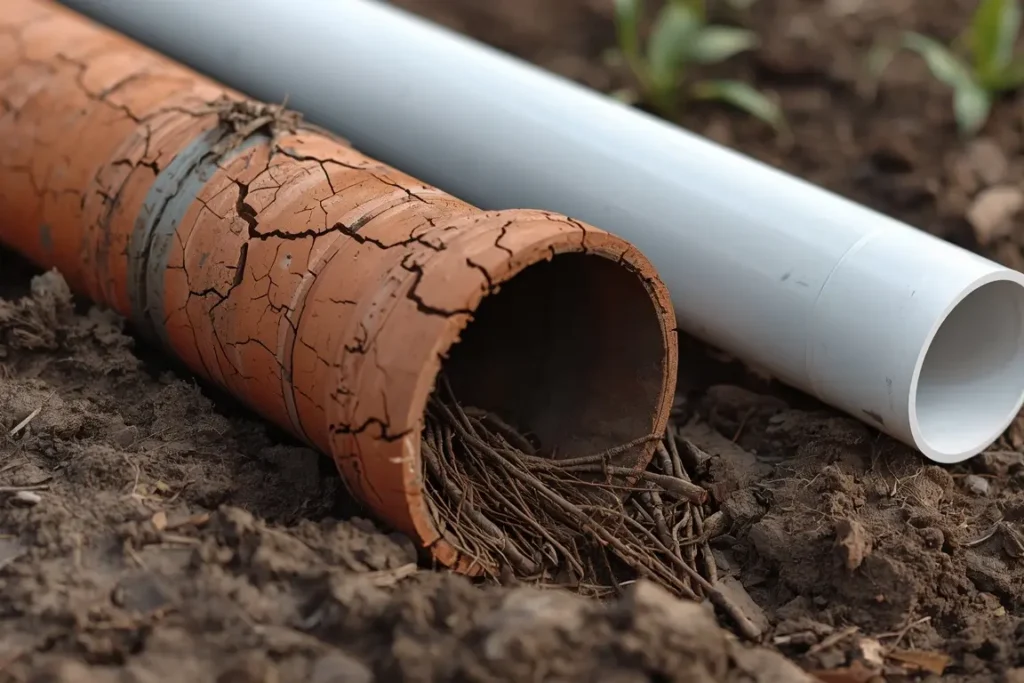
What you have in the ground now matters as much as what goes in. Older Orangeburg and clay sewer pipes last 30 to 60 years, while PVC, cast iron and copper lines last 50 to 100 years; soil, maintenance and nearby tree roots decide where in that range a pipe falls (HomeGuide). Cast iron is rarely used for new lines because it tends to rust, and plastic is common because it is cheap and does not corrode. ABS handles extreme cold well but not heat, and some places, California among them, restrict it, so check local rules before choosing it (HomeGuide).
Who pays: your lateral or the city main
In most places, the homeowner is responsible for the pipe from the house to the public main, and the city or utility is responsible for the main itself (HomeGuide). The City of Livermore, California, is a typical example: the city owns, maintains and repairs the sewer mains under streets and easements, and the property owner is responsible for maintaining, repairing and replacing the lateral from the building to the point where it connects to the main (City of Livermore).
Livermore also tells residents to call its Water Resources Division before calling a plumber, because it is often not obvious whether a backup is in the lateral or the main; its staff inspect the main at no cost to the property owner (City of Livermore). Many utilities offer a similar check, and the dividing line is set by local rules, so ask yours before paying for work. In a townhome or condo, the HOA may cover the cost (HomeGuide).
Permits and digging rules
Plumbing permits cost $30 to $500 depending on the job and the area, and most contractors can pull the permit for you (HomeGuide). This Old House gives a wider $100 to $1,000 for permit requirements on a sewer replacement. If the work means cutting a sidewalk, curb, gutter or street, a city may require a second permit: Livermore, for example, asks for an encroachment permit on top of the plumbing permit, and reminds owners to call 811 at least 48 hours before digging so utility lines are marked free of charge (City of Livermore).
Landscaping, driveway and other extras
| Extra work | Typical cost |
|---|---|
| Concrete removal | $3 – $8 per sq ft |
| Driveway repair | $100 – $400 (major: $600 – $3,000) |
| Landscaping | $4 – $12 per sq ft |
| Sod installation | $1 – $2 per sq ft |
| Tree removal | $400 – $1,200 |
| Stump removal | $100 – $400 |
| Camera inspection | $125 – $500 (This Old House: $100 – $500) |
| Plumbing permit | $30 – $500 (This Old House: $100 – $1,000) |
| Sewer cleanout | $500 – $2,000 |
| Backflow preventer | $150 – $1,200 |
| Sewer backup cleanup, minor | $500 – $2,000 |
A line covered only by soil or sod costs less to replace than one under a basement, driveway or sidewalk (HomeGuide). This is where trenchless methods earn their higher per-foot price: they avoid most of the restoration bill.
Our estimate: an open trench 3 feet wide crossing a 20-foot driveway means about 60 square feet of concrete to remove, or roughly $180 to $480 at HomeGuide’s $3 to $8 per square foot, before the driveway is repaired. The trench width and driveway length are our assumptions, not measured figures.
What the labor line pays for
Most plumbers charge $75 to $150 an hour according to HomeGuide, while This Old House says plumbers may charge $150 to $500 an hour for sewer work and that labor and excavation usually make up the largest share of the price. The gap is wide, so compare quotes by total job price rather than hourly rate. A plumber without the crew or equipment for trenching may bring in a subcontractor (HomeGuide). The job itself takes 1 to 5 days, with trenchless work on the shorter end (HomeGuide). For comparison, the median annual wage for plumbers, pipefitters and steamfitters was $63,800 in May 2025, according to the Bureau of Labor Statistics. The billed rate also covers equipment, licensing, insurance and overhead, not just the wage.
Does insurance cover a sewer line?
The National Association of Insurance Commissioners lists sewer backup among the common optional add-ons to a homeowners policy; this water backup coverage pays for losses to the house from a sewer or drain backup (NAIC). That is damage inside the home, not the pipe. Most policies do not cover wear and tear from lack of maintenance, and separate sewer line coverage exists for repairs to the line itself (HomeGuide). Read your own policy, or ask your agent, before you assume either is included.
How to keep the bill down
- Call your city or sewer utility first. If the problem is in the main, it is their repair, not yours.
- Pay for a camera inspection and keep the video, so every contractor quotes the same problem.
- Fix a single bad section when the rest of the pipe is sound; replace the whole line when the damage is spread out.
- If the line runs under a driveway, patio or mature trees, price a trenchless method against digging plus restoration.
- Get at least three written estimates and never pay in full before the work starts (HomeGuide).
Questions to ask before you sign
- Can I see the camera video, and where exactly is the damage?
- Is the problem in my lateral or in the public main?
- Which method do you recommend (trench, bursting or lining) and why for my pipe?
- Does the quote include the permit, a cleanout, cleanup and restoring the lawn or driveway?
- Will you use a subcontractor for the digging?
- What does your warranty cover, and for how long?
Sources
- U.S. Bureau of Labor Statistics, Occupational Outlook Handbook: Plumbers, Pipefitters, and Steamfitters, pay data for May 2025.
- City of Livermore, California, Sewer Laterals: Information for Property Owners.
- National Association of Insurance Commissioners, Homeowners Insurance.
- HomeGuide, Sewer Line Replacement Cost, December 22, 2025.
- This Old House, How Much Does a Sewer Line Replacement Cost?, updated March 30, 2026.
- Forbes Home, Average Sewer Line Repair And Replacement Cost, updated October 31, 2024 (older guide, used only alongside newer sources).