$1,000 – $9,000That is the typical attic mold removal cost in 2026 across the three national cost guides we checked: This Old House puts it at $1,000 to $4,000, HomeGuide at $1,500 to $6,000 for part of the attic, and Fixr at $1,500 to $9,000. Treating a whole attic with extensive damage, poor access or insulation to replace runs $6,000 to $15,000 in HomeGuide’s figures. Fixing the moisture that caused the mold is usually a separate line.
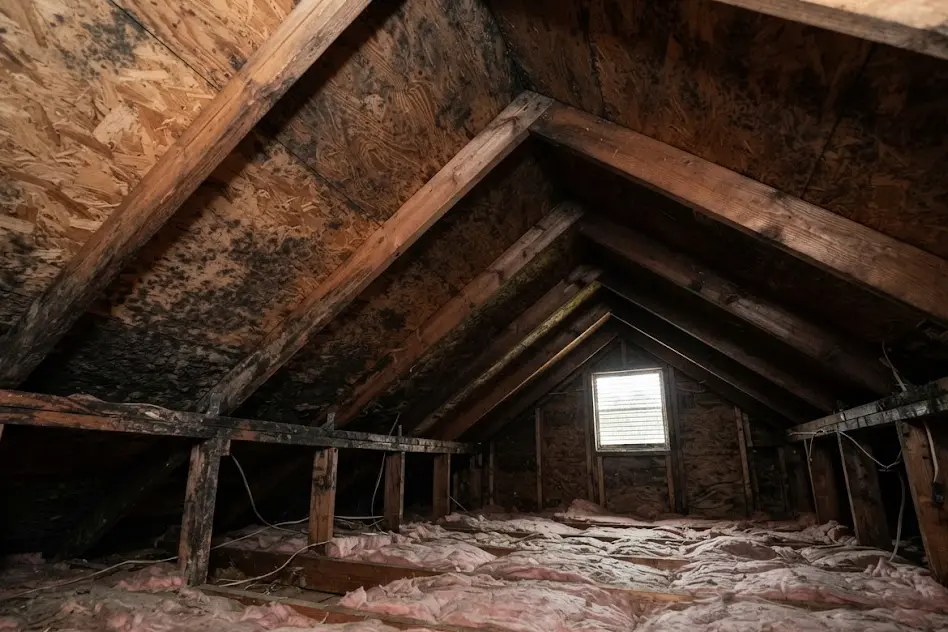
Attic mold is rarely a mystery once you look at where the water came from: a roof leak, an ice dam, or warm, damp air from the house condensing on cold roof sheathing. Removing the mold without dealing with that source is money spent twice. The figures below show what the removal costs, what the insulation and ventilation fixes add, and how to tell a complete quote from a partial one.
Attic mold removal cost at a glance
| Job | HomeGuide | Fixr | This Old House |
|---|---|---|---|
| Attic mold removal, typical job | $1,500 – $6,000 (partial attic) | $1,500 – $9,000 | $1,000 – $4,000 |
| Attic mold removal, full attic | $6,000 – $15,000 | – | – |
| Mold remediation rate, any location | $15 – $30 per sq ft | $10 – $30 per sq ft | $10 – $25 per sq ft |
| Remediation labor | $75 – $120 per hour | $75 – $120 per hour | – |
| Professional mold inspection | $300 – $650 (average home) | $450 – $800 (when billed separately) | – |
HomeGuide puts the whole attic in its “large” band of 300 to 1,000 square feet, and a partial attic in the “medium” band of 100 to 300 square feet. A small or medium job usually takes 1 to 3 days, while large or severe ones can take up to 7 (HomeGuide). Its attic insulation guide gives a similar overall range for attic mold removal, $1,500 to $15,000 (HomeGuide).
The guides do not agree on the top of the range. This Old House says a small spot in an easily accessible attic could cost as little as $1,000, and extensive mold in a cramped or hard-to-reach attic as much as $4,000 (This Old House). Fixr’s attic range reaches $9,000, and it gives $3,500 as what most homeowners pay for attic mold remediation (Fixr). HomeGuide is the only one of the three that prices a full attic separately, at up to $15,000. If your quote is above $4,000, ask whether it covers the whole attic or insulation work; that is where the guides diverge.
Our estimate: the $1,000 to $9,000 headline range is the lowest low and the highest high of the three guides’ typical attic ranges above ($1,000 from This Old House, $9,000 from Fixr). It is our combination of their figures, not a measured price, and it leaves out HomeGuide’s separate $6,000 to $15,000 band for a full attic.
Cost by size of the moldy area
| Area with mold | Fixr | This Old House |
|---|---|---|
| 100 sq ft | $1,000 – $3,000 | $1,000 – $2,500 |
| 200 sq ft | $2,000 – $6,000 | $2,000 – $5,000 |
| 500 sq ft | $5,000 – $15,000 | $5,000 – $12,500 |
| 1,000 sq ft | $10,000 – $30,000 | $10,000 – $25,000 |
Both guides scale with the area that has mold, not the size of the attic floor. This Old House notes that smaller areas tend to land at the higher end of the per-foot range because of minimum labor fees, while larger areas may get lower per-foot rates (This Old House).
Estimate your attic mold removal cost
Use the tables above to estimate your cost. The interactive calculator needs JavaScript.
Our estimate: the calculator’s per-square-foot rate of $10 to $30 spans the three guides in the first table (the $10 low from Fixr and This Old House, the $30 high from HomeGuide and Fixr). The flat attic prices are HomeGuide’s, and each extra uses the range shown in the tables on this page. It assumes labor is about 60 percent of the bill, the share Fixr gives for mold remediation. The result is a rough planning range, not a quote.
What drives the price up
- How much of the attic is affected. The jump from a partial to a full attic roughly moves the job from the $1,500–$6,000 band to the $6,000–$15,000 one (HomeGuide).
- Access. Limited access is one of the three reasons HomeGuide gives for an attic job reaching the upper range (HomeGuide). This Old House likewise puts extensive mold in cramped or hard-to-access attics at the top of its range (This Old House).
- Labor. Fixr puts labor at about 60 percent of a mold remediation bill and materials at the other 40 percent, and This Old House says labor often makes up more than half (Fixr; This Old House). Both HomeGuide and Fixr give $75 to $120 an hour, so anything that slows the crew raises the price.
- Insulation that has to come out. Wet, moldy insulation is a porous material, and the EPA notes that porous materials with mold growing on them may have to be discarded because mold can be difficult or impossible to remove from them completely (EPA). Removal and replacement are priced in the next section.
- Damage to the wood. The EPA warns that with a long-term roof leak, molds can weaken floors and walls as they feed on wet wood, and that you should consult a structural engineer or other qualified professional if you suspect structural damage (EPA). Replacing sheathing or framing is roofing or carpentry work, not remediation, and is quoted separately.
- Containment and equipment. Air scrubbers, dehumidifiers, HEPA vacuums, protective gear and disposal fees for contaminated materials all appear in the price of larger jobs (HomeGuide). For more than 100 square feet of mold, the EPA generally recommends full containment with a double layer of plastic sheeting and an airlock (EPA).
Why attics grow mold
Roof leaks. The EPA lists roof materials above ceiling tiles, wet from roof leaks or insufficient insulation, among the places where mold hides (EPA). Fixing a small roof leak costs $150 to $1,000, and a large leak that needs structural repairs $3,000 to $6,000 (HomeGuide). If the roof is near the end of its life, our guide to roof replacement cost shows what a new one runs.
Ice dams. The University of Minnesota Extension explains that an ice dam forms when heat from the house melts snow on the upper roof and the water refreezes at the colder edge. The water that backs up behind the dam finds openings in the roof covering and flows into the attic, and the moisture that enters can lead to mold and mildew. It identifies air leaking from the house into the attic, around fixtures and other ceiling penetrations, as the major cause of that heat in many homes (University of Minnesota Extension).
Exhaust fans and damp indoor air. The EPA advises venting moisture-producing appliances such as clothes dryers to the outside, and running the bathroom fan or opening a window when showering (EPA). A fan that dumps that humid air into the attic instead of outdoors defeats the purpose. HomeGuide’s attic insulation guide states that vents exhausting into the attic must be vented outside before new insulation goes in (HomeGuide).
How attic mold is removed
The EPA’s professional guidance, Mold Remediation in Schools and Commercial Buildings, describes the core methods a remediator works from:
- Damp wipe. Mold can generally be removed from hard, nonporous surfaces by wiping or scrubbing with water, or water and detergent, then drying them quickly and thoroughly.
- Discarding porous materials. Moldy porous materials may have to be thrown out, because mold fills their crevices. Discarded materials are double-bagged in 6-mil plastic before they leave the contained area.
- HEPA vacuum. Used for final cleanup once materials are thoroughly dried and contaminated ones removed.
The EPA also notes that professional remediators may use methods not covered in its guidelines, and that leaving a method out does not mean it is not useful (EPA). If a quote names a method you do not recognize, ask the contractor to explain what it removes and how the result will be checked.
Two things the EPA says do not count as removal. Killing the mold is not enough, because dead mold may still cause allergic reactions, and biocides such as chlorine bleach are not recommended as a routine practice. And you should not paint or caulk over moldy surfaces; clean and dry them first, because paint applied over mold is likely to peel (EPA). A quote that consists only of spraying a product on the sheathing should raise questions.
Insulation removal and replacement
| Job | HomeGuide | HomeBuddy | Homewyse |
|---|---|---|---|
| Removing old attic insulation | $1 – $2 per sq ft | $1.00 – $2.25 per sq ft | – |
| Replacing attic insulation, removal included | $2 – $6 per sq ft | $3,000 – $10,000+ per job | – |
| New blown-in insulation | $0.90 – $2.40 per sq ft | $1.00 – $2.50 per sq ft (cellulose) | $3.74 – $7.72 per sq ft (loose fill, R-19) |
| New batt and roll insulation | $0.80 – $2.60 per sq ft | $0.90 – $1.80 per sq ft (fiberglass) | – |
| Air sealing the attic | $350 – $3,000 | $200 – $600 (average attic) | – |
| Attic cleaning | $100 – $500+ | – | – |
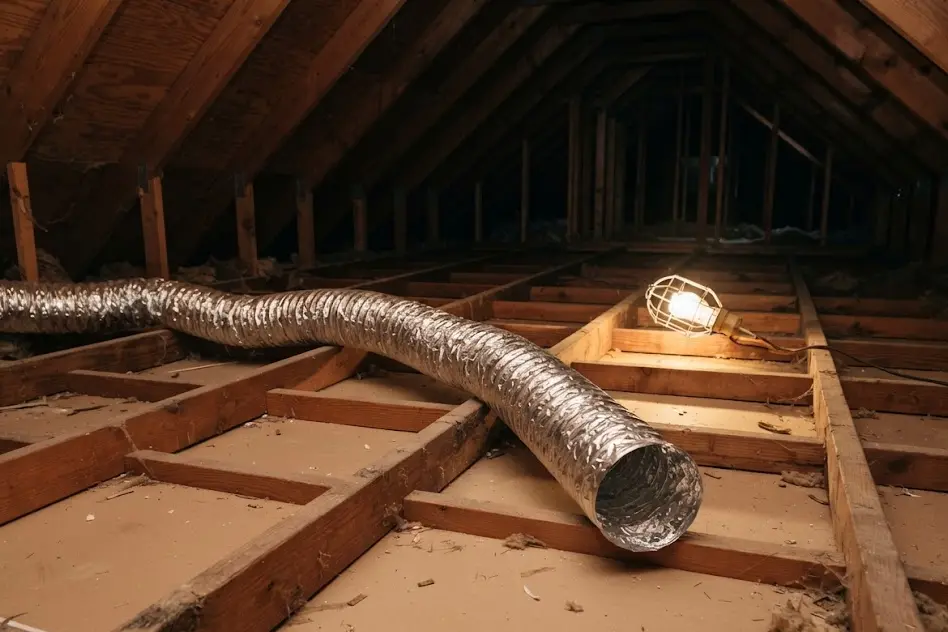
HomeGuide recommends removing old insulation when it has fire, water or pest damage, and points out that taking it out also exposes the attic floor so every penetration can be sealed (HomeGuide). That matters for mold, because air leaking up through those penetrations is the same path the University of Minnesota Extension blames for ice dams.
HomeBuddy names wet or moldy insulation among the reasons to replace rather than top up, and says moisture, mold or pest cleanup before installation is an additional expense (HomeBuddy). Homewyse’s national average, $3.74 to $7.72 per square foot, is well above the other two guides for new insulation; its default estimate is for loose-fill R-19 insulation and lists removal of old insulation as a separate option (Homewyse). Treat it as the high end when you compare quotes.
Our estimate: for a 1,000-square-foot attic floor, replacing the insulation at HomeGuide’s $2 to $6 per square foot would add about $2,000 to $6,000. Added to a full-attic removal of $6,000 to $15,000, the combined bill would come to roughly $8,000 to $21,000 before any roof or ventilation work. This is our calculation from the figures above, not a measured price; your attic’s size and the insulation chosen will change it. HomeBuddy’s $3,000 to $10,000+ for replacing old attic insulation lands in a similar range for the insulation part.
Why attic mold keeps coming back
The EPA is direct: if you clean up the mold but do not fix the water problem, the mold will most likely come back, and a cleanup cannot be considered finished until the water or moisture problem has been completely fixed (EPA). It also notes that it is impossible to get rid of every mold spore indoors; a background level remains, and those spores will not grow once the moisture problem is resolved (EPA). In an attic, the recurring culprits are the ones above: a leak that was patched but not found, exhaust air still reaching the attic, or warm air escaping through the ceiling.
Ventilation and air sealing fixes
| Fix | HomeGuide | Second guide |
|---|---|---|
| Roof vent installation | $200 – $700 | $240 – $600 (Fixr) |
| Soffit vent, installed, per vent | – | $290 – $475 (Fixr) |
| Baffles at soffit vents | $2 – $3 per baffle | – |
| Air sealing the attic floor | $350 – $3,000 | $200 – $600 (HomeBuddy) |
| Small roof leak repair | $150 – $1,000 | – |
| Large roof leak with structural repairs | $3,000 – $6,000 | – |
The University of Minnesota Extension sets out the order of work for ice dam attics: first make the ceiling airtight so no warm, moist air flows from the house into the attic, then consider adding insulation. Natural attic ventilation is needed to dry the attic and remove summer heat, but it recommends against mechanical attic ventilation as an ice dam fix in Minnesota, because it can create other attic moisture problems and pull the house into undesirable negative pressure. It also advises not repairing interior damage until ceilings and walls are dry, and doing the repairs together with fixing the heat loss, or the damage will happen again (University of Minnesota Extension).
The extension recommends hiring a weatherization contractor who runs a blower door test to measure how airtight the ceiling is, and who may use an infrared camera to find heat loss. It adds that whenever a house is tightened up, ventilation, exhaust and combustion devices must still get enough air to operate safely (University of Minnesota Extension).
Is testing worth it for attic mold?
Usually not when you can see it. The EPA says that in most cases, if visible mold growth is present, sampling is unnecessary, and no federal limits exist that a test could be measured against (EPA). A professional inspection costs $300 to $650 for an average home (HomeGuide). Fixr gives $450 to $800 when the inspection is billed separately, and notes that some companies waive or include it if they also do the remediation (Fixr). Where it can help is in finding where the moisture comes from, or confirming afterwards that the cleanup worked, which the EPA says surface sampling can do (EPA).
Can you do it yourself?
The EPA says that if the moldy area is less than about 10 square feet, in most cases you can handle the job yourself, and it points to professional guidance for larger areas or where there has been a lot of water damage (EPA). Mold in an attic often covers far more than that across the underside of the roof. For small patches, the EPA recommends an N-95 respirator, long gloves and goggles without ventilation holes, and advises against touching mold with bare hands (EPA).
How to keep the bill down
- Dry wet materials within 24 to 48 hours of a leak; in most cases, the EPA says, mold will not grow if you do (EPA).
- Keep indoor humidity below 60 percent, ideally 30 to 50 percent, and run the bathroom fan when showering (EPA).
- Bundle the insulation work with the remediation: removing the old insulation opens the attic floor for air sealing in the same visit (HomeGuide).
- Skip lab testing when the mold is visible, unless you need to prove the cleanup worked (EPA).
- If you do need an inspection, ask whether the fee is waived or included when the same company does the remediation (Fixr).
- Get estimates from at least three companies and check each covers the same testing, cleanup and containment; never pay in full before the work is complete (HomeGuide).
Questions to ask before you sign
- What caused the moisture in my attic, and does the quote fix it or only remove the mold?
- Will you follow the EPA’s Mold Remediation in Schools and Commercial Buildings guidance or the ACGIH guidelines? The EPA suggests asking and checking references (EPA).
- Which removal method will you use on the sheathing, and how will you show the mold is gone rather than covered?
- Does the price include removing and replacing the insulation, air sealing, and disposal?
- Are any bathroom or kitchen fans venting into the attic, and is rerouting them included?
- How will you contain the attic so spores do not reach the rooms below?
- What happens to the price if you find damaged wood once work starts?
Sources
- U.S. Environmental Protection Agency, A Brief Guide to Mold, Moisture and Your Home, last updated February 18, 2026.
- U.S. Environmental Protection Agency, Mold Remediation in Schools and Commercial Buildings Guide, Chapter 3, last updated April 29, 2026.
- University of Minnesota Extension, Dealing with and preventing ice dams, reviewed 2022.
- HomeGuide, How Much Does Mold Removal and Remediation Cost?, February 5, 2026.
- HomeGuide, Attic Insulation Cost, January 13, 2026.
- Fixr, Mold Remediation Cost, updated August 29, 2025.
- This Old House, How Much Does Mold Remediation Cost? (2026 Guide), updated March 11, 2026.
- HomeBuddy, How Much Does Attic Insulation Cost in 2026?, updated August 25, 2026.
- Homewyse, Cost to Insulate an Attic, September 2026.
- Fixr, Cost to Install Roof Vent, updated January 31, 2025.