$1,000 – $2,000That is the typical radon mitigation cost in 2026 for a contractor-installed system. The Wisconsin Department of Health Services puts the average at $1,000 to $2,000 (Wisconsin DHS, June 2026), and HomeGuide prices the most common fix, active sub-slab depressurization, at $1,200 to $2,000, with other methods running from $500 to $8,000 depending on the foundation (HomeGuide, February 2026). The EPA’s own cost model uses $1,826 for that same system (EPA, October 2025). Testing first costs about $10 to $30 for a kit (Wisconsin DHS, July 2026).
The U.S. Environmental Protection Agency describes the cost plainly: “Most homes can be fixed for about the same cost as other common home repairs,” and the cost “depends on how your home was built and the extent of the radon problem” (EPA, A Citizen’s Guide to Radon). The figures below put numbers on that, by method, and add the costs that come before and after the installation: the test, the follow-up test and the fan that has to keep running.
When the EPA says to fix your home
The EPA’s advice is to “Fix your home if your radon level is confirmed to be 4 picocuries per liter, pCi/L, or higher,” and it adds that “Radon levels less than 4 pCi/L still pose a risk, and in many cases may be reduced” (EPA, Consumer’s Guide to Radon Reduction). The same guide says the EPA recommends fixing your home if one long-term test, or the average of two short-term tests, shows 4 pCi/L or higher, and that “You also may want to consider fixing if the level is between 2 and 4 pCi/L.” With current technology, it says, radon in most homes can be brought down to 2 pCi/L or below.
On health, the EPA states that radon “is the leading cause of lung cancer for non-smokers and the second leading cause of lung cancer for the general population,” and that if you smoke and your home has high radon levels, your risk of lung cancer is especially high (EPA). The CDC notes that the EPA and the Surgeon General’s office estimate radon is responsible for more than 21,000 lung cancer deaths each year in the United States (CDC, Radon and Your Health, June 18, 2026).
Radon testing cost
| Test | HomeGuide (2023 guide) | State health agencies | How long it runs |
|---|---|---|---|
| Short-term DIY kit | $10 – $25 | $10 – $20 (Michigan); $10 – $30 for a kit (Wisconsin) | 2 to 7 days |
| Long-term DIY kit | $25 – $50 | Within $10 – $30 for a kit (Wisconsin) | 90 days to 1 year |
| Continuous radon monitor (consumer) | $150 – $300 | – | 30 days minimum |
| Professional radon test | $125 – $400 | $75 – $200 with a continuous monitor (Michigan) | Varies by device |
| Radon in water test | $25 – $150 | – | 7– to 10-day lab turnaround |
The sources line up on kits but not on professional tests. Michigan’s environment agency says a short-term charcoal device typically sells for $10 to $20, often with postage and lab fees included, and that tests run with a continuous monitor, the kind common in real estate sales, are around $75 to $200 (Michigan EGLE). HomeGuide’s older guide puts a professional test at $125 to $400. The continuous monitor and water test rows come from HomeGuide alone, and its test guide dates from August 2023, so treat those as a rough guide.
The EPA explains the difference between the two kinds of test: a short-term test stays in your home for two to 90 days, a long-term test for more than 90 days, and every test should run for at least 48 hours. A short-term test gives faster results, “but a long-term test will give you a better understanding of your home’s year-round average radon level” (EPA). Passive devices, which need no power, are “generally inexpensive”; active devices such as continuous monitors “may cost more.” HomeGuide adds that some states offer free or discounted short-term kits, so check with your state radon office before you buy one.
Radon mitigation cost by system type
| System | HomeGuide (Feb 2026) | Forbes Home (July 2024) |
|---|---|---|
| Active soil (sub-slab) depressurization | $1,200 – $2,000 | $1,000 – $2,500 |
| Drain-tile suction (existing perimeter drain) | $900 – $1,800 | $700 – $1,500 |
| Sump pit sealing and cover | $900 – $2,500 | $800 – $2,500 |
| Block-wall depressurization | $1,800 – $3,000 | $1,700 – $2,400 |
| Above-slab pressure differential barrier | $500 – $1,200 | $300 – $1,000 |
| Heat recovery ventilator (HRV) | $1,300 – $2,200 | $700 – $1,400 |
| Energy recovery ventilator (ERV) | $1,500 – $2,500 | $600 – $1,200 |
| Radon in well water: carbon filter | $1,200 – $1,800 | $1,000 – $1,700 |
| Radon in well water: aeration | $4,000 – $5,000 | $4,500 – $5,000 |
For the systems most homes get, the guides broadly agree: sub-slab, drain-tile and sump systems land between about $700 and $2,500 in both, and the Wisconsin health department’s $1,000 to $2,000 average sits inside that band. The EPA’s $1,826 figure is built from cost studies from the 1990s adjusted for inflation to 2023 dollars, and the agency itself says the cost data “are from the 1990s,” so read it as a cross-check rather than a quote (EPA). Where the guides disagree is ventilation: HomeGuide’s HRV and ERV prices are roughly double Forbes Home’s, and the Forbes guide is older, so get a quote before budgeting for either.
Estimate your radon mitigation cost
Use the tables above to estimate your cost. The interactive calculator needs JavaScript.
Sub-slab depressurization is the standard fix for homes with a basement or slab. A pipe runs through the floor into the soil or gravel below, and a fan draws the radon up and vents it outdoors. The EPA rates it at 50 to 99 percent reduction and says it “works best if air can move easily in material under slab.” The passive version, with no fan, reaches only 30 to 70 percent (EPA).
Drain-tile and sump-hole suction use what is already under the floor. The EPA rates both at 50 to 99 percent; drain-tile suction works with either a partial or a complete drain loop, and sump-hole suction works best when air moves easily to the sump from under the slab.
Block-wall suction is only for homes with hollow block walls, and the EPA notes it requires sealing major openings. It is also rated at 50 to 99 percent.
Ventilation (HRV, ERV or opening the house) is the weakest option. The EPA lists an HRV’s effectiveness as variable, limited by the radon level and the amount of air available, and best in limited spaces like basements. Natural ventilation is “Variable/Temporary,” with significant loss of heated or cooled air.
Crawl space radon mitigation
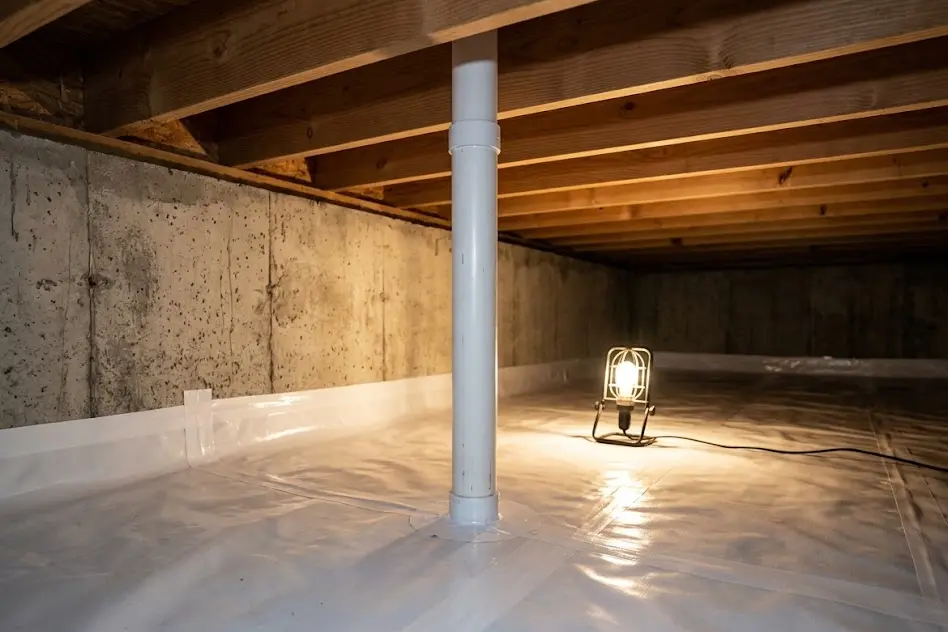
In a crawl space, the EPA’s preferred method is submembrane depressurization: covering the earth floor with a high-density plastic sheet and using a vent pipe and fan to draw radon from under it. The EPA rates it at 50 to 99 percent reduction, with less heat loss than natural ventilation in cold climates. Ventilating the crawl space instead achieves 0 to 50 percent, and the EPA notes that drawing air out of the crawl space with a fan can raise energy costs because conditioned air is lost (EPA).
If the plan is to seal the whole crawl space rather than just lay a radon membrane, the job is priced as an encapsulation, which HomeGuide puts at $3,000 to $15,000. We cover that work in our guide to crawl space encapsulation cost.
Running and upkeep costs
| Item | HomeGuide (Feb 2026) | Other source |
|---|---|---|
| Running the system | About $70 – $80 a year (fan electricity) | $206 a year operating cost (EPA model, 2023 dollars) |
| Fan replacement | – | $476 every 10 years (EPA model, 2023 dollars) |
| Permit | $25 – $150 | $25 – $150 (Forbes Home, July 2024) |
| Digital radon detector | $150 – $300 | – |
| HRV replacement filter | – | $10 – $25 (EPA Consumer’s Guide) |
HomeGuide says the fan uses about as much electricity as a 60-watt light bulb. It has to: the EPA is explicit that “the fan should NEVER be turned off; it must run continuously for the system to work correctly.” The EPA also says systems that use fans are more effective, but “will slightly increase your electric bill,” and most systems cause some loss of heated or cooled air (EPA).
The two running-cost figures do not agree. HomeGuide’s $70 to $80 counts the fan’s electricity. The EPA’s cost-benefit analysis uses $206 a year for operating costs, which it says account for the electricity to run the fan, and prices a replacement fan at $476 every 10 years, but those figures come from 1990s studies adjusted for inflation to 2023 dollars (EPA). Your real cost depends on the fan and your electricity rate, so ask the installer for the fan’s wattage.
Plan for a fan replacement. According to the EPA, fans “may last for five years or more,” manufacturer warranties tend not to exceed five years, and the cost to replace one varies with labor and materials, so ask for an estimate before work begins. HomeGuide puts the fan’s life at 5 to 10 years and the piping’s at 20 to 50 years or more. An HRV filter should be changed twice a year.
Our estimate: five years of owning a typical sub-slab system comes to about $1,550 to $2,400. That is HomeGuide’s $1,200 to $2,000 installed cost plus five years of fan electricity at $70 to $80 a year ($350 to $400). It is our calculation, not a measured figure, and it leaves out testing and any fan replacement. Using the EPA model’s figures instead, $1,826 installed plus five years at $206 ($1,030), the total is about $2,856 in 2023 dollars.
Testing after the system is installed
The EPA says a post-mitigation test should be done within 30 days of installation, but no sooner than 24 hours after the system is running with the fan on. The contractor may test to check the work, but the EPA recommends you also get an independent follow-up measurement, either by an independent tester or by doing it yourself, to avoid any conflict of interest. A two- to seven-day measurement is recommended, with windows and doors closed for 12 hours before and during the test, except for normal entry and exit. After that, the EPA suggests retesting at least every two years, and again after any major renovation (EPA). At kit prices, each retest costs $10 to $25.
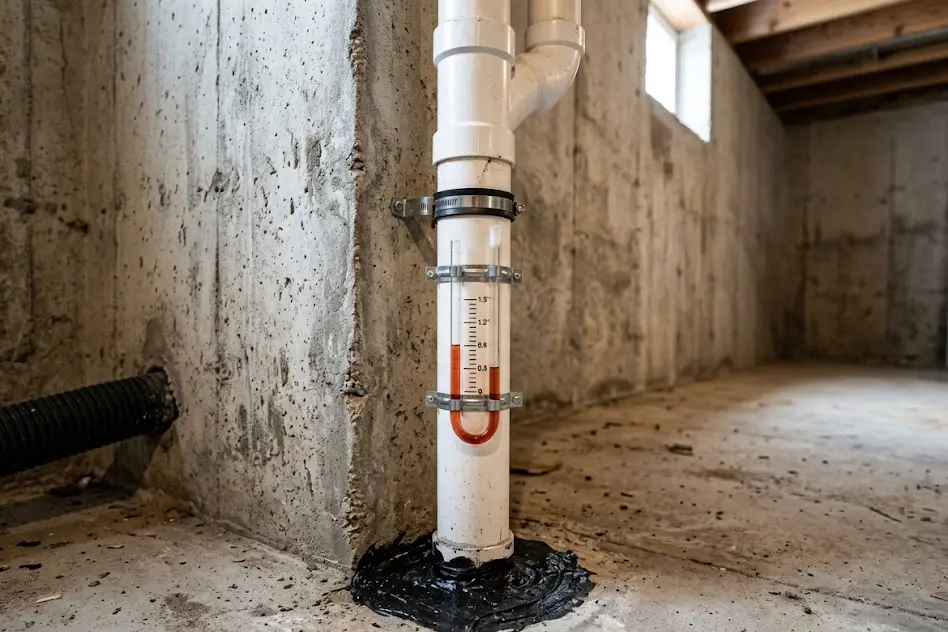
A fan-powered system should have a warning device, usually a manometer, placed where it can be seen or heard easily. Check it regularly, and if it shows the system is not working properly, call a contractor.
New construction: radon-resistant features
The EPA says it is “almost always less expensive to build radon-resistant features into new construction than it is to fix an existing home,” and that the cost of fixing “is much less if a passive system was installed during construction” (EPA; EPA). It recommends radon-resistant features for new homes in high radon potential (Zone 1) areas, and local building codes may require them. Even so, every new home should be tested after occupancy. If the result is 4 pCi/L or more, a qualified mitigator can add a vent fan to turn the passive system into an active one.
How to keep the bill down
- Confirm the result before you pay for a system. The EPA bases its fix recommendation on one long-term test or the average of two short-term tests.
- Check with your state radon office first. It can point you to qualified test kits and contractors, and HomeGuide notes some states offer free or discounted kits.
- Get estimates from more than one qualified mitigation contractor, as both the EPA and HomeGuide advise.
- Compare running costs, not just the price. The EPA warns that “a less expensive system may cost more to operate.”
- If you are building, have radon-resistant features put in during construction. Adding a fan later costs far less than a full retrofit.
- Do the independent follow-up test yourself with a short-term kit.
Questions to ask before you sign
- Are you licensed, certified or registered where my state requires it?
- Which method do you recommend for my foundation, and why?
- Do you guarantee to bring radon below 4 pCi/L, and for how long?
- Does the total include taxes, the permit fee and a post-mitigation test?
- Where will the fan and exhaust go, and what warning device will you install?
- What warranty covers the fan and your workmanship, and what will a replacement fan cost?
Sources
- U.S. Environmental Protection Agency, A Consumer’s Guide to Radon Reduction: How to Fix Your Home.
- U.S. Environmental Protection Agency, A Citizen’s Guide to Radon, EPA 402/K-12/002, 2016 edition.
- Centers for Disease Control and Prevention, Radon and Your Health, June 18, 2026.
- HomeGuide, How Much Does a Radon Mitigation System Cost?, February 5, 2026.
- HomeGuide, How Much Does Radon Testing Cost?, older guide (August 23, 2023).
- U.S. Environmental Protection Agency, Analysis of Benefits and Costs of Radon Reduction Strategies Recommended by the EPA, October 2025 (posted December 2025).
- Wisconsin Department of Health Services, Radon Mitigation, last revised June 25, 2026.
- Wisconsin Department of Health Services, Testing for Radon, last revised July 6, 2026.
- Michigan Department of Environment, Great Lakes, and Energy, Testing for Radon.
- Forbes Home, How Much Do Radon Mitigation Systems Cost?, older guide (July 26, 2024).