$3,500 – $8,500That is the typical septic tank installation cost in 2026 for a new conventional system, including a 1,000-gallon tank, labor, permits and inspections (HomeGuide). Fixr gives $4,500 to $9,000, and This Old House gives $3,480 to $11,625 across all system types. If the soil rules out a standard drain field, an alternative system runs $4,000 to $15,000 and an engineered one $15,000 to $50,000 (HomeGuide).
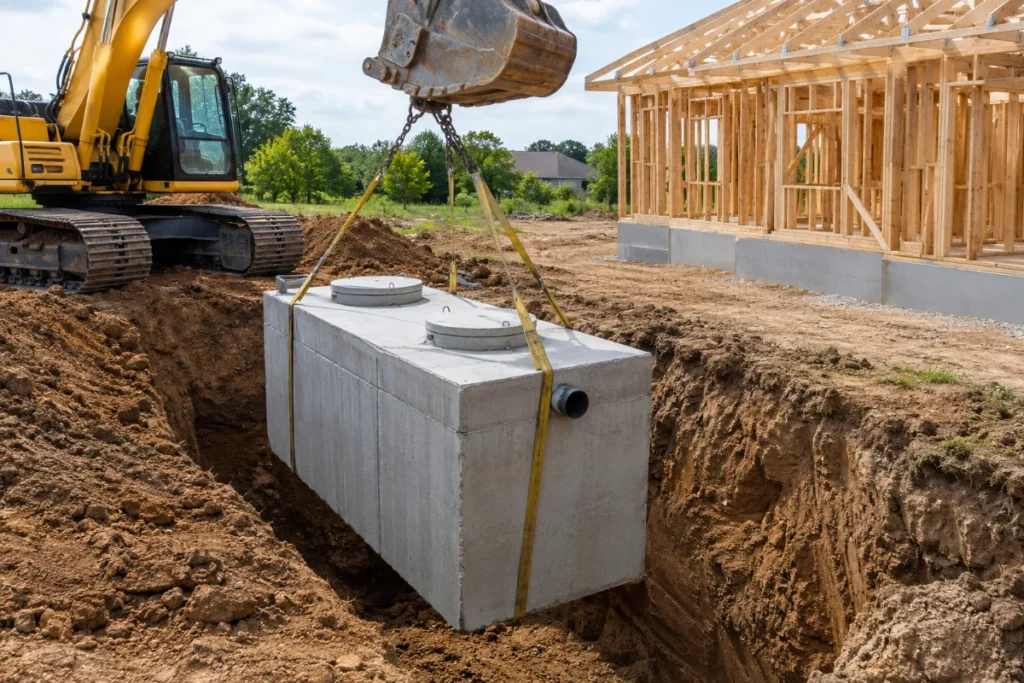
This guide is for a lot that has no septic system yet: new construction, or a cleared parcel with no sewer service. If a system already exists and has failed, read our septic tank replacement cost guide instead. A new site starts from scratch. Fixr lists the phases as inspection and possible soil tests, design and permit application, excavation, installation, then inspector approval before backfilling (Fixr). What your soil allows decides the price more than the tank does, so the soil work comes first.
Septic tank installation cost: what four guides say
| Source | Total installed | Average | What it covers |
|---|---|---|---|
| HomeGuide | $3,500 – $8,500 | — | Conventional system, 1,000-gallon tank |
| Fixr | $4,500 – $9,000 | $6,100 | Low end $3,000 for a small plastic system; high end $22,500 for a 4- or 5-bedroom concrete or fiberglass system |
| This Old House | $3,480 – $11,625 | $7,500 | All system types; complex systems can pass $23,000 |
| Today’s Homeowner | $3,610 – $12,412 | $8,011 | Range for most homeowners; its headline range is $4,000 – $12,000 |
The guides agree on a low end near $3,500 and split above it. Part of the gap is scope: HomeGuide prices a conventional gravity system, while This Old House and Today’s Homeowner blend in the dearer system types.
Our estimate: on a lot that still has to be surveyed and cleared, add the land survey ($330 to $900) and land clearing ($1,200 to $4,800) from Today’s Homeowner to HomeGuide’s conventional system. That gives roughly $5,030 to $14,200. It is our own sum from two different guides, and a quote may already include part of it, so it is not a measured price.
Septic system cost by type
| System type | HomeGuide (installed) | This Old House (installed) | Fixr (materials only) |
|---|---|---|---|
| Conventional / anaerobic | $3,500 – $8,500 | $3,000 – $8,000 | $2,000 – $5,000 |
| Chamber | $4,000 – $11,000 | $5,000 – $12,000 | $3,500 – $10,000 |
| Drip distribution | $6,500 – $15,000 | $8,000 – $18,000 | $4,000 – $10,000 |
| Constructed wetland | $7,000 – $14,000 | $5,000 – $12,000 | $6,000 – $10,000 |
| Evapotranspiration | $10,000 – $15,000 | $10,000 – $15,000 | $10,000 – $15,000 |
| Sand filter | $15,000 – $25,000+ (recirculating) | $7,000 – $18,000 | $6,000 – $10,000 (recirculating) |
| Aerobic treatment unit | $20,000 – $40,000+ | $10,000 – $20,000 | $10,000 – $20,000 |
| Mound | $25,000 – $50,000+ | $10,000 – $20,000 | $10,000 – $20,000 |
The guides disagree sharply on the engineered systems. HomeGuide’s aerobic and mound ranges start at or above the top of the other two. Today’s Homeowner lists the same ranges as This Old House for every type, so do not count them as two separate opinions. Treat the table as a rough bracket and rely on written quotes.
The EPA says the choice depends on household size, soil type, site slope, lot size and local regulations. Mound systems are an option in areas of shallow soil depth, high groundwater or shallow bedrock, and aerobic units can be used on smaller lots or where the water table is too high (EPA). HomeGuide says engineered systems are usually needed with poor soil, an uphill slope, or when wastewater must be pumped to a particular part of the property, and that a mound is useful when there is only 1 to 2 feet of native soil (HomeGuide).
Estimate your new septic system cost
Our estimate: the published ranges above multiplied out for your inputs. Not a quote. System ranges from HomeGuide (Sep 2025); its conventional total includes engineering, permits and inspections. Extras: land survey, land clearing and riser from Today's Homeowner (Apr 2025), land leveling from HomeGuide, pump alarm from Fixr (Jan 2025). Labor share of about 50% is HomeGuide's figure. Extras may overlap with a quote. State adjustment: BLS construction wages (May 2025), applied to an assumed 50% labor share. How we calculate
Septic tank size and cost by number of bedrooms
| Bedrooms | HomeGuide (tank only) | This Old House (tank only) | Fixr (minimum tank) |
|---|---|---|---|
| 1 | — | 500 gal, $500 – $900 | — |
| 2 | 750 gal, $700 – $1,200 | 750 gal, $700 – $1,200 | 750 gal; many municipalities require 1,000 |
| 3 | 1,000 gal, $1,000 – $1,500 | 1,000 gal, $900 – $1,500 (3 – 4 bedrooms) | 1,000 gal |
| 4 | 1,250 gal, $1,200 – $1,800 | 1,000 gal, $900 – $1,500 (3 – 4 bedrooms) | 1,250 gal |
| 5 | 1,500 gal, $1,500 – $2,500 | 1,200 gal, $1,200 – $1,600 (5 – 6 bedrooms) | Up to 1,500 gal |
| 6+ | 1,750 gal, $2,000 – $3,000 | 1,500 gal, $1,500 – $2,500 (6 – 7 bedrooms) | — |
Tanks are sized by bedrooms, not bathrooms, because two people per bedroom is a good indicator of the wastewater a home produces (HomeGuide). The guides do not match each other, and the rule that counts is local. In North Carolina, for example, the minimum tank is 1,000 gallons for a home with 4 or fewer bedrooms and 1,250 gallons for 5 bedrooms, in a rule effective January 1, 2024 (15A NCAC 18E .0801). Ask your county for its table before you order a tank.
Perc test, soil evaluation and permits
| Item | HomeGuide | Fixr | This Old House | Today’s Homeowner |
|---|---|---|---|---|
| Septic permits | $250 – $450 (tank); $250 – $650 (drain field) | Typically not more than $1,000 | $450 – $2,300 | $450 – $2,300 |
| Soil or perc test | $250 – $700 (soil test); up to $2,000 (deep-hole test by an engineer) | $600 – $800 | $700 – $2,000 | $700 – $2,000 |
| System design | — | $600 – $800 | — | — |
| Land survey | — | — | — | $330 – $900 |
| Land clearing or site prep | $500 – $5,000 (land leveling) | $1,600 – $8,000 | — | $1,200 – $4,800 |
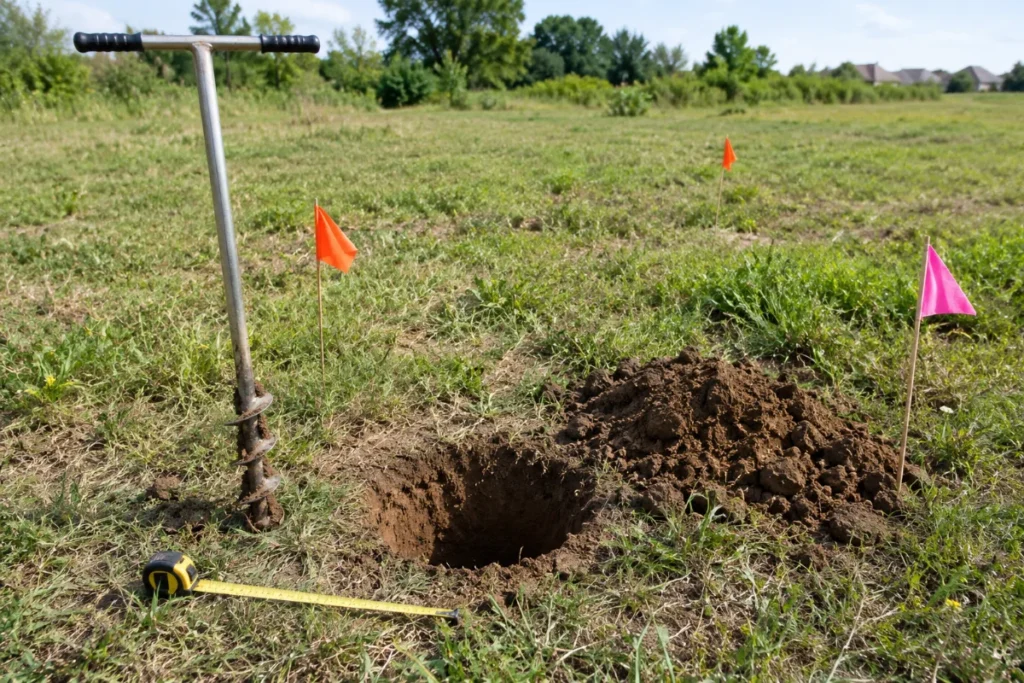
A perc test digs holes, soaks them, then times how fast water drains. HomeGuide describes the percolation rate as the minutes it takes for one inch of water to drain, and says it should fall between 10 and 60 minutes per inch; soil that drains too fast or too slow cannot support a standard system (HomeGuide). Larimer County, Colorado, gives a different cut-off: it requires an engineered design when the rate is outside 5 to 60 minutes per inch, or when bedrock or groundwater is 4 feet or less below the surface (Larimer County).
Not every county uses a timed perc test. Clackamas County, Oregon, says its site evaluation takes the place of the “largely obsolete” perc test and relies on two to six test pits (Clackamas County). Larimer asks for two pits dug 8 feet deep, or to groundwater or bedrock if shallower (Larimer County). Ask the health department which test it wants before you hire anyone.
| Perc test alone (older sources) | Cost |
|---|---|
| HomeGuide, January 31, 2024 (older) | $200 – $1,500 hand-dug; $500 – $3,000+ excavator-dug |
| Bob Vila, February 28, 2023 (older) | $750 – $1,850, average $1,300 (citing HomeAdvisor) |
If the lot fails, HomeGuide says the options are an alternative system, a different spot on the property, or a community septic system if one is nearby (HomeGuide). That is how a $3,500 budget can turn into a $15,000 one.
How long a new septic system takes
Today’s Homeowner puts the installation itself at five to seven days and the full process, with soil testing and inspections, at up to eight weeks (Today’s Homeowner). Fixr says two to five days (Fixr). Larimer County says a test-pit inspection takes at least 5 business days to arrange and a permit comes about 5 days after the application, longer in busy season (Larimer County). For a new home, This Old House suggests scheduling excavation after the main frame is built and before the driveway and sidewalks are paved (This Old House).
Septic or sewer connection?
If a sewer main reaches your lot, compare the two before you buy a tank. Fixr puts a septic system at $3,100 to $9,600 installed, a sewer connection at $1,500 to $8,000 and a holding tank at $500 to $4,000 (Fixr). The sewer range is wide, so ask the municipality for its connection fee in writing.
What a septic system costs to run
HomeGuide puts yearly maintenance at $150 to $1,000, including an inspection ($150 to $450) and pumping ($300 to $700) every 3 to 5 years, and says a concrete tank lasts 20 to 30 years with care (HomeGuide). It adds that an aerobic unit must be inspected at least once a year, and the EPA says regular life-time maintenance should be expected for these units (EPA). Our septic tank pumping cost guide covers the pumping bill.
Other jobs on a new lot
The disturbed ground needs new grass: see sod installation cost. If the lot also needs drinking water, read well pump installation cost. Because minimum tank size is set by bedroom count, as in the North Carolina rule above, ask the health department before adding bedrooms to a house on septic, and see home addition cost.
How to keep the bill down
- Test the soil before you buy the lot, as This Old House recommends (This Old House). A passing result keeps you near the $3,500 to $8,500 conventional range; a failing one points to $4,000 to $15,000 or more (HomeGuide).
- Ask whether a conventional design fits before accepting an engineered one, and get the soil report in writing.
- Get estimates from several licensed septic companies and ask for the estimate, contract and warranty in writing, as HomeGuide recommends (HomeGuide).
- Book excavation for after the frame and before paving (This Old House).
Questions to ask before you sign
- Which system does my soil evaluation call for, and can I see the report?
- Does the price include the perc or soil test, design, permit, inspections, clearing and backfill?
- What is the minimum tank size for my bedroom count under county rules?
- Are you licensed for septic work in this county, and what warranty and service contract come with the system?
For more on vetting an installer, read how to find a contractor.
Sources
- U.S. Environmental Protection Agency, Types of Septic Systems, no date shown.
- North Carolina Administrative Code, 15A NCAC 18E .0801, Septic Tank Capacity Requirements, effective January 1, 2024.
- Larimer County Environmental Health, Septic Systems (OWTS), no date shown.
- Clackamas County, Site Evaluation Guide, no date shown.
- HomeGuide, How Much Does a Septic Tank System Cost?, September 22, 2025.
- Fixr, Septic System Installation Cost, updated January 31, 2025.
- This Old House, How Much Does a Septic Tank Installation Cost?, updated March 12, 2026.
- Today’s Homeowner, How Much Does Septic Tank Installation Cost?, updated April 11, 2025.
- HomeGuide, How Much Does a Perc Test Cost?, January 31, 2024 (older).
- Bob Vila, How Much Does a Perc Test Cost?, February 28, 2023 (older).